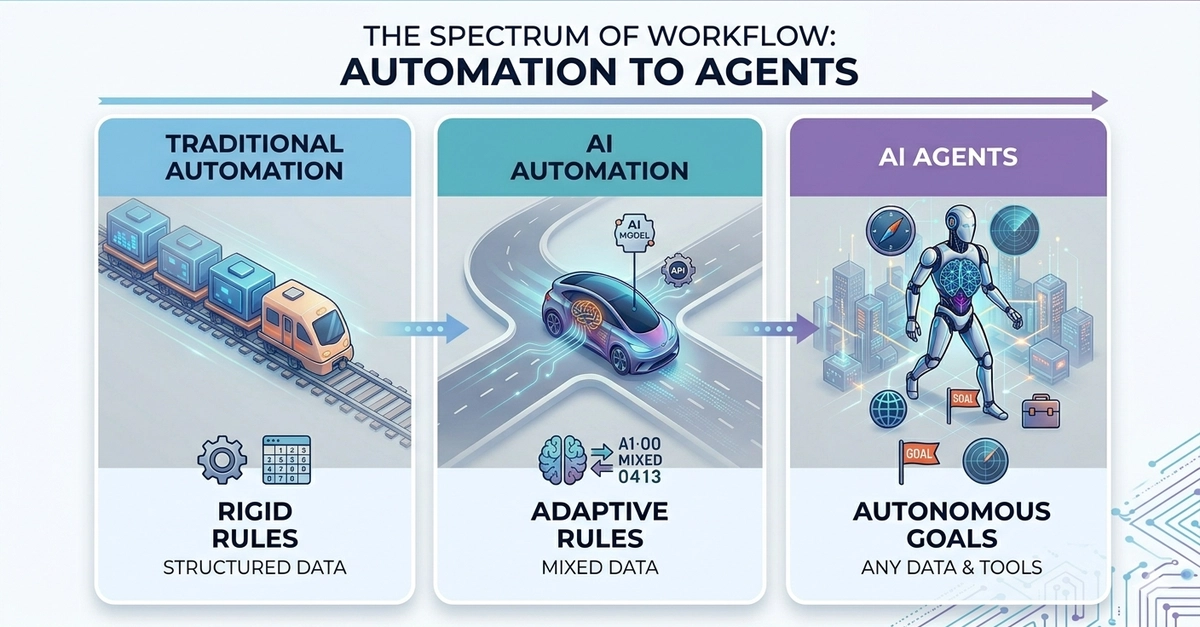
We use terms like "automation," "AI automation," and "AI agents" constantly, but they often blend together into generic tech jargon. In reality, they aren’t the same thing at all.
The easiest way to understand the difference is to look at how much thinking the software is actually doing. We are moving away from a world where computers only do exactly what they are told, and entering a world where we can give software a goal and let it figure out the best way to get there.
If you are trying to decide which approach fits a project, or just want to cut through the hype, it helps to look at them on a spectrum: from rigid rules to true adaptability.
1. Traditional Automation (The "Train on Tracks")
Traditional automation is entirely deterministic. It operates on hardcoded, explicit logic defined by a human programmer. It cannot handle unexpected variables; if a single condition deviates from the script, the system breaks.