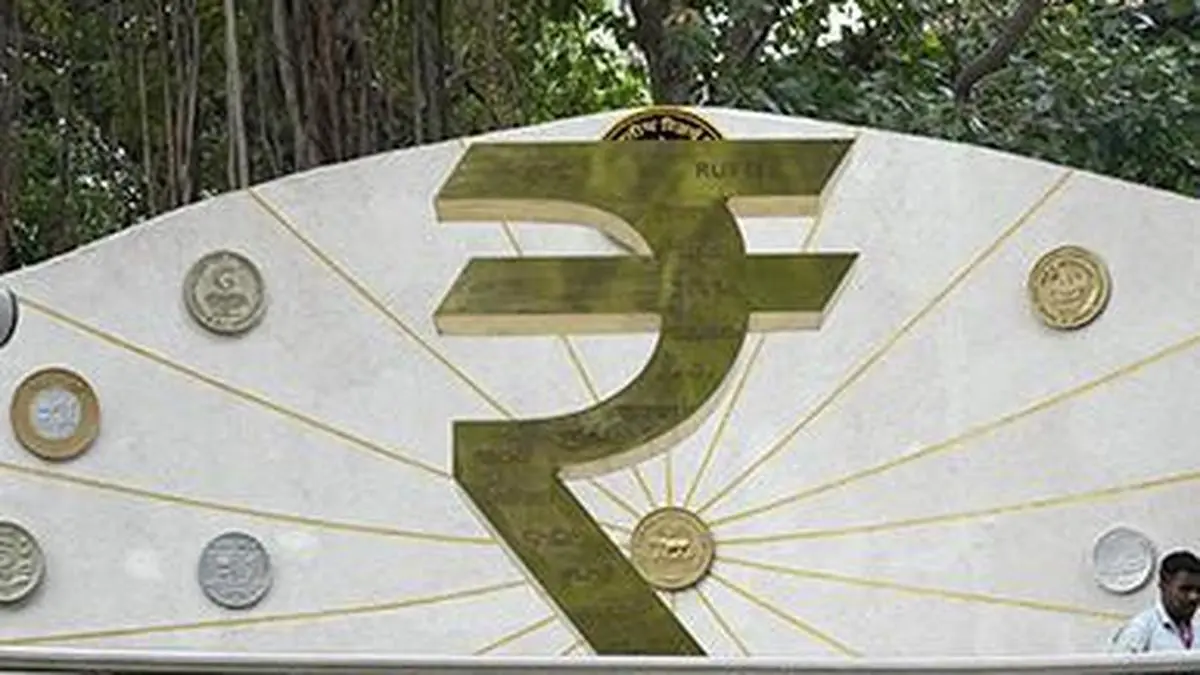
A man walks past the Rupee symbol outside the Reserve Bank of India (RBI) headquarters in Mumbai, India, Friday, June 6, 2025. (AP Photo/Rajanish Kakade)
| Photo Credit:
Rajanish Kakade
As widely expected, the Monetary Policy Committee of the Reserve Bank took a unanimous decision to keep the policy rate unchanged at 5.25 per cent at the end of its second bi-monthly meeting of the current fiscal on June 5.The MPC also voted in favour of continuation of the neutral stance. By all indications, the coordinated measures announced by the Government and the RBI on the very same day to attract more foreign capital to India drew significant attention and scrutiny on the part of all concerned. In the aftermath of all this, the ten-year G-Sec yield fell a bit, while equity markets ended lower. The rupee posted its biggest one-day gain since April.Growth and inflation outlookThe impacts of the headwinds emanating from the on-going Middle East conflict on the growth and inflation prospects of the Indian economy are now clear and obvious: Real GDP growth for 2026-27 is now projected lower at 6.6 per cent vis-à-vis 6.9 per cent at the time of the last policy two months earlier. Added to the conflict-related factors, is the possibility of a below normal monsoon and El Nino conditions.In the MPC’s view, prolonged global supply chain disruptions, heightened volatility in global financial markets, and weather-related shocks continue to pose downside risks to the domestic growth outlook.While this assessment may be realistic for the short run, there are gathering concerns surrounding the country’s long-term growth story: The vulnerability of India’s external sector and its macroeconomic prospects, in general, to oil price shocks has not reduced significantly since the BoP crisis of 1990-91. The country is not yet a big or even a visible player in the new-age major technology areas such as microchip manufacturing, electric vehicles and AI. There are no signs of any buoyancy in its equity market, driven by AI-fuelled optimism.At the same time, the growth of AI in quite a few other major economies now poses a threat to India’s services sector, dampening investment and exports. These features have negative implications for the country’s current account as well as capital account inflows by way of FDI and FPI. The delay in a trade agreement with the US is also a negative.A view is gaining ground that the factors underlying the current external sector difficulties of India are mostly endogenous in nature. The exogenous shocks emanating from the US-Iran conflict have only acted as a trigger.Hence, the situation calls for bold and pragmatic reforms in both the real and the financial sectors and for enhancing energy security.CPI inflation for 2026-27 has been projected at 5.1 per cent with Q1 at 4.2 per cent; Q2 at 5.1 per cent; Q3 at 5.9 per cent; and Q4 at 5.4 per cent. Core inflation is projected at 4.7 per cent for 2026-27 – a rise by a full percentage point vis-à-vis 2024-25.In MPC’s assessment, demand pressures in the economy remain contained but indications of the cost-push phenomenon are already visible, with higher energy prices and an increase in several input prices resulting in a sharp spike in WPI inflation in April 2026. In the MPC’s reckoning, there are upside risks to the projected CPI inflation due to global supply chain disruptions and monsoon shortfall.Apart from the fact that the projected CPI inflation for 2026-27 is half a percentage point higher that the projection at the time of the April meeting, headline inflation is expected to be very close to the upper limit of the 4+/- 2 per cent band in Q3, with a softening in the next quarter, though. As per the latest bi-monthly household inflation expectation survey conducted by the RBI, the inflation expectations for the next three months and one year edged up by 80 basis points and 50 basis points, respectively, reaching 9.3 per cent for both horizons.All in all, the upside risks to CPI inflation for the rest of 2026-27 seem obvious and the MPC’s take in this regard is grounded in reality. These developments would call for a tightening of the policy rate in a pre-emptive manner under the inflation-targeting framework. However, ‘the MPC felt it would be prudent to wait for greater clarity to emerge’.In plain terms this means that if the projected inflation for 2026-27 is required to be further raised at the time of the next MPC meeting to be held in early August – the likelihood of which seems high – a hike in policy rate would be a near certainty.External sector measuresGiven the country’s high dependence on imported crude oil, LPG and fertilizers, on the one hand, and on short-term debt and portfolio flows for funding its current account deficit and for reserves growth, on the other, the standard metrics such as import cover etc. do not apply to it. Instead, for the sake of practicality, the adequacy of only the foreign currency assets (FCA), net of forward selling commitments should be assessed by applying the Modified Greenspan Guidotti (MGG) rule. Net FCA as on March 31, 2026 was $450 billion and short-term external debt (by residual maturity) was about $330 billion.The coverage of FCA in relation to the current account deficit combined with short-term external debt, applying the MGG rule on this date was only a little over 100%, which does not indicate a very comfortable situation.The co-ordinated measures of the Government and the RBI, referred to in the foregoing, will likely spur financial capital inflows.Two of them, namely concessional forex swap to be provided till September 30, 2026 to incentivise ECBs by PSUs, and a similar facility for bearing the full hedging cost to be provided till September 30, 2026 to AD banks for raising fresh 3–5-year FCNR (B) deposits are quasi-fiscal in nature, which central banks are well-advised to avoid.However, given the trend of robust income growth of the RBI in recent years, it should be possible for it to absorb the cost of doing so.One hopes that the forward legs of the swaps are recognised and periodically revalued like all other outstanding forward foreign exchange contracts of the RBI and a full disclosure is made in this regard in its annual audited financial statements.One also hopes that the RBI adheres to the end date of September 30, 2026 for these facilities, as announced, and no extension thereof is allowed.The writer is a former central banker and a consultant to the IMF. (Through The Billion Press)Published on June 10, 2026