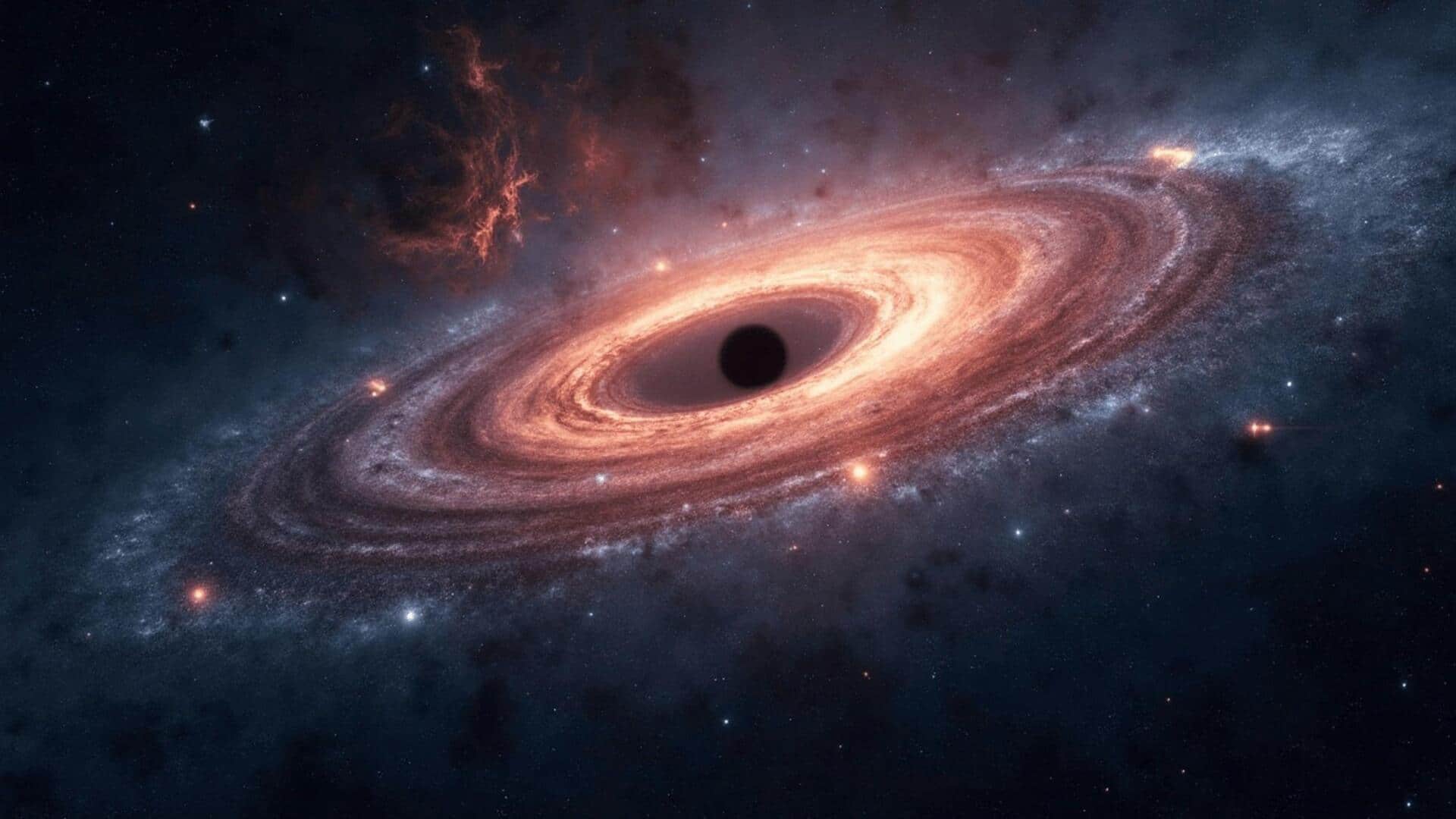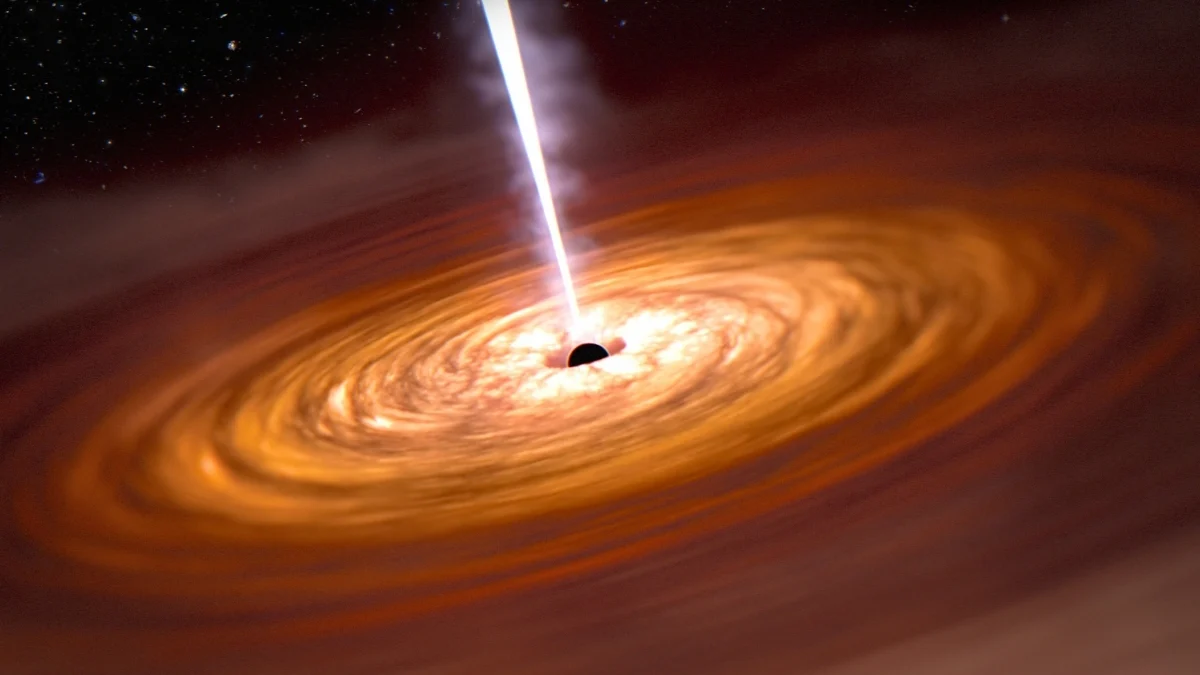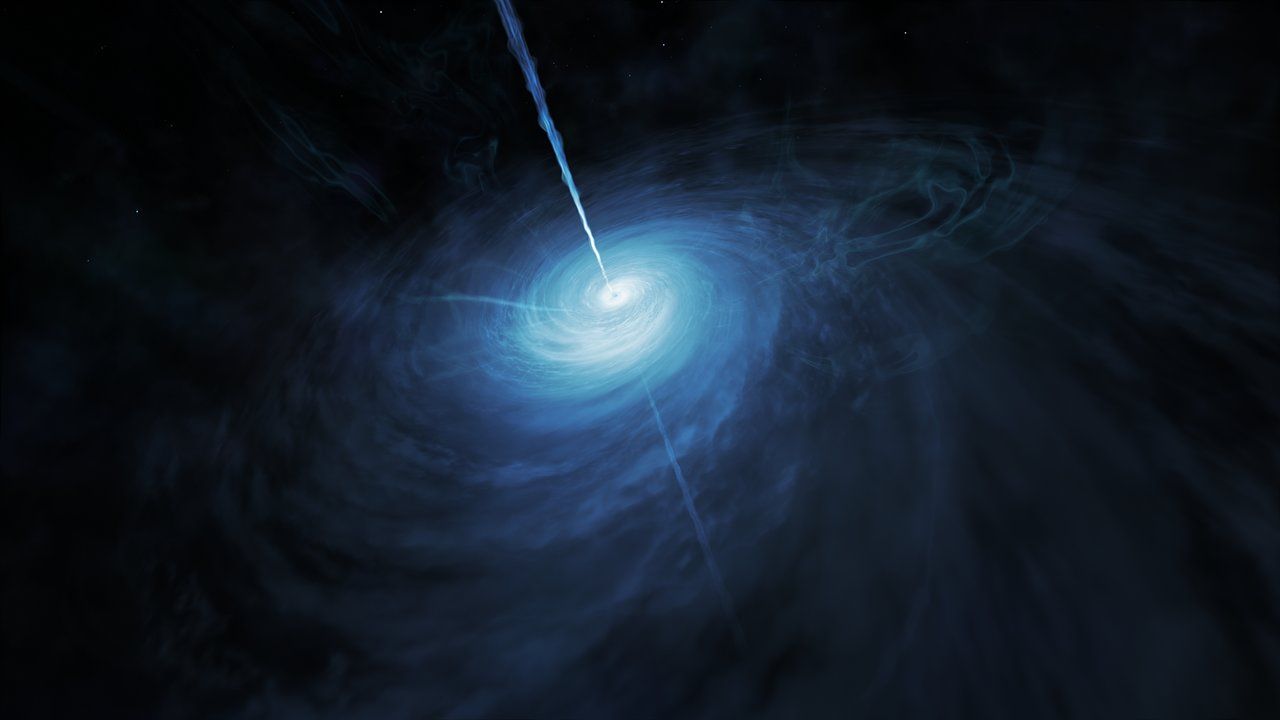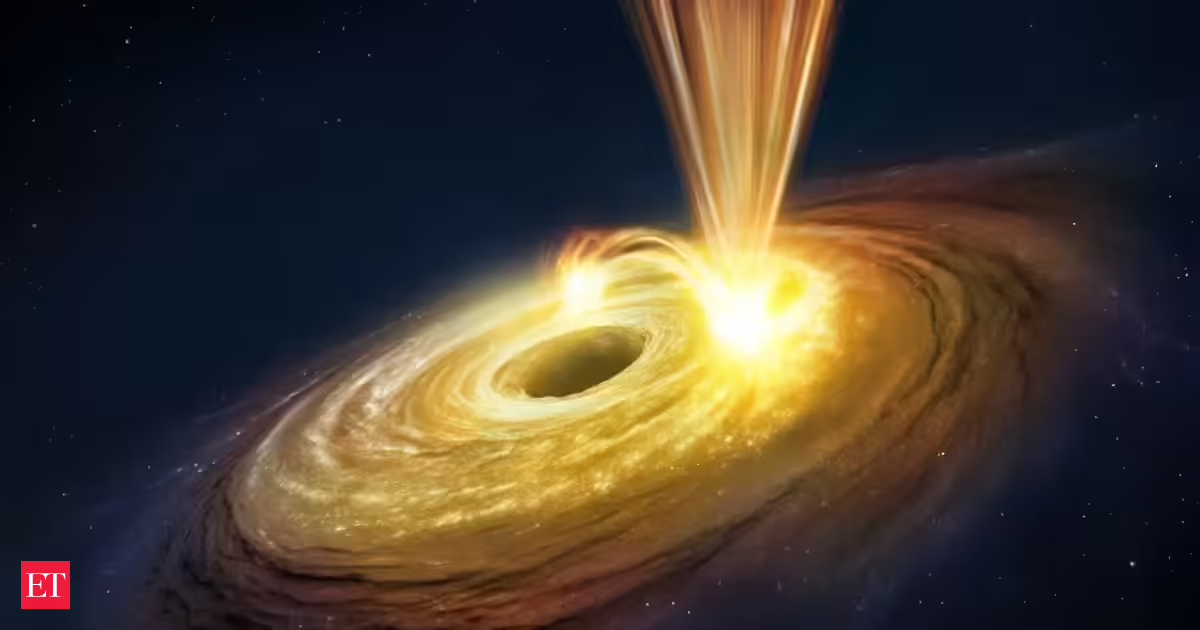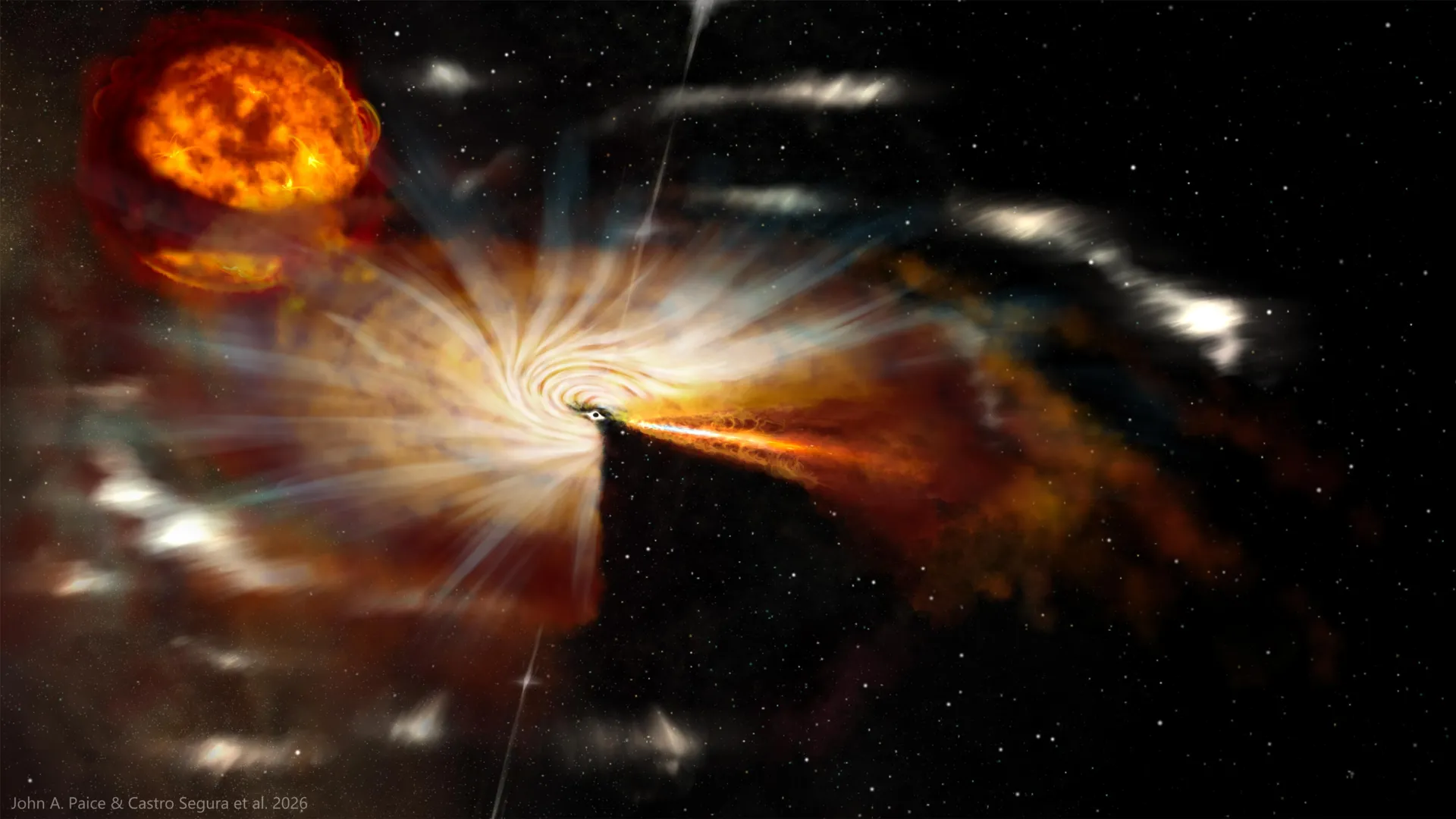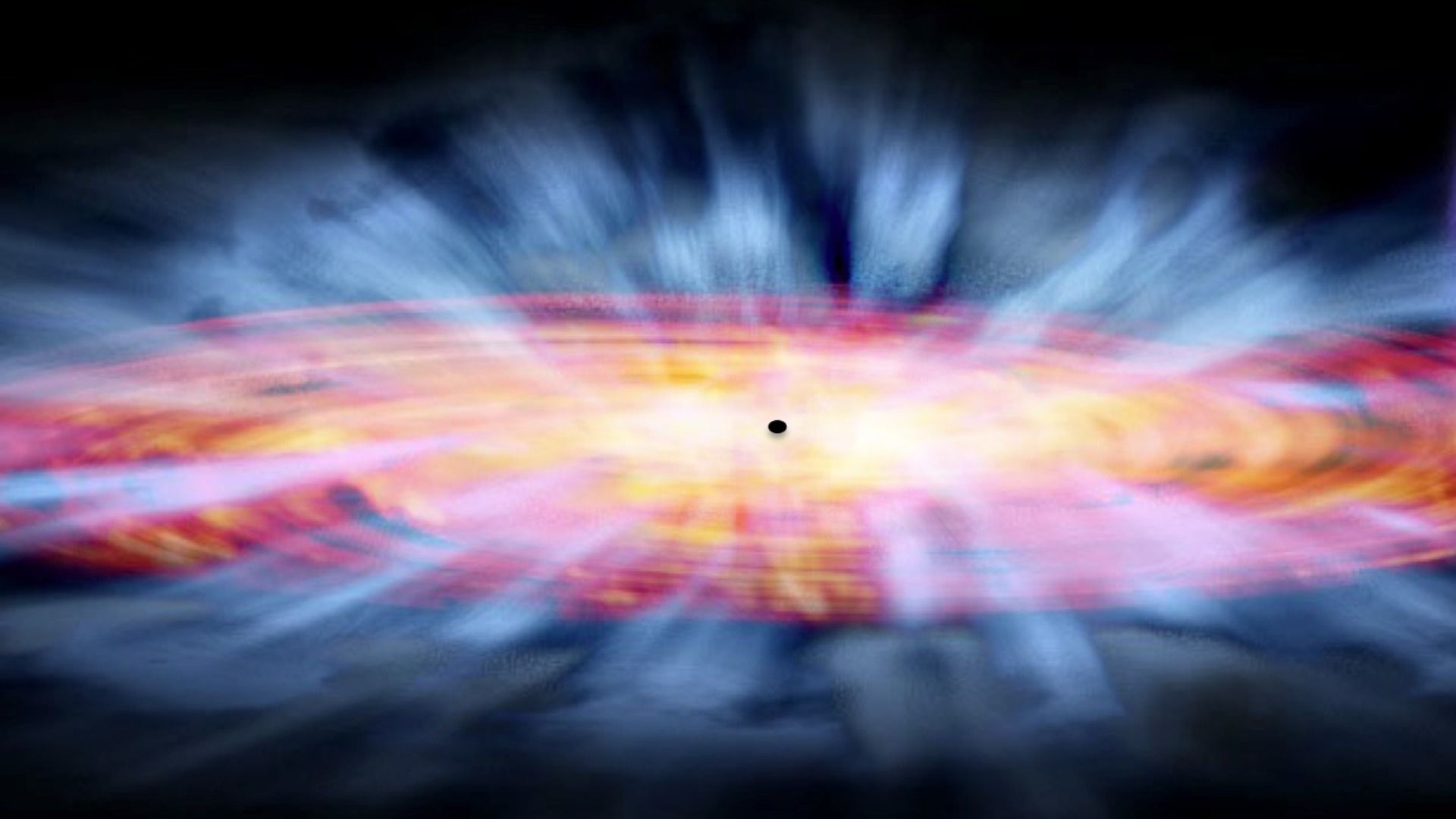
An artist's impression of a quasar. The black dot in the center represents the supermassive black hole at the center of the quasar. The red-and-yellow spiral surrounding it shows the disc of hot gas falling into the black hole. Some of this gas is ejected as the quasar's wind, which is shown in light blue. The size of the disc shown is comparable to the size of our solar system.
(Image credit: NASA/CXC/M. Weiss, Nahks Tr'Ehnl, Nurten Filiz Ak)
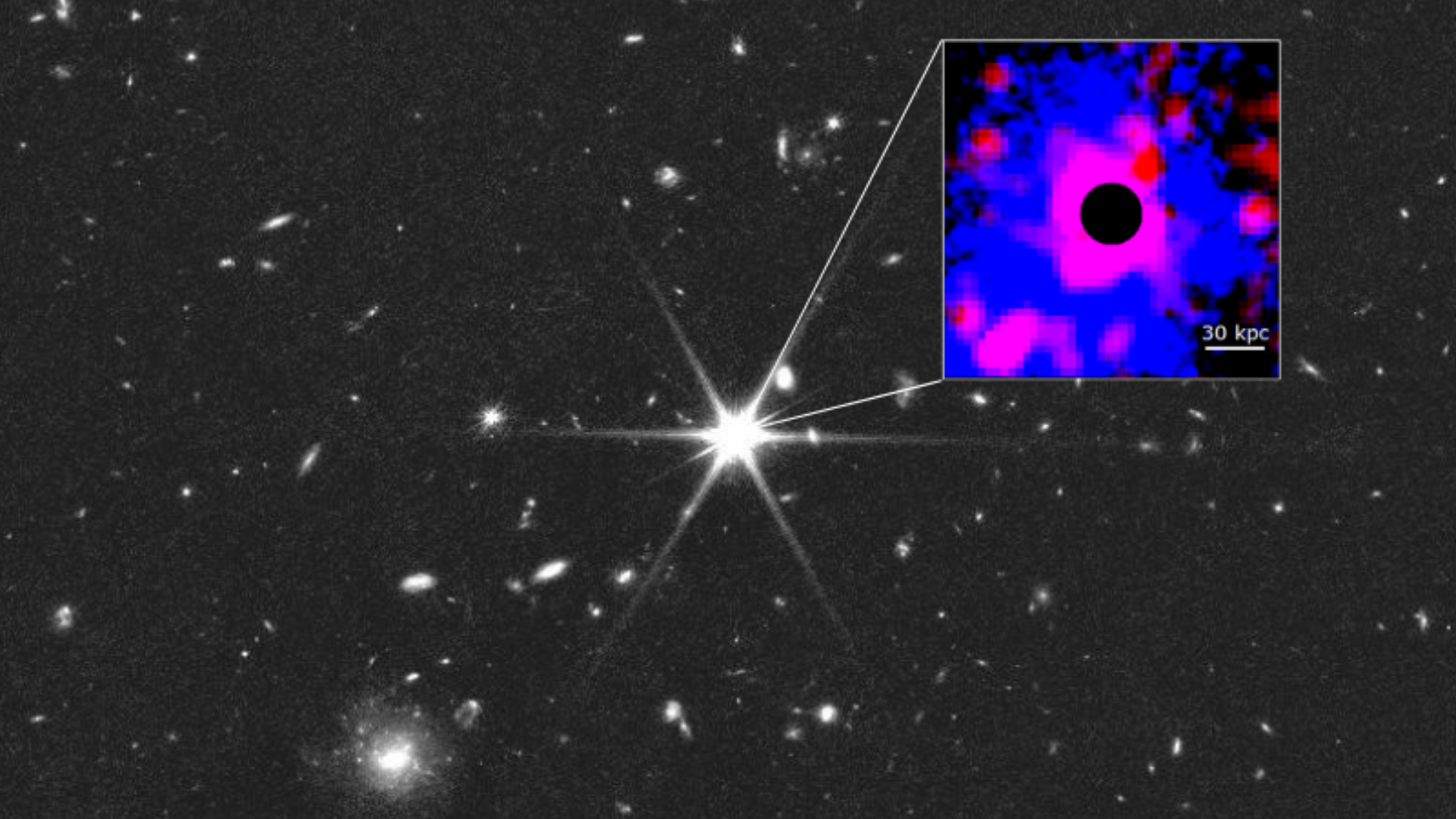
Astronomers have discovered a distant quasar — or active nucleus of a galaxy — that's powered by a feeding supermassive black hole blasting out winds at record-breaking speeds of 30% the speed of light, around 201 million miles (323 million kilometers) per hour. This is the fastest black hole wind seen specifically in ultraviolet wavelengths.The black hole-powered quasar, known as J2318, has an incredible mass of 1.7 billion times that of the sun and is located around 3 billion light-years away. While that is a pretty typical mass for a supermassive black hole, the speed of these winds is anything but typical, according to team member and York University researcher Patrick Hall."In terms of its speed, this quasar's wind could be called a category 79 hurricane," team leader and York University researcher Lucas Seaton said in a statement. "Every category of hurricane is about 20% faster than the category below it. Calling it category 79 gives an idea of just how fast it is, but of course this wind is unlike anything on Earth."All large galaxies are thought to host a supermassive black hole at their hearts with masses of millions, or even billions, of times that of the sun, but not all of these cosmic titans power quasars or emit such incredibly powerful winds. Quasars occur when these central supermassive black holes are surrounded by vast amounts of gas and dust called accretion disks. These disks gradually feed the black holes.Black hole winds vs. Earth windsAs you might imagine, masses of millions or billions of times that of the sun generate incredible gravitational forces, and this means accretion disks can have powerful tidal forces of their own that create friction and cause them to glow brightly across the electromagnetic spectrum. This radiation also pushes matter away from accretion disks in the form of intense black hole "winds.""In quasars, we often see winds of gas pushed away from the black hole by the light of the quasar," Seaton said. "The wind in J2318 can be seen at ultraviolet wavelengths at velocities up to 30% the speed of light. Even faster winds can be seen at X-ray wavelengths, but J2318 is the fastest ever discovered at ultraviolet wavelengths."The fact that black hole winds are radiation-driven, pushed by particles of light called photons bouncing off atoms (and not caused by air pressure) is what makes these cosmic gales so different from Earth's atmospheric winds."Quasars put out so many photons that those tiny pushes add up to extreme velocities," Seaton said. "The problem is, the photons can also remove all the electrons from the atoms, making them invisible. How to push the gas to the speeds we see while keeping the carbon and silicon ions we see intact … it's quite a puzzle!"