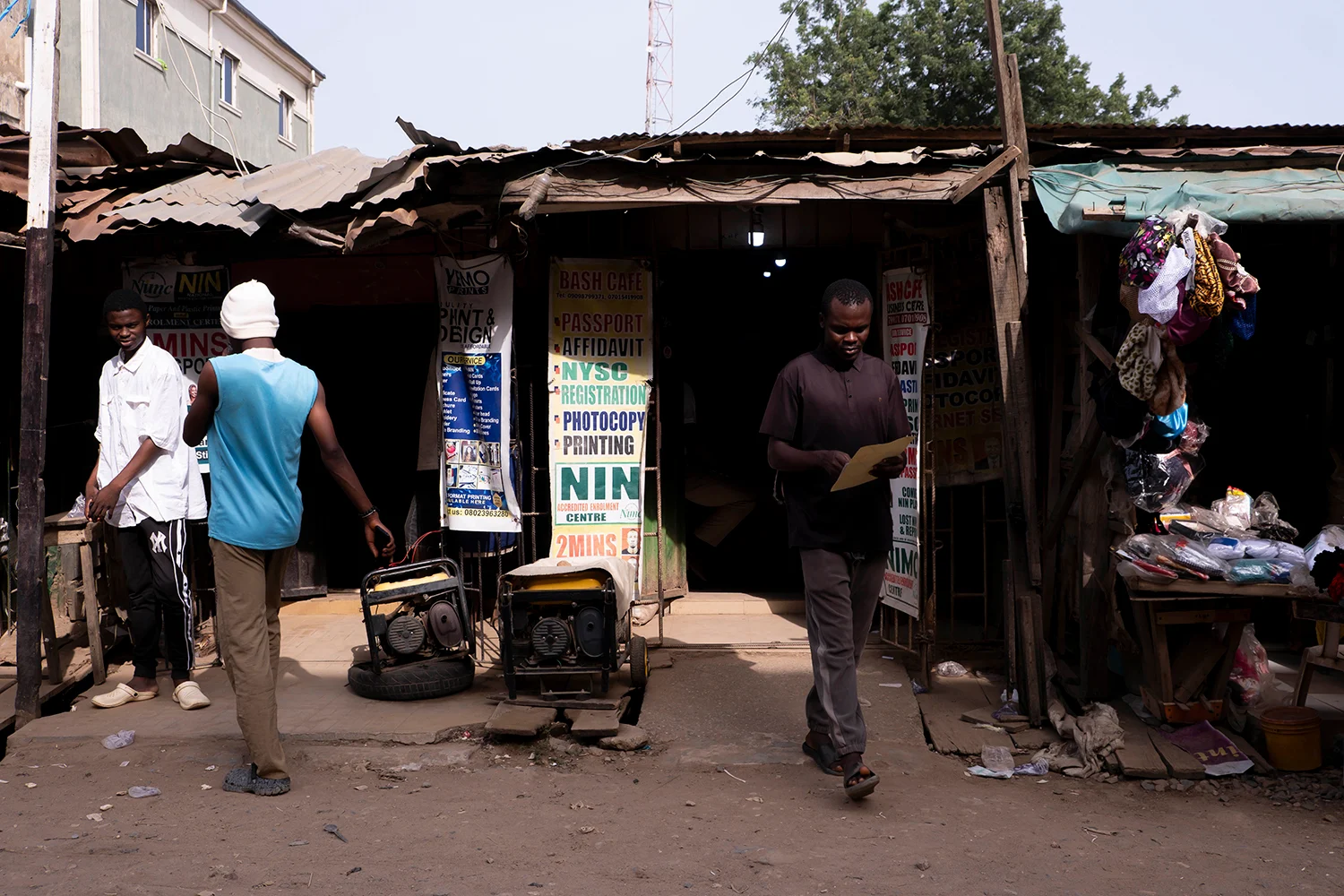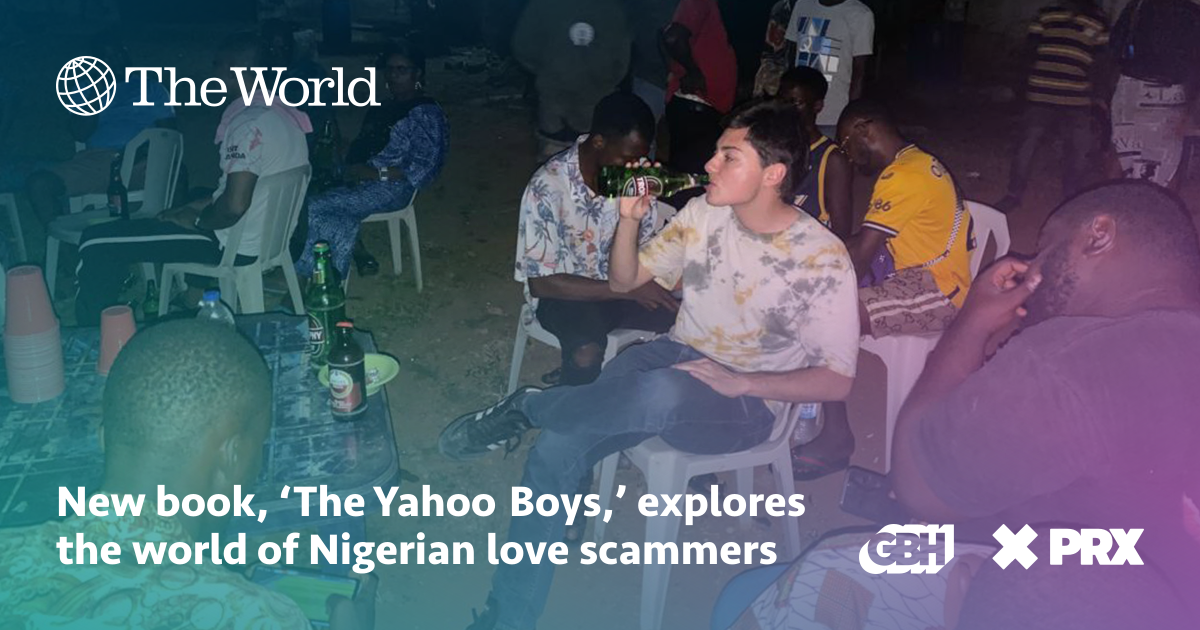
Public radio’s longest-running daily global news program.AboutContactDonateMeet the TeamPrivacyTerms of use©2026 The World from PRXPRX is a 501(c)(3) organization recognized by the IRS: #263347402.New book, ‘The Yahoo Boys,’ explores the world of Nigerian love scammersSpanish journalist Carlos Barragán delves into the world of the Yahoo Boys, young Nigerian hustlers who scam lonely Westerners out of their money online.Carlos Barragán in Ikotun hanging out with locals and some Yahoo Boys.In the US, they’re called romance scammers. But in Nigeria, they are known as “Yahoo Boys” — that’s a reference to their Yahoo email addresses. They are young Nigerian hustlers who con lonely Americans and Europeans out of their money through online scams. In cafes and hotel rooms around Lagos, they chat endlessly on their phones with foreigners, angling for a payout.Spanish journalist Carlos Barragán wrote about them in his new book, “The Yahoo Boys: Real Life with the Love Scammers of Lagos.” It delves into how loneliness and economic inequality have fueled a major scam industry in Nigeria. Barragán joined The World’s Host Carolyn Beeler to discuss what he discovered.He began researching and reporting on the scams after his own family member was affected.“I’m the youngest of three brothers and my mom had been single for a long time. And in 2015, I told her, ‘Why don’t you join Tinder?'” Barragán said.He added that she didn’t use online dating apps at the time, so after he encouraged her, she met someone she thought was an American soldier, but who turned out to be a scammer. In her case, she didn’t lose money, but was very close to it. Other people, as Barragán found out, weren’t quite so lucky. His reporting started with trying to track down his mother’s scammer.Spanish journalist Carlos Barragán reporting in the Ikotun district of Lagos, Nigeria.Courtesy of Carlos BarragánCarlos Barragán: These are people who scour the internet for lonely people. And when I say the internet, it can be any social media. Mostly older people, but also younger people trying to connect with others. And they create these fake personas. Normally these [personas] are white people, and they try to engage with you in a conversation. In the past, we are aware of these Nigerian prince scams.But after a few decades in the early 2000s, they discovered that there was something much more profitable than greed, and that was loneliness. So, especially with the beginning of dating apps and with the loneliness epidemic that we have here in the Western world, more and more people showed up at these social dating apps, and these scammers engaged in conversations with them.They pretended that they were interested in them and they said “good morning” every morning. And what they are aiming at is just to build a relationship between the apps and the scammer, that is so powerful that the victim will end up sending money for a myriad of reasons. And that can be from paying the plane [ticket] so that the victim can finally meet their lover, or all the multiple excuses they come up with. So, in a way, they create a fake relationship. And once the victim is locked into that relationship, they come up with excuses to steal money from the victim.So first, it’s very important to understand, because when I first came to Lagos, I thought I was going to encounter a very sophisticated industry of scams. You know, you have those scams in other parts of the world. But what I discovered was the opposite. It was mostly young people, young men in their 20s, who were just learning from their older friends and older brothers how to fool Westerners, how to scam lonely people. So, in Chibuike’s case, he’s a guy from a very poor community with no dad and a mother who, in his own words, didn’t care for him.So, because he was looking for some sort of camaraderie with the people around him, he engaged in these scams as well, because older people in the neighborhood were doing exactly that. So, at the beginning, he didn’t make any money. He was just pretending to be a white man, scamming white women. And then he changed because sometimes these scammers pretend to be white women as well to scam other men. And he wasn’t getting any money until he decided to impersonate a WWE superstar named Cody Rhodes.And this was a surprise to me because what the scammers discovered is that impersonating a famous person can sometimes lead them to riches, since Americans and Europeans are eager to talk to their favorite celebrities.Carlos Barragán during an interview with Azeez, one of the main characters of his new book, who started scamming people at the age of 14.Courtesy of Carlos BarragánExactly. I’ve encountered scammers who were impersonating [US President] Donald Trump, Elon Musk, Brad Pitt — you name it. In Chibuike’s case, he was doing WWE scams because his stepfather used to [watch] these fights. And in the end, he started talking to an Irish woman named Theresa. And the scam went on for years. At the beginning, she sent him 300 euros ($347), and that kept piling up until he had tens of thousands of euros. Of course, it came bit by bit, in his own words, and it came in the form of gift cards, as I explained in the book.But as you were saying before, it’s a very interesting way, the way they spend the money they are receiving, because you would think that some of these scammers would invest the money wisely to step out of their criminal activities. But in a way, these boys who I describe in the book, they come from very poor communities. And in these communities, sometimes they even struggle to find money to eat.And what they’ve seen is that older men, whenever they cash out, as they refer to getting money from a Westerner, they spend that money in the community. They go big; they buy bottles of champagne, they go to the club, they buy a car, to tell the community, “I’ve made it.”Yeah, exactly. Some people in the community would say he was doomed from the beginning, because that is popular knowledge in a place like Ikotun. They think that, in a way, they’re dealing with some sort of black magic, as they call it, and they will get the money and they will know riches and they will have a lot of people around them, but as fast as they came, they will leave. And in a way, that’s what happened to Chibuike. Of course, he denied to me engaging in any sort of black magic or juju, as they call it there.But it’s true that there was an element of irrationality in the way he spent the money, which is hard to fathom. Because the community, whenever they see that a small boy — Chibuike was 24, 25, maybe a bit older — has plenty of money, they just come to him. And Chibuike was very generous because he said he had felt lonely his whole life. So, you add this other layer of complexity to the scam. And all at the same time, he was scamming this Irish woman who was losing everything in her house and who was getting closer to a mental breakdown.So, Ikotun is in the outskirts of Lagos, and Lagos is a city where the first characteristic that comes to mind is inequality. When you step out to the outskirts, mainly what you see is slum-like conditions. The citizens there, the people there, they don’t have potable water; they don’t have electricity most of the time; the roads are unpaved, so the conditions there are quite hard.When you see a boy, as I’ve seen, with gold rings in his two hands, stepping out of a Lexus car that might be $30,000 or $20,000, because obviously it’s secondhand, but it’s still an enormous amount of money for someone there — you need to understand that people there, they don’t even have $1 a day to eat. So, suddenly, you see this 16- or 17-year-old boy stepping out of that car. And in one case, we even saw one of these guys carrying a pillow because he wasn’t tall enough to see over the car’s windshield.Carlos Barragán playing pool with Yahoo Boys at a hotel in Ikotun, Nigeria.Courtesy of Carlos BarragánSo, listeners need to understand that [those are] only reported losses. And there was that separate study in Canada that said only 5% of cybercrimes get reported. Not all romance scams originate in Nigeria. In fact, the other hotspot is in Southeast Asia, where conditions are completely different. What I’m saying is that it’s very prevalent. And once you get to communities like Ikotun and start talking to young people who have no opportunity to attend places like the university, many of them engage in cybercrime.And I remember talking to a woman who was pregnant, and she was kind of jokingly saying, ‘As soon as my boy is born, I will tell him, ‘Come on, be quick, because I want you to do Yahoo Yahoo,’ which will bring money to the family.’Yeah, many scammers I talked to said they usually encountered certain clients, in their own words, because they talked about them as if they were psychologists or therapists. They were talking about their victims in a way that suggested they sometimes knew they were being scammed, or at least had suspicions. And it is very hard for any human being to accept that the person they love most is someone who is completely different from what they see.And it’s hard for victims to come out and say what they are going through because what they’re facing from society is disbelief or mockery or condescension. So, once you put all that into the mix, it’s very hard for victims to accept that the scammer is a scammer. And at the same time, they are meeting an emotional need they are not getting from family or friends: constant attention. It is a very powerful thing, as the scammer told me, to say “good morning” to someone every single morning.Well, I think that there are people way smarter than me who can prescribe policies to fix this. What I would say is that criminal underworlds evolve very fast, and once there is a new tactic on the street that is successful and profitable, it spreads like wildfire. So, I met a Yahoo girl that I described in the book, because women also engage in cybercrime, even though not as much as men. And she was already scamming women who were trying to adopt a baby. So, there are new ways to scam people. And I’m sure that, at least in the near future, the loneliness epidemic will stick with us. So, they will try to find new ways to take advantage of this. And obviously, in Nigeria, you need a long-term solution to improve the conditions of all these young people so they have better opportunities.This interview has been lightly edited and condensed for clarity.
New book, 'The Yahoo Boys,' explores the world of Nigerian love scammers - The World from PRX
Spanish journalist Carlos Barragán delves into the world of the Yahoo Boys, young Nigerian hustlers who scam lonely Westerners out of their money online.
1,849 words~8 min read