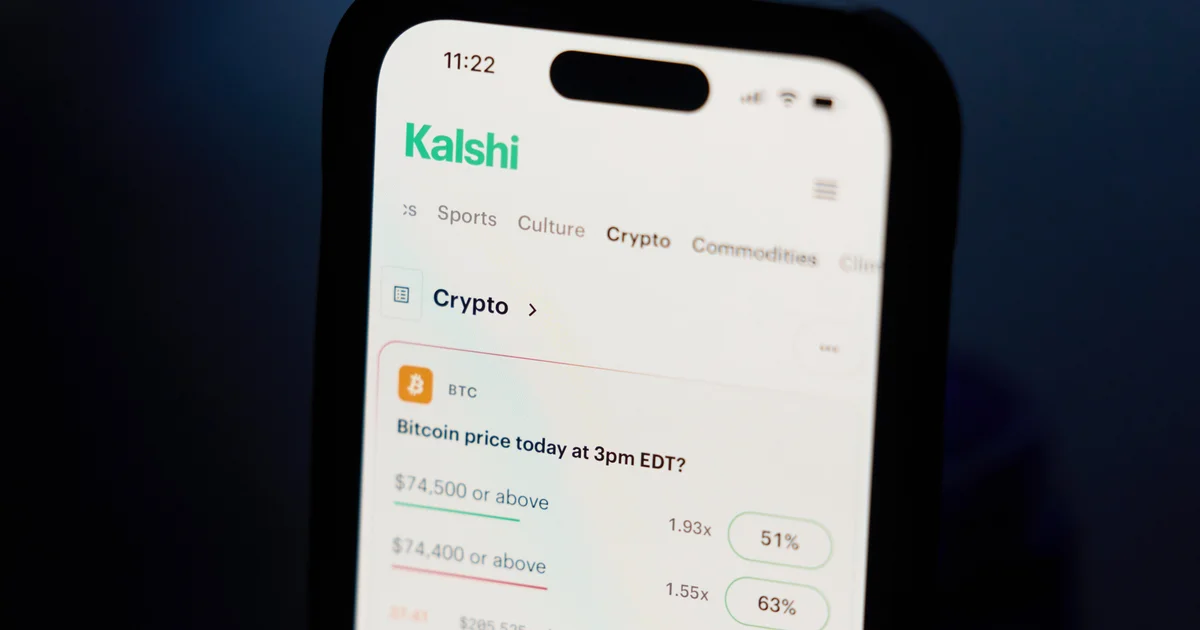
As prediction markets gain popularity, young traders need to beware of the risks—and their sophisticated competition.gettySomething is happening in American finance that deserves far more attention than it is getting.Two industries — retail trading and prediction markets — are growing at extraordinary speed, capturing the time and money of millions of people, wrapped in the language of empowerment and democratization. They look different on the surface. One involves stocks and options; the other, event contracts that pay out $1 if you are right. But spend any time with both, and a striking picture emerges: they share the same user base, the same psychological architecture, and the same uncomfortable gap between how they are marketed and what they actually deliver.I have spent my career running Select Vantage Inc., one of the world’s largest human-driven proprietary trading firms. I have watched the retail trading boom from close range. And the more I learn about Polymarket and Kalshi, the two dominant prediction market platforms, valued at $8 billion and $11 billion, respectively, the more I feel an unsettling sense of recognition. The patterns are too similar to ignore.The Same People, Drawn to the Same ThingThe retail trading boom was not built on seasoned investors. It was built on young, digitally native users who had never traded before: people in their twenties and thirties, comfortable with apps, looking for action and upside. When sports paused during the pandemic, retail trading volumes surged. When professional sports returned, some of that volume migrated back. The psychological draw was essentially constant; only the vehicle changed.Prediction markets are drawing the same crowd. Polymarket’s most active users skew young and tech-savvy, already familiar with financial speculation through crypto, Robinhood, or sports betting apps, moving fluidly between all of them. Robinhood’s CEO recently said he imagines prediction markets drawing first-time customers who might then open retirement accounts. Kalshi has already partnered with both Robinhood and Coinbase to distribute its contracts. The ecosystems are not just parallel; they are actively merging.The Illusion of Informed ParticipationIn my book Real Trading, I argue that the most damaging myth in modern retail finance is that access equals empowerment. Commission-free trading removed the cost of entry but did nothing to close the information gap between retail participants and professionals.The same logic applies to prediction markets, with a more sophisticated veneer. Kalshi’s co-founder calls betting on one’s beliefs a “tax on bullshit.” Polymarket’s CEO describes his platform as indispensable for thinking about government and macro trends. Defenders of the industry go further, arguing that event contracts give retail investors a genuine hedging tool; a way for ordinary people to offset exposure to fixed events such as Federal Reserve interest rate decisions, inflation prints, or election outcomes. It is a tidy theoretical case. It also bears almost no resemblance to how these platforms are actually used. The retail investor sitting at home with a few hundred dollars to allocate is not running a duration-hedged bond portfolio that needs a Polymarket overlay against the next FOMC meeting. They are placing a bet, often on something they find entertaining, sometimes on something they feel strongly about. The hedging argument is the kind of justification an industry reaches for when it needs to sound serious in front of regulators. Watch where the volume actually goes, and the story tells itself.These are extraordinary claims. And they may occasionally hold for the most resourceful participants: the traders who drove two hours to interview voters before a congressional special election, or who reverse-engineered NASA’s weather methodology to gain a meteorological edge.But for most users, something very different is happening. Prediction markets have the same structural problem as retail trading: a small number of highly informed participants operating against a large number of people who believe they understand more than they do. On Polymarket, token “whales” (each holding at least 1% of all tokens) control 95% of the resolution pool. The supposedly decentralized system is anything but. Insider trading incidents, manipulated markets, and arbitrary resolution decisions are already well-documented.I have described retail trading using a Wimbledon analogy: open the tournament to anyone, and headlines celebrate the occasional amateur upset while quietly ignoring thousands of predictable professional victories. The same tournament is playing out on prediction markets, sometimes with professionals manipulating the very events being bet on.Death by a Thousand CutsThere is another feature of prediction markets that deserves more scrutiny than it gets: the size of the bets. Individual wagers tend to be small: a few dollars here, twenty dollars there, spread across dozens of contracts in a single week. That smallness is precisely the problem. It lowers the psychological barrier to placing the next bet, and the one after that. No single ticket feels meaningful enough to pause over. But the losses accumulate, quietly and relentlessly, across hundreds of micro-decisions made over months. This is not the kind of loss that produces a single painful moment of reckoning. It is death by a thousand cuts.The business model depends on this. Frequent small bets generate more engagement, more data, and more cumulative spread capture than infrequent large ones. Users walk away convinced they have only ever lost “a little.” The platforms walk away with the aggregate. It is the same arithmetic that has always governed casinos and slot machines, dressed up in the language of forecasting and civic participation.Designed to Keep You PlayingBoth industries share a behavioral dimension which should be troubling. Modern retail platforms were designed for activity, not outcomes: notifications, frictionless execution, simplified interfaces, every design choice pushing toward more action. I have written about the uncomfortable parallel with casino architecture. Both industries have borrowed the same playbook.Prediction markets have taken it further. Bettors traded $2.8 million on a Federal Reserve press conference before it even began, tracking individual words in real time via Discord. The whole experience — livestreams, moment-by-moment odds, community highs and lows — is engineered for maximum engagement. Polymarket recently announced “attention markets” where users bet on what will go viral. As one cultural anthropologist put it, this fragments experience, turning every event into a collection of micro-assets. “We get reduced,” she said. That is an accurate description.The Pattern Is the WarningI have spent years watching retail traders enter professional markets believing they are competing on equal footing, only to discover (too late, and at real financial cost) that the game was far more complicated than it appeared. The system is not malicious. But it is designed around incentives that do not align with the interests of the people it recruits.Prediction markets are newer, brasher, and more openly gamified. But the pattern is identical. Young people with disposable income and appetite for risk are being recruited into a competitive arena through the language of empowerment and truth, while the structural advantages — informational, financial, and operational — lie overwhelmingly with the most sophisticated participants.When two fast-growing industries share the same user base, the same behavioral design principles, the same information asymmetries, and the same gap between marketing and reality, that is not a coincidence. It is a signal.The question is whether anyone in a position of authority will pay attention to it before the correction arrives.
Prediction Markets Are Becoming Retail Trading’s Next Dangerous Game
As prediction markets capture the time and money of millions of people in the name of empowerment and democratization, a disturbing yet familiar pattern is emerging.
1,188 words~5 min read