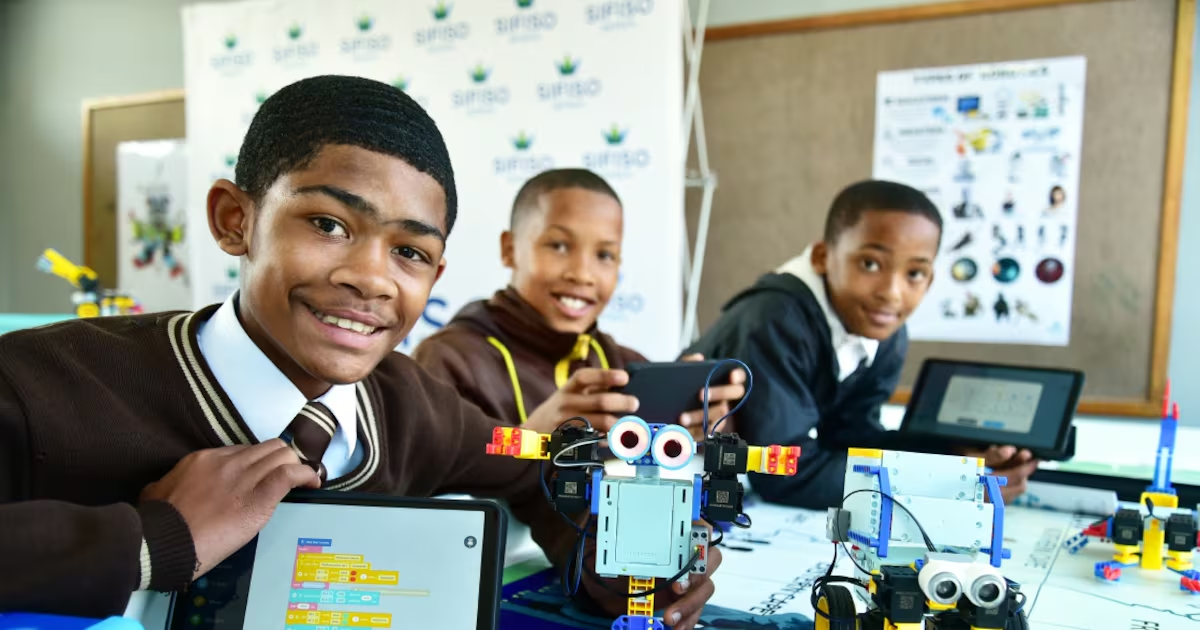
South African school governing bodies, principals and provincial directors are taking the most consequential education decision of the decade by default: whether to develop AI as a pupil and teacher competence or to police it as a transgression to be detected and punished. The decision is being taken in silence, often without minutes, increasingly under the cover of generic AI policies downloaded from other jurisdictions. The cost of that silence will accrue to the country for a generation.Two years of field research across three secondary institutions in São Paulo, with longitudinal measurement at eight months and about 50 teachers tracked from training onwards, surfaced a result that runs against the dominant intuition. The variable that best predicted adoption, downstream pupil skills and integrity of assessment was not the platform chosen. It was not the training budget allocated, not the demographic of the student body, not even the technical proficiency of the teachers at the outset. The variable was institutional posture. Institutional posture is the prior decision school leadership communicates about what AI is. There are two coherent postures and a great deal of incoherent improvisation in between. The first treats AI as a competence to develop in pupils and teachers, with explicit standards, transparent norms and assessment redesign. The second treats AI as a transgression to police, with detection software, punitive frameworks and informal pressure to pretend the tools do not exist. Same platform, same budget, same student demographic, opposite results.Schools resolving the posture towards competence development produced pupils who could critique, correct and extend AI output in the subjects we tracked. Their teachers, after eight months, reported sustained use of generative tools in lesson planning, formative feedback and differentiation. Their assessment integrity improved, not despite the change, but because of it, as redesigned assessments rewarded reasoning that could not be reproduced by any current model.Schools defaulting to the policing posture produced what we have come to call compliance theatre. Detection software triggered weekly, learners learned to obscure rather than to think, teachers reported exhaustion, and senior leadership reported policy success measured by the volume of incidents detected, not by pupil outcomes. The capital spent on the same platform produced no return on either side of the ledger.South Africa is, in this debate, structurally luckier than most jurisdictions. Section 29 of the constitution does not merely guarantee a right to basic education. It guarantees a right that the state must take reasonable measures to make progressively available and accessible in a constitutional framework that has been read by the Constitutional Court as requiring substantive, not merely formal, equality. Few education systems anywhere in the world have such an explicit constitutional basis for arguing that the school’s obligation runs forward in time towards the competencies a pupil will need to function as an adult in the world that actually arrives.Section 29 of the constitution does not merely guarantee a right to basic education. It guarantees a right that the state must take reasonable measures to make progressively available and accessible in a constitutional framework that has been read by the Constitutional Court as requiring substantive, not merely formal, equality. That argument cuts cleanly through the current paralysis. If AI will materially shape adult labour markets, civic participation, scientific literacy and economic agency for the cohort now in grade 8, a posture that treats AI primarily as a transgression to be policed is not just pedagogically weak.It is, on a defensible reading of section 29, a failure of the state’s positive obligation to take reasonable measures. The Constitutional Court has never accepted lack of knowledge as a justification when the evidence was available. The evidence is, by now, available.The quintile structure complicates this only superficially. Quintile 1 and 5 schools face the same posture decision, with different capacities to execute on it. The posture question itself does not require capital. It requires governance. A school governing body in a quintile 2 township school can resolve the posture as cleanly as a quintile 5 independent school in the northern suburbs, and the resolution produces an immediate compass for every subsequent decision about platforms, training and assessment. The capital then follows the posture, not the other way around.What this asks of school governing bodies, of provincial education departments and of the department of basic education is straightforward to state and uncomfortable to do. The posture must be decided explicitly, written down, communicated to pupils and parents, and tested against the constitutional standard before any platform is procured, any detection software licensed or any training delivered. The platform question is downstream. The posture question is upstream and, in South Africa, is also constitutional.The cost of getting this wrong is not symmetrical. Schools defaulting to policing now will have to undo that posture under conditions of public scrutiny and pupil complaint within three to five years, when the cohort that lost those years reaches matric and the labour market. Schools deciding the posture deliberately now, towards competence development, will have those same three to five years to refine practice while their peer institutions are still litigating their initial silence.South African education does not need to invent the framework for this decision. The framework is already in the constitution. What it needs is for the institutions tasked with implementing section 29 to recognise that the AI literacy decision is not a procurement decision. It is a constitutional one. The schools that recognise that first will be the ones their pupils thank in 2035.• Do Nascimento, a PhD candidate in pure mathematics at the University of São Paulo, is an AI solutions developer and consultant. He is a confirmed keynote speaker at the second International Conference on Artificial Intelligence & Generative AI in Cape Town this September.
RONEY LIMA DO NASCIMENTO | The question SA schools are not yet asking about AI
Section 29 of the constitution demands a forward-looking approach to AI education
949 words~4 min read