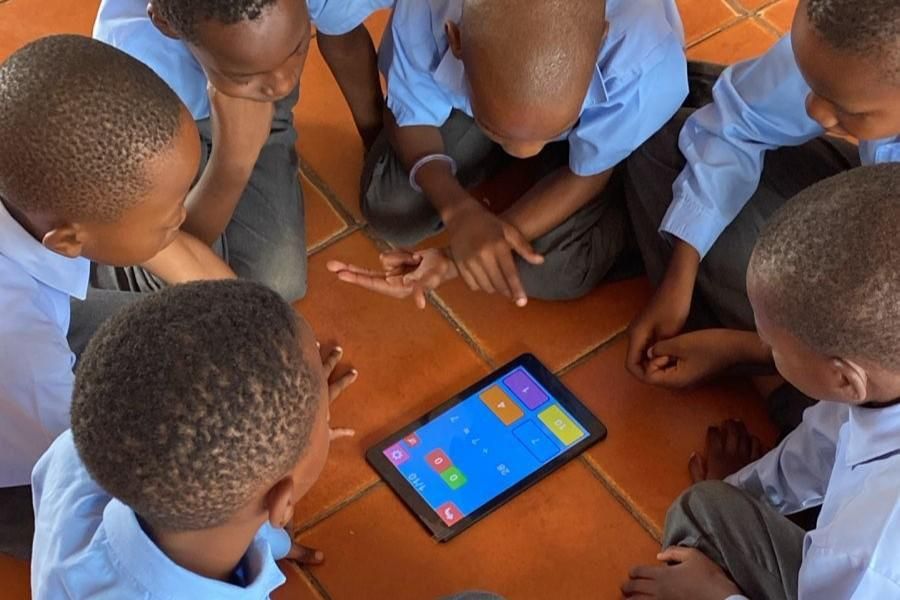
Rural learners gather around a tablet during a guided lesson, as technology opens new pathways to education and future opportunities.
A pattern is emerging within our schooling system that needs highlighting as South Africa faces its next major technology decision. In coding and robotics, with the best intentions, directives were given, curriculum was developed, and then the move forward stalled. We are beginning to see the same pattern with artificial intelligence (AI).
Globally, the question is no longer whether AI should be used in schools, but how it can be integrated responsibly, ethically and effectively. Most countries entered the generative AI debate with national AI or digital strategies already in place, many updated since 2023.
The OECD’s Digital Education Outlook 2026 notes that the most common immediate policy response has been national or system-level guidance covering ethical use, academic integrity, data protection, and the roles of teachers and students. In South Africa, we are still waiting for that conversation to properly begin.
Without direction from the Basic Education Department, teachers are experimenting with AI tools on their own because pupils are already using them, and pretending otherwise is not a strategy. Without a shared framework, the outcome will be uneven – some pupils receiving structured exposure, others receiving none, with no curriculum designed to build progressively from one year to the next.