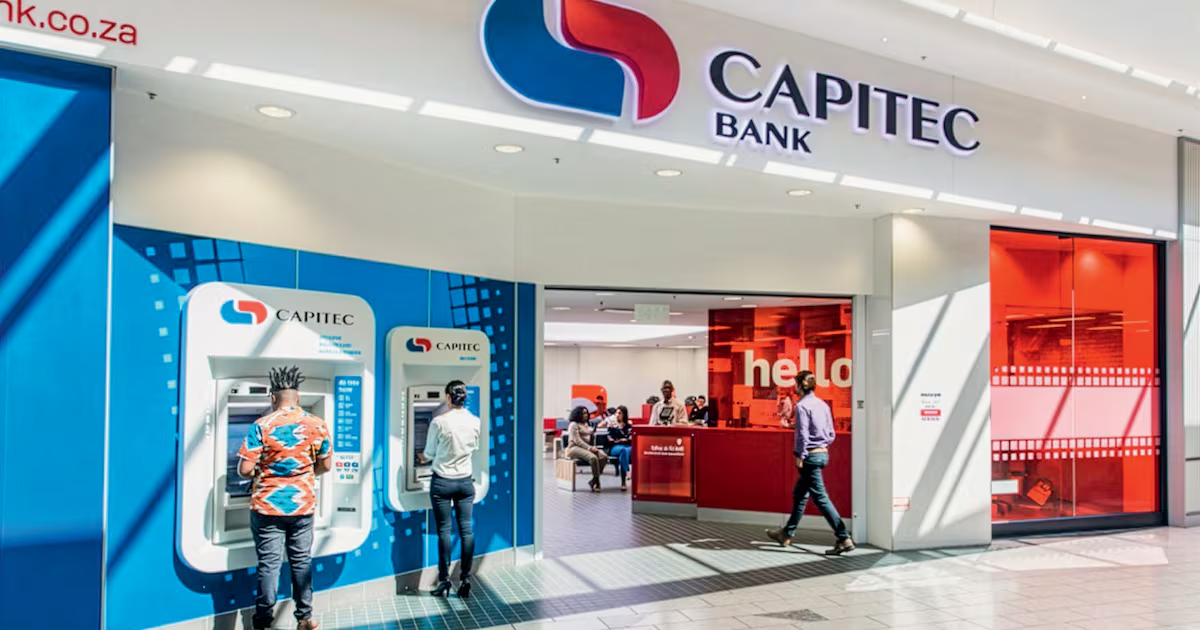
South Africa’s biggest bank by customer numbers just told the market something every university in the country should pay serious attention to. It indicates a step change in the skills companies need, and the bank is taking charge of this upskilling.Capitec’s latest annual report shows a focus on artificial intelligence (AI) training, as it put 568 employees through cloud-focused learning last year with staff clocking nearly 43,000 hours on Udemy Business and Pluralsight. The bank is running its own masterclasses in SQL, Java and JavaScript, and has built internal “centres of mastery” across engineering, data and payments.This is more than a skills investment story. While continuous upskilling remains a vital corporate responsibility, it signals how rapidly the capabilities required by industry are evolving, making it vital for higher education and industry to work together more closely. That is a gap that institutions of higher learning, private and public, increasingly need to address.Nowhere is this more visible than in technology, where AI, cybersecurity, automation and data-led decision-making are reshaping industries. PNET’s latest Job Market Trends Report confirms that AI is no longer a future concept but is actively reshaping how South Africans work, hire and build careers and is no longer limited to technical roles. Professionals across industries are integrating it into everyday workflows.The AI economy does not reward the deep specialist working in a single lane. It rewards the person who can navigate across several. Technical competence alone will increasingly not be enough as employers now seek graduates who can combine computational thinking with ethical judgment, systems thinking, communication skills and the ability to work across disciplines.Closing the gapSome privately funded higher education institutions have a clear advantage in being able to pivot to industry’s evolving requirements relatively quickly, particularly as AI technologies continue to develop at pace.They can update curricula in line with technological change and offer more personalised learning environments. This differs from many traditional higher education environments where large-scale curriculum review and approval processes can naturally take longer due to institutional and regulatory complexity.That agility shows up in the classroom too. Modern, technology-rich campuses and smaller class sizes support hands-on learning and individualised attention. Focused programmes in software development, cybersecurity, cloud computing, AI and data science attract students seeking career-relevant education. Employers increasingly look for graduates who can contribute from day one, not after 18 months of internal retraining.At Belgium Campus iTversity disciplines such as AI, intelligent systems, data science, cloud infrastructure and cybersecurity are approached as interconnected ecosystems rather than isolated technical streams, with emphasis on applied problem-solving, interdisciplinary collaboration and understanding how digital systems interact within real organisational environments.While platform-based learning solutions like Udemy play an important complementary role in continuous upskilling, higher education institutions can integrate technical capability, contextual understanding and applied problem-solving within a more holistic learning environment — producing graduates who enter the workplace with stronger foundations and require less catch-up training once employed.The private sector’s demand for AI skills, from banking to manufacturing, is also changing job design in ways that go beyond technical abilities. New demand is emerging for professionals who can manage AI systems, interpret outputs, govern data, ensure ethical use and combine technical tools with business understanding.Delivering on the promiseAs the country accelerates its digital transformation, private institutions are playing an increasingly important role in developing that talent — and smaller, specialised, industry-connected institutions are often structurally better positioned to respond quickly to emerging skills demands.When a major bank builds its own internal training capability to compensate for what the education system did not deliver, that is a signal worth taking seriously. Private institutions have the tools, the agility and the industry alignment to close that gap upstream.The credibility of that proposition depends on actually living it: building programmes that reflect where technology is heading, not where it has been.South Africa’s corporates will keep investing in internal training. The goal should be a market where that investment deepens expertise rather than remedies its absence. We know what the market needs.We have the tools to deliver it, and we must help enable greater digital transformation and economic growth.• Klopper is academic head at Belgium Campus iTversity.
HB KLOPPER | What Capitec’s AI investment says about the future of higher education
SA’s private higher education institutions are closing the skills gap but the window to act is narrow
687 words~3 min read