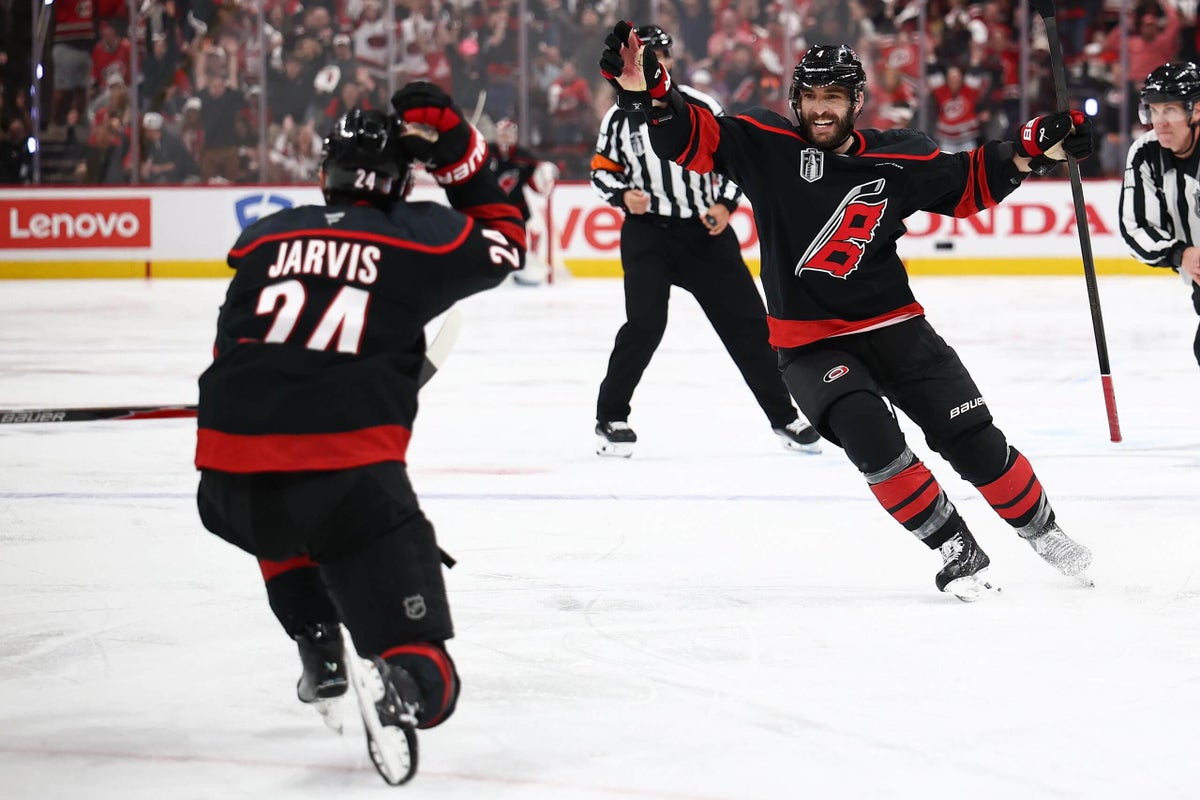
LAS VEGAS — One positive the Carolina Hurricanes can look to ahead of Tuesday’s Game 4 of the Stanley Cup Final: Their forever-moribund power play has come to life.Hovering at around 11 percent for the playoffs at one point in Game 2 after starting the series 0-for-5 and looking listless doing so, Carolina now finds itself up to 15.6 percent following two huge power-play goals to key the win that night and another goal to cap a furious four-goal third-period rally on Saturday.That still isn’t very good. But it’s better. And it comes at a crucial time.“It’s funny how that works, right?” Canes coach Rod Brind’Amour said. “We were pretty much trying the same things for a couple of games, and it’s not working, and all of a sudden, a shot goes through, and everything is great again. It’s just the nature of our game. Power plays really come down to execution. Putting passes in the right spots so you can shoot. All these little things that we weren’t really doing before.”The real question is, does a team need a good power play to win the Stanley Cup? It certainly helps, but the answer is actually no.I looked back at the past 15 Stanley Cup champions to get my answer. Six had power plays that operated under 20 percent, all ranking in the bottom half of the 16 playoff teams in their respective years:TeamYearPP%RankPanthers202418.511Blues201916.312Blackhawks201517.910Blackhawks201311.413Kings201212.812Bruins201111.414So a good power play is hardly a necessity — if a team is excellent at five-on-five and on the penalty kill.The 2024 Florida Panthers never sweated their lackluster power play. Their second-ranked penalty kill (88 percent) is what gave them security.“I really never thought of the PP as something that you wanted to rely on,” two-time Stanley Cup champion Panthers coach Paul Maurice told The Athletic on Sunday. “We felt strongly that our PK would have a great influence because it also can cause problems for other teams’ confidence five-on-five.”Those 2013 and 2015 Chicago Blackhawks absolutely made up for their power play elsewhere, too, with the third-best penalty kill in 2013 (90.8 percent) and the most five-on-five goals in 2015.“I never felt like our power play increased any pressure on us because we weren’t scoring on it,” Hall of Famer Duncan Keith, a key member of those Chicago championship squads, told The Athletic over the weekend. “Our team game and identity was how we checked defensively to beat teams five-on-five. Our penalty kill was good, and any time we did manage to get one in the power play, which was rare, just felt like a bonus to us. At least that is my interpretation.
Can a team win the Stanley Cup without a good power play? Hurricanes wouldn’t be the first
Carolina's power play has come to life a bit but still is at just 15.6 percent in the playoffs.
1,248 words~6 min read