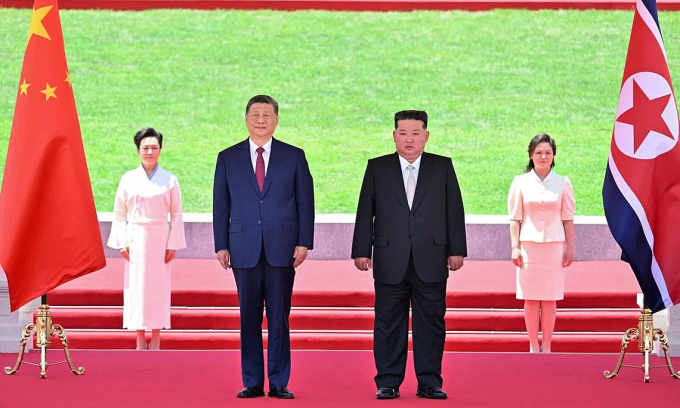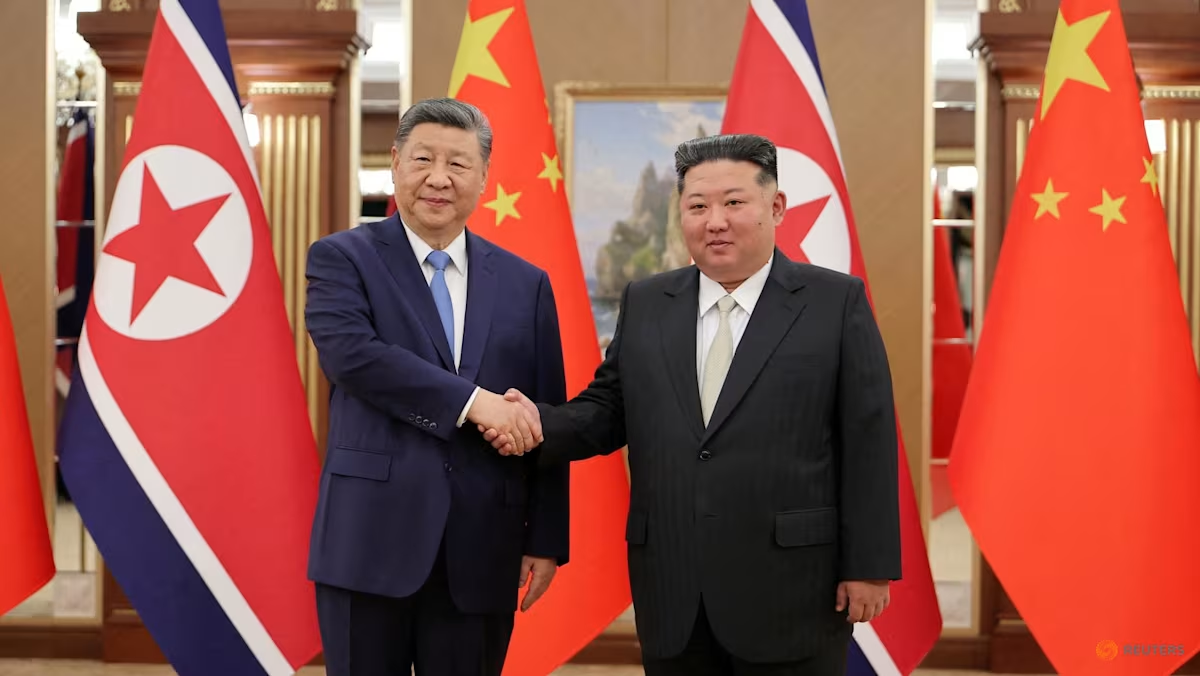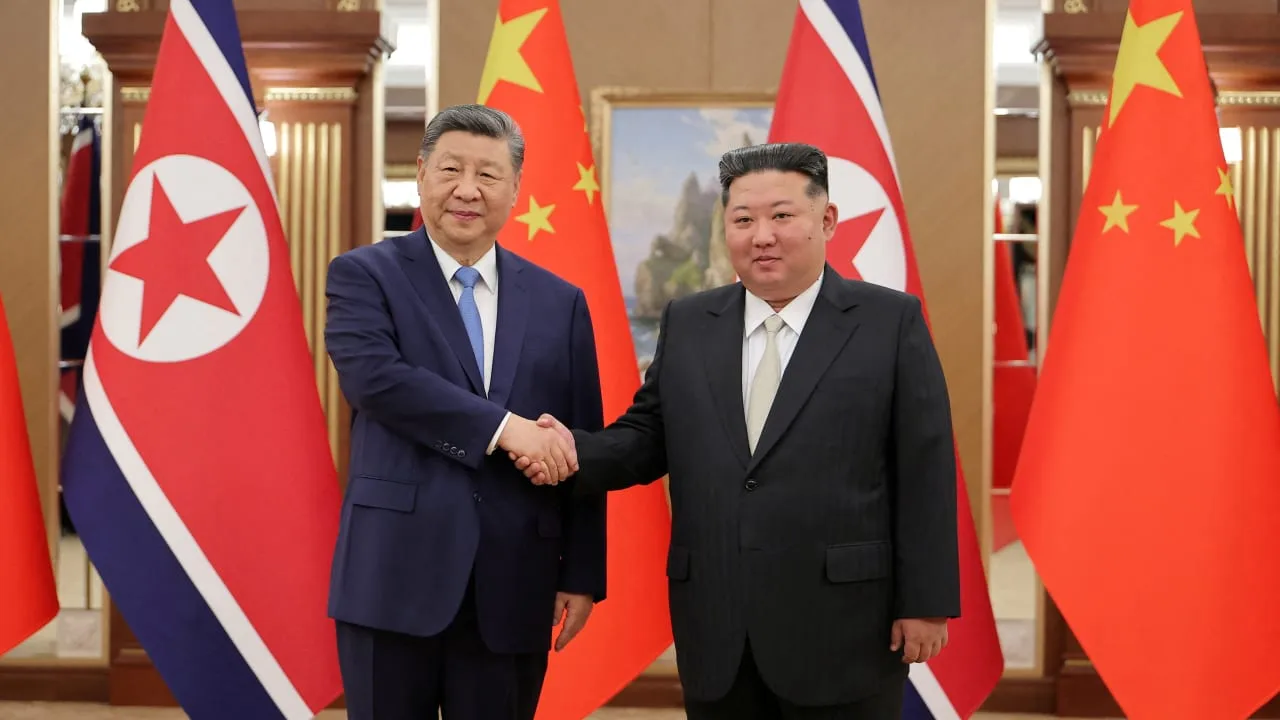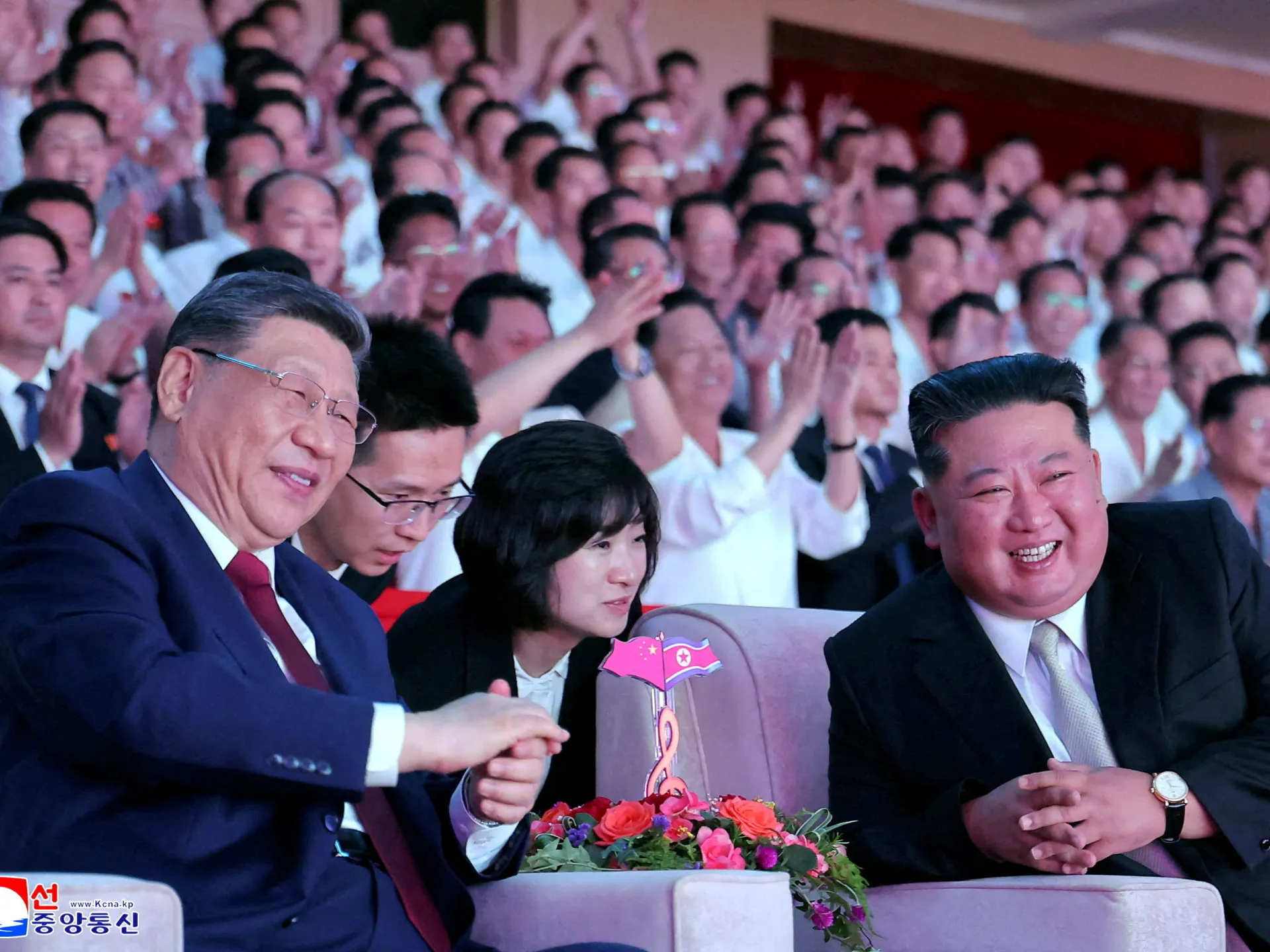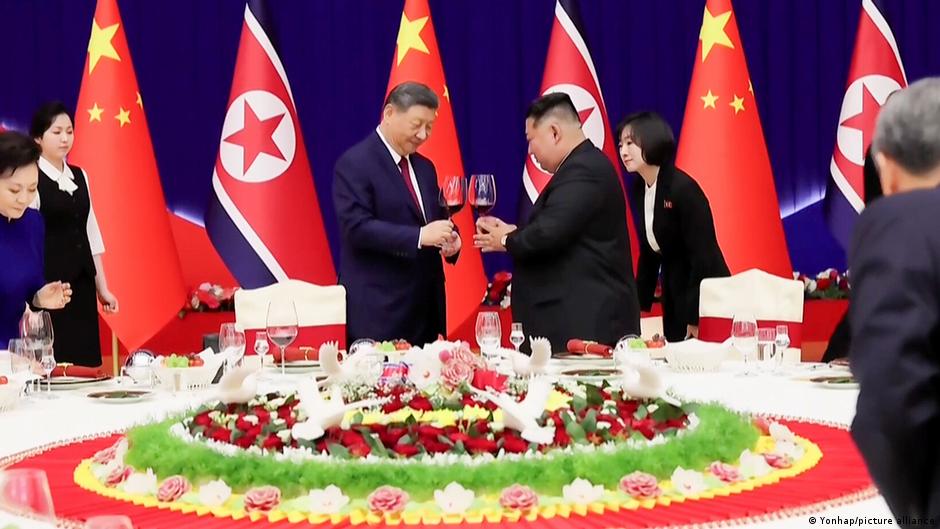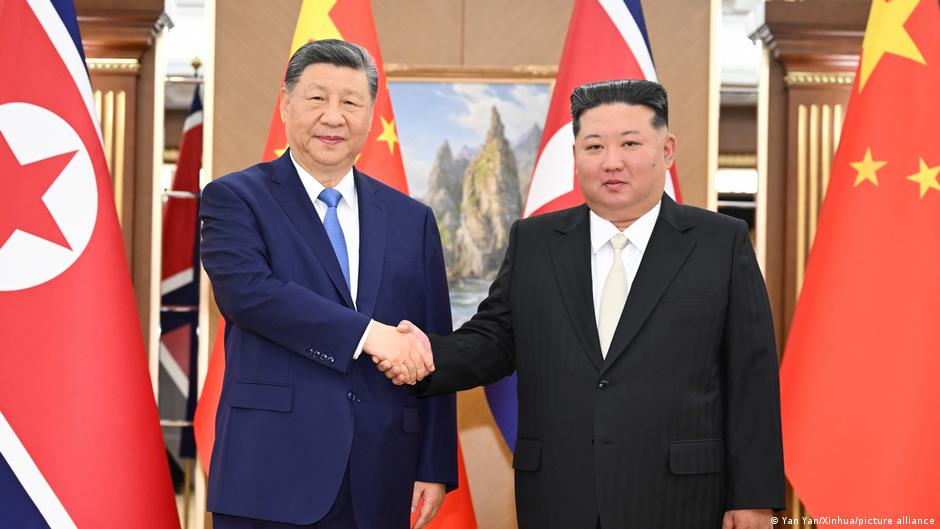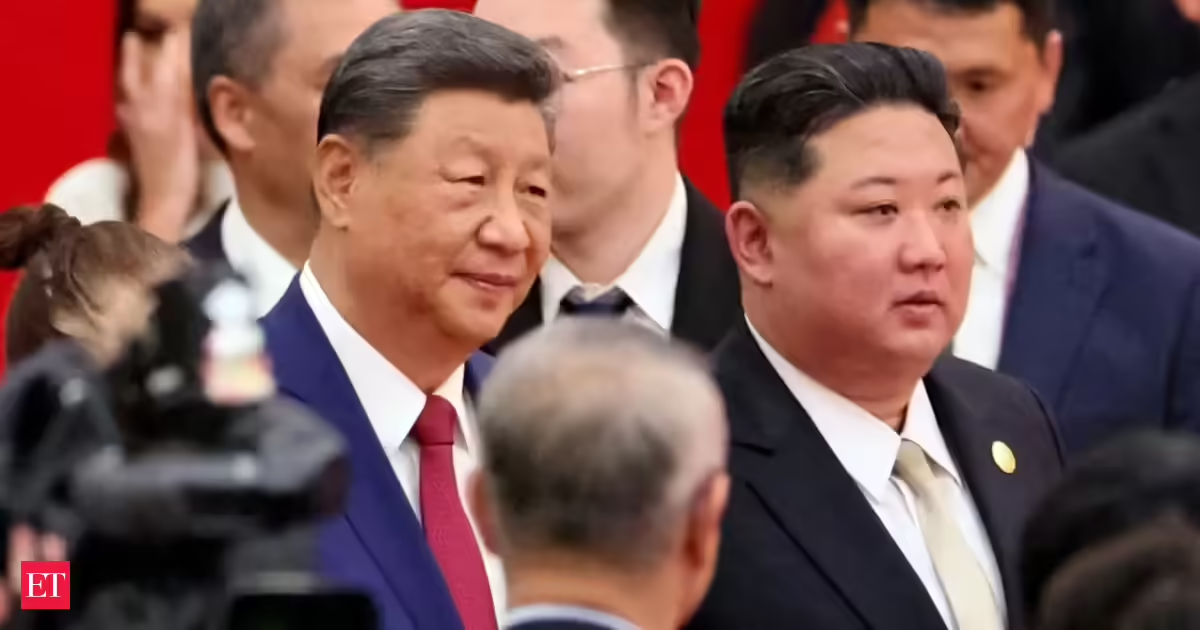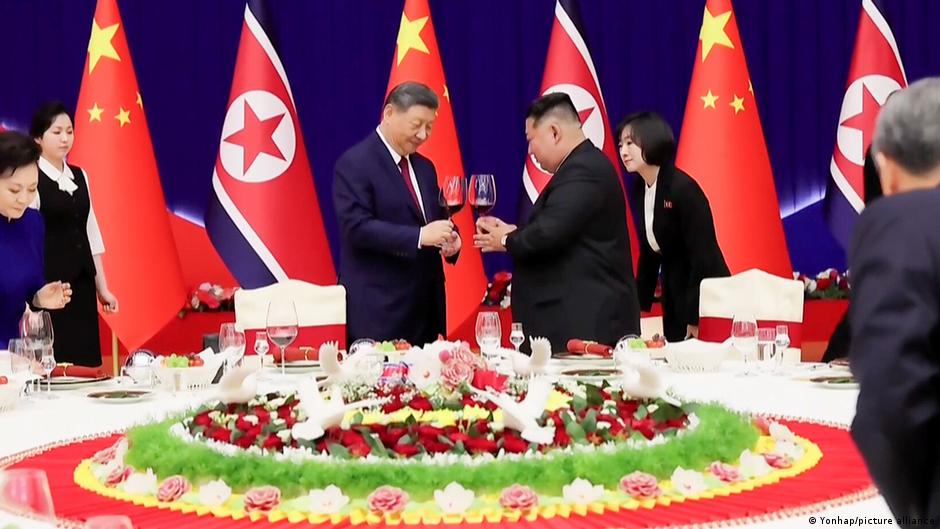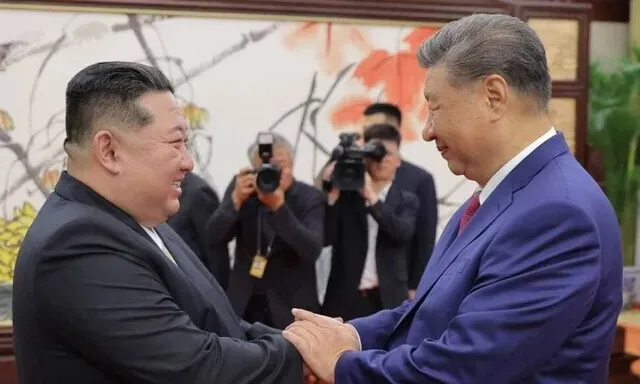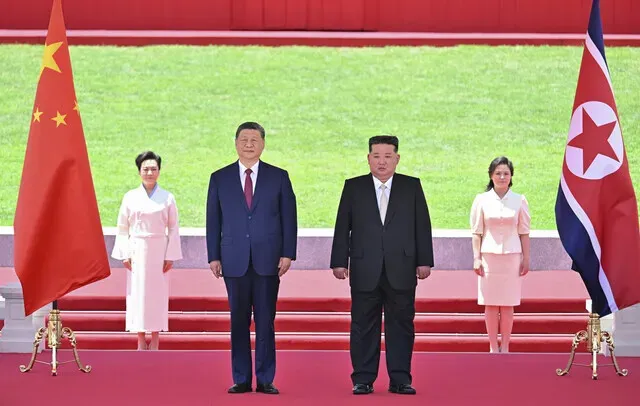
President Xi Jinping of China of North Korean leader Kim Jong-un stand side by side at a welcome reception for Xi held in Pyongyang’s Kim Il-sung Square on June 8, 2026. (Xinhua/Yonhap)
During his first visit to North Korea in seven years, Chinese President Xi Jinping pledged to restore and develop bilateral relations into a strategic partnership during a summit with North Korean leader Kim Jong-un in Pyongyang on Monday. The two leaders pledged to significantly strengthen bilateral economic ties, including the full resumption of customs operations, and hinted at the possibility of military cooperation. No mention of North Korea’s denuclearization was made.China’s state-run Xinhua News Agency reported Monday that, during the summit at the Kumsusan State Guesthouse in Pyongyang, Kim characterized the development of the bilateral relationship as the “foremost strategic undertaking of the state,” as well as being the “choice of the peoples of the two countries and a necessity of the times.”Kim further said that North Korea would “unwaveringly uphold the one-China principle and firmly support China’s policies and positions on safeguarding its core interests,” making clear Pyongyang’s intention to support Beijing in its efforts to protect its key interests, which include Taiwan.Xi expressed his readiness to use this visit as an opportunity to “strengthen top-level planning and strategic guidance for China-DPRK relations in the new era [and] keep bilateral relations advancing with the times [to] achieve better progress in bilateral ties,” using the abbreviated form of North Korea’s official name. Xi reportedly put forth four proposals for the sake of developing bilateral relations. These included consolidating the foundation of political mutual trust through high-level exchanges, elevating the level of practical cooperation while staying committed to the goal of delivering benefits to the people of each nation, upholding the legacy of friendship as a driving force to strengthen the bonds between their peoples, and deepening strategic coordination by upholding fairness and justice. One particularly noteworthy proposal was Xi’s call to “leverage the opportunity of the full reopening of border crossings and the resumption of civil aviation flights and international passenger trains to increase people-to-people exchanges and foster mutual interaction.”Such remarks hint at a comprehensive expansion of economic cooperation between the two countries, including the possible opening of the New Yalu River Bridge linking North Korea’s Sinuiju and China’s Dandong, which has yet to open for use despite construction having been completed around a decade ago.Xi also noted that China is ready to “strengthen the alignment of development strategies” with North Korea, which could signal an expansion of economic cooperation on a scale incomparable to Beijing’s past aid to Pyongyang. The two leaders also highlighted military and diplomatic cooperation. Xi noted that 2026 marks the 65th anniversary of the China-DPRK Treaty of Friendship, Cooperation and Mutual Assistance, calling for both sides to “enhance exchanges in diplomacy, law enforcement, military affairs and others, implement the important consensus reached between the two leaders, and pool wisdom and strength for the development of China-DPRK relations.”In an article that ran on the front page of North Korea’s state-run Rodong Sinmun on Monday, the first day of his visit, Xi wrote that the two countries should “support each other in pursuing socialist paths suited to their own national conditions, firmly safeguard the political security of both nations,” as well as “jointly uphold the international system with the UN at its core and the international order based on international law.”Xi emphasized in his article that China-North Korea relations extend beyond the Korean Peninsula, describing them as an important partnership within the broader international order shaped by the US-China rivalry and growing cooperation between Beijing, Pyongyang and Moscow. “The two sides should oppose hegemonism and power politics, and reject any scheme or action aimed at reviving militarism and undermining regional security and stability. The two countries should jointly promote an equal and orderly multipolarization of the world and a universally beneficial and inclusive economic globalization,” Xi wrote in his piece.The Chinese leader’s reference to the “equal and orderly multipolarization of the world” reflects China’s foreign policy approach aimed at challenging US hegemony.. The rejection of “reviving militarism” can be interpreted to mean that the two countries will stand together to oppose Japan’s remilitarization. Neither the report on the bilateral summit nor Xi’s article mentioned the Korean Peninsula issues, glossing over the possibility of North Korea’s denuclearization or the status of inter-Korean relations. This stands in contrast with the piece Xi wrote for his 2019 North Korean visit, in which he mentioned the Korean Peninsula six times while praising North Korea’s attempts at dialogue with the US. This suggests that denuclearization is no longer a priority for China-North Korea relations, and that China is quietly condoning North Korea’s demands to be acknowledged as a nuclear power. “This signals a paradigm shift in China’s approach to North Korea, moving completely from ‘mediator of North Korea-US denuclearization’ to ‘tightly knit strategic partner for systemic containment of the US,’” assessed Hong Min, a senior research fellow at the Korea Institute for National Unification in Seoul.By Park Min-hee, senior staff writerPlease direct questions or comments to [english@hani.co.kr]