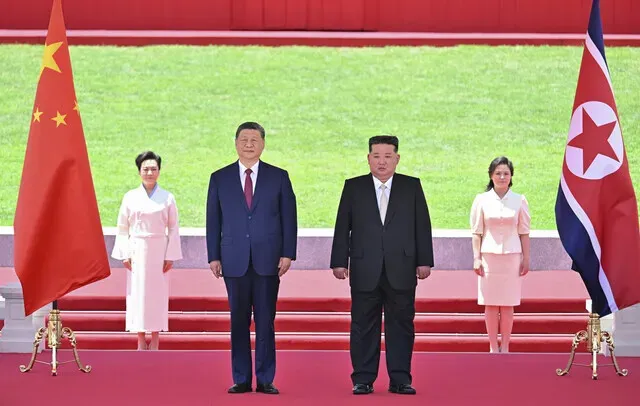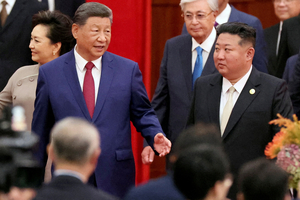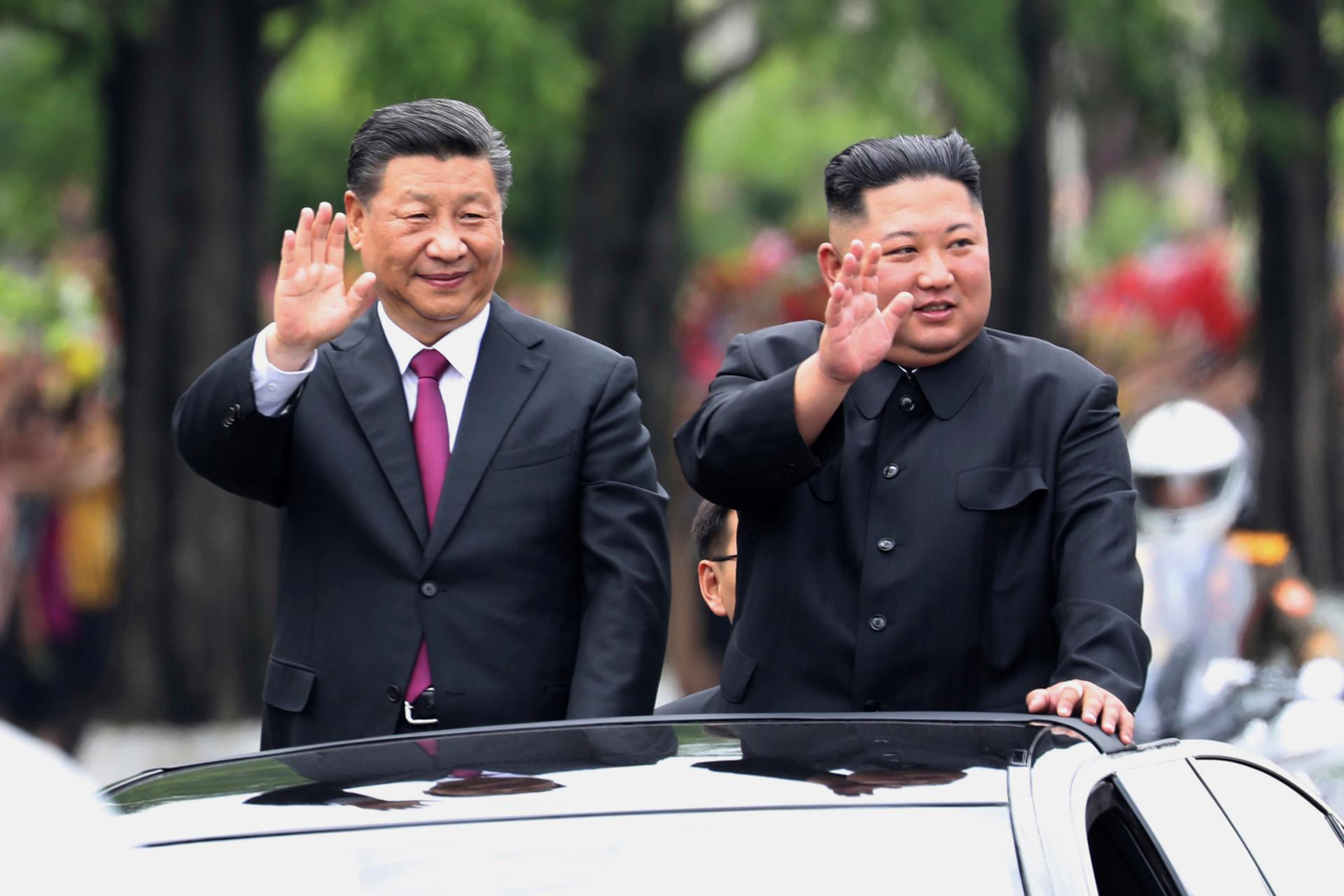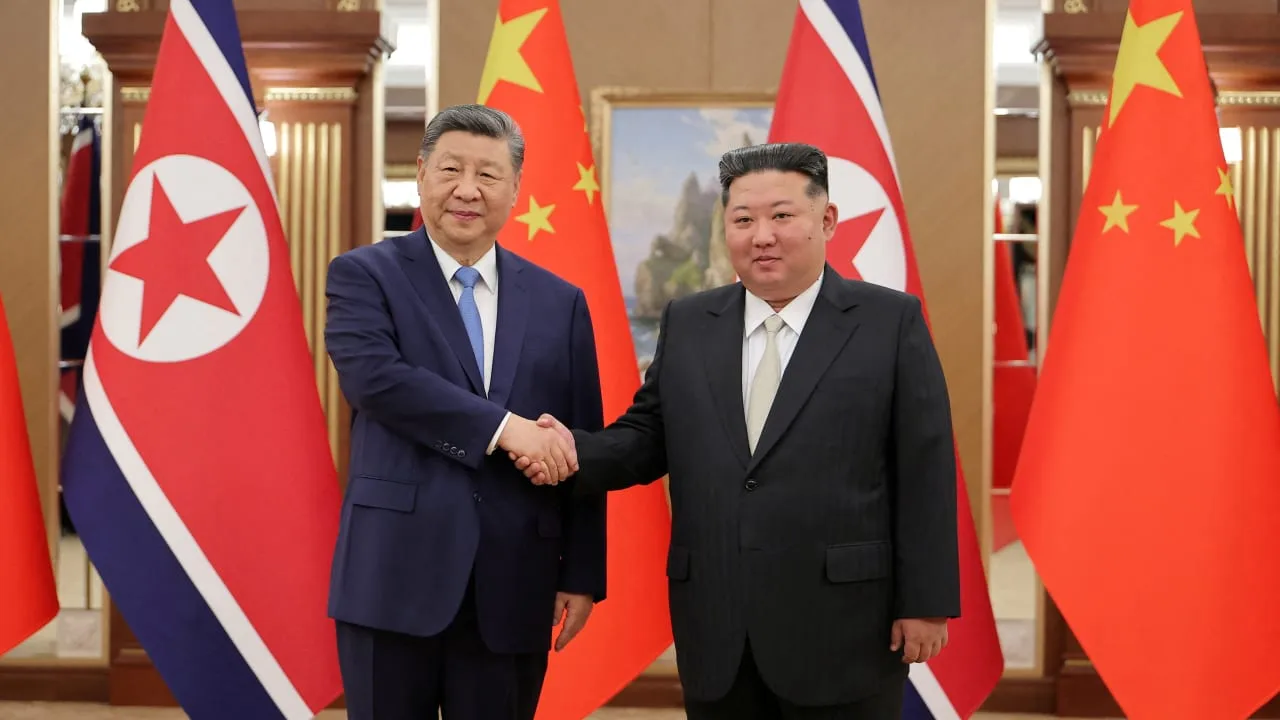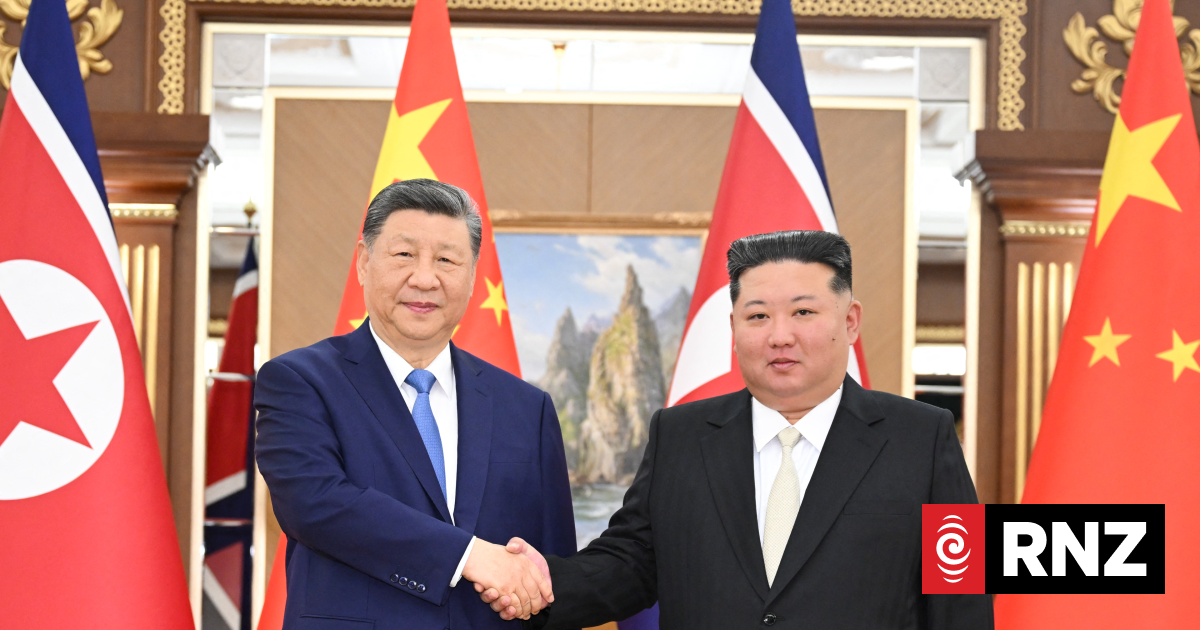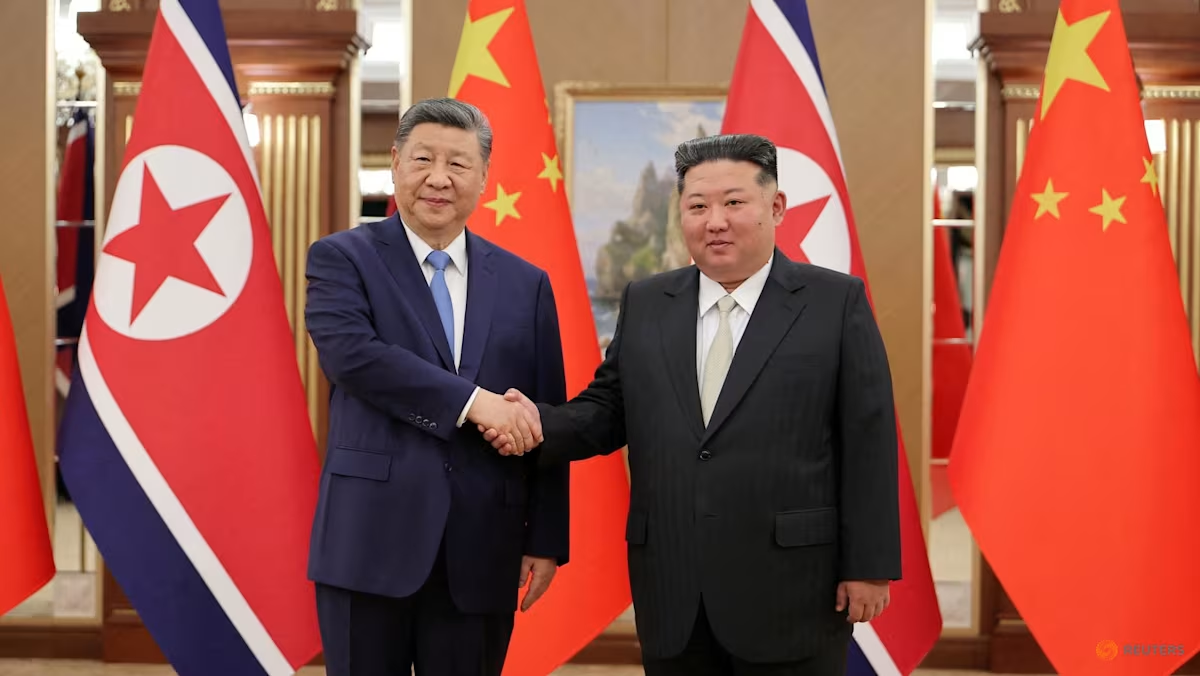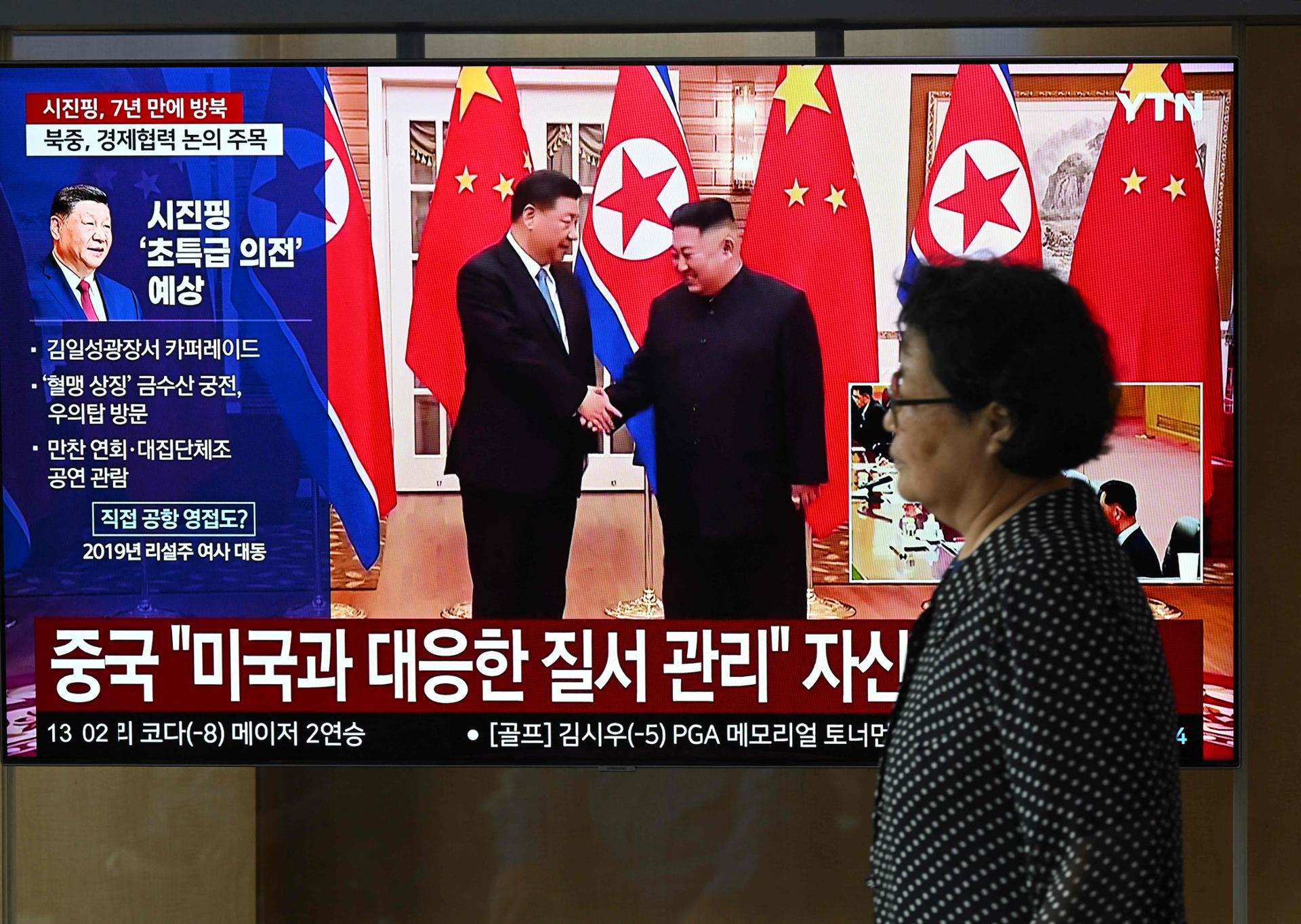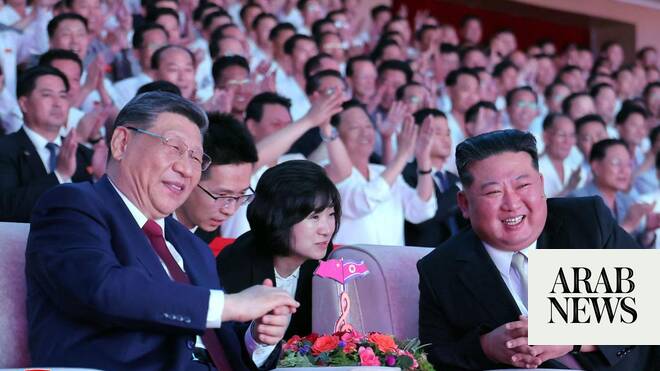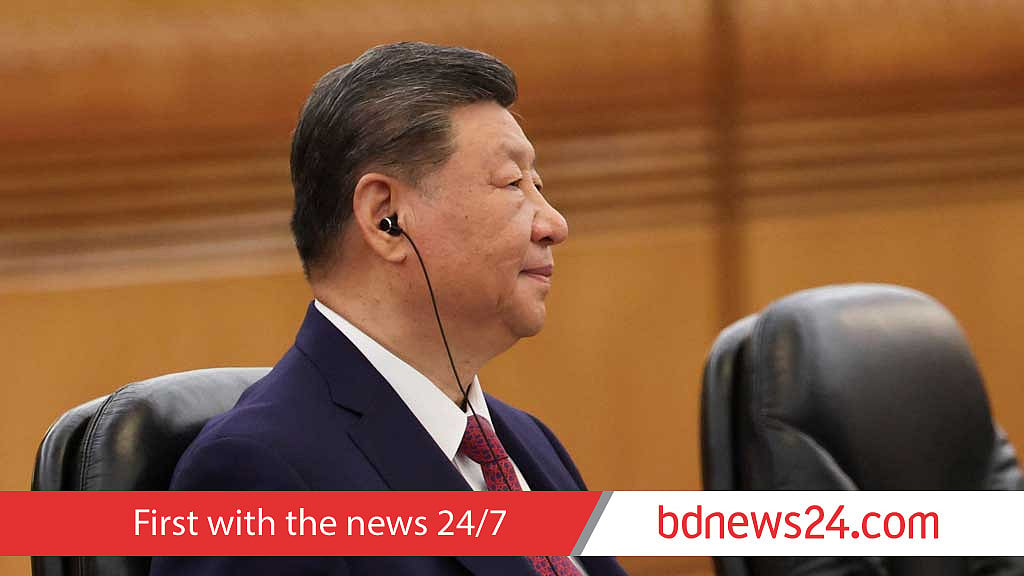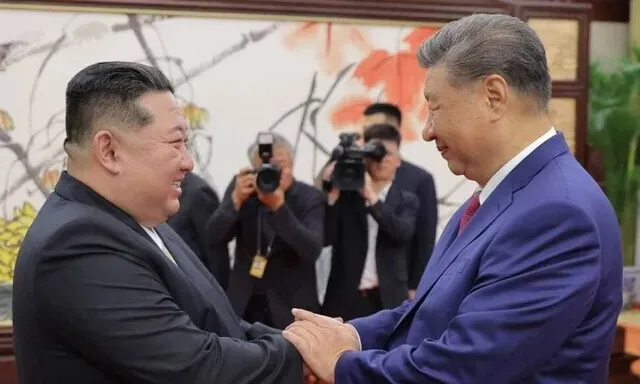
North Korean leader Kim Jong-un greets Chinese President Xi Jinping in Beijing’s Great Hall of the People on Sept. 4, 2025. (KCNA/Yonhap)
Chinese President Xi Jinping declared the goal of building a multipolar world while emphasizing strategic communication and cooperation with North Korea ahead of his first visit to Pyongyang in seven years on Monday.Xi wrote about Pyongyang-Beijing relations in a signed article that ran on the front page of North Korea’s state-run Rodong Sinmun on Monday.“The two sides should strengthen strategic communication and coordination, and jointly uphold the international system with the United Nations at its core and the international order based on international law,” Xi wrote in the article. Xi repeatedly used such phrases as “strategic guidance at the highest level,” “strategic coordination” and “strategic communication” in the article, emphasizing the strategic importance of bilateral relations.These remarks appear to signal the intention of not only fully restoring Pyongyang-Beijing relations — which had appeared strained after Pyongyang and Moscow strengthened ties — but of elevating those relations to a strategic partnership.Xi underscored that Pyongyang-Beijing relations concern more than Korean Peninsula issues and play into the world order, including the US-China rivalry and trilateral relations with Moscow.“The two sides should oppose hegemonism and power politics and reject any scheme or action aimed at reviving militarism and undermining regional security and stability. The two countries should jointly promote an equal and orderly multipolarization of the world and a universally beneficial and inclusive economic globalization,” Xi said.Xi’s mention of the “multipolarization of the world” is a nod to China’s external strategy of challenging US’ hegemony. The phrase about “reviving militarism” is thought to be an appeal to jointly oppose Japan’s rearmament.Notably, Xi emphasized that “China and the DPRK should support each other in pursuing socialist paths suited to their own national conditions [and] firmly safeguard the political security of both nations” without explicitly mentioning Korean Peninsula issues such as inter-Korean relations or denuclearization.That can be taken as tacit tolerance and even support for North Korea’s continuing development of its nuclear arsenal and adoption of the “two hostile states” narrative vis-á-vis South Korea despite intense disapproval from the international community.In a joint statement following his summit with Russian President Vladimir Putin last month, Xi generally endorsed North Korea’s positions while voicing opposition to any attempts to threaten North Korean security through diplomatic isolation, economic sanctions or military pressure.“In an article [published in the Rodong Sinmun] during his visit to North Korea in 2019, Xi emphasized his role as a mediator for denuclearization by expressing his ‘support for the correct objective of a political solution to Korean Peninsula issues.’ But his latest article makes no mention of ‘Korean Peninsula issues,’ ‘denuclearization,’ ‘dialogue and negotiations,’ or ‘North Korea-US,’” said Hong Min, a senior research fellow at the Korea Institute for National Unification in Seoul.Hong sees that as “signaling a paradigm shift in China’s approach to North Korea, moving completely from ‘mediator of North Korea-US denuclearization’ to ‘tightly knit strategic partner for systemic containment of the US.’”In regard to Pyongyang-Beijing relations, Xi said that “across eras and despite geopolitical changes, the traditional friendship between China and North Korea is forever invincible,” while stressing that he and North Korean leader Kim Jong-un had met on six separate occasions.“A high level of strategic cooperation reflects the significance of Beijing-Pyongyang relations in the current era. We are steadfast in our support of defending state sovereignty, safety, and development interests. Regional peace and welfare, international fairness and justice, and the postwar international order must be jointly safeguarded,” Xi said.Xi also mentioned the possibility of strengthening military cooperation with North Korea on July 11, which will mark the 65th anniversary of the signing of the Treaty on Friendship, Cooperation and Mutual Assistance between China and North Korea.“The two sides should take the 65th anniversary of the China-DPRK Treaty of Friendship, Cooperation and Mutual Assistance as an opportunity, strengthen exchanges at all levels and across party, government and military institutions, implement the important consensus reached by the two sides, and add fresh impetus to the development of bilateral relations,” he wrote. Noting China’s latest five-year plan and the recently concluded Workers’ Party of Korea congress in North Korea, Xi expressed a commitment to bilateral economic cooperation. “The two sides should enhance the alignment of development strategies, tap the potential for cooperation in various fields, share opportunities and promote development together, so as to better benefit the two peoples,” he wrote. The Chinese leader further said that the two countries should “jointly promote an equal and orderly multipolarization of the world and a universally beneficial and inclusive economic globalization, implement the four major global initiatives put forward by China, and work together to build a community with a shared future for humanity.” Those four major global initiatives include the Global Development Initiative, the Global Security Initiative, the Global Civilization Initiative and the Global Governance Initiative. In effect, Xi was drawing a connection between Beijing-Pyongyang ties and the vision of the world order that China is attempting to build. Xi arrived in Pyongyang at noon on Monday for a two-day state visit to North Korea, his first visit to the country since June 2019. By Park Min-hee, senior staff writerPlease direct questions or comments to [english@hani.co.kr]