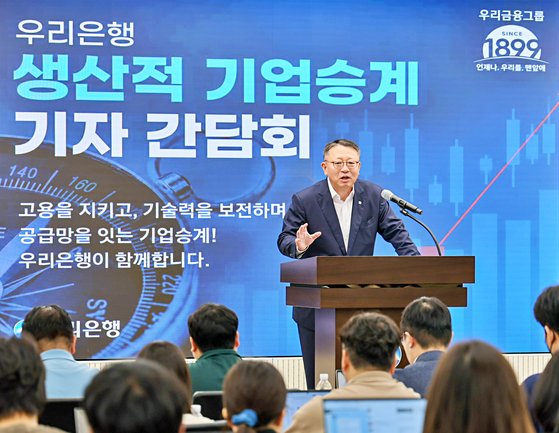
Taxonomy-based lending, AI screening aim to verify environmental impact Woori Bank CEO Jung Jin-wan (Woori Bank) For Korean banks, green finance is becoming less about branding money as ESG and more about proving where that money goes.That shift is being driven by the Korean green taxonomy, also known locally as K-Taxonomy. The framework defines which activities can be considered environmentally sustainable and puts stricter standards around green loans and bonds.Woori Bank is moving ahead with loans and bonds screened against the taxonomy rather than broader ESG standards.The lender said it has provided 1.08 trillion won ($714 million) in taxonomy-based green loans as of May 21, about five months after it began actively expanding the program. The total excludes general ESG loans and counts only credit that meets the government's green loan guidelines and K-Taxonomy criteria, which cover areas such as greenhouse gas reduction, climate adaptation, water, circular economy, pollution prevention and biodiversity.The distinction is becoming more important as banks seek to reduce greenwashing risks, where financing is marketed as environmentally friendly without clear evidence that the underlying project has a measurable environmental impact.Green loans are also becoming a tool for banks to influence the real economy. By extending credit, and in some cases offering preferential rates, lenders can help companies invest in renewable energy, energy-efficient buildings, recycling facilities and other projects tied to Korea's carbon neutrality goals.Woori Bank has also expanded its presence in the green bond market. In May, the bank issued 300 billion won in Korean green bonds, bringing its cumulative issuance to 600 billion won since 2024. The proceeds are set to be allocated to projects including offshore wind power in Shinan, waste-to-energy recovery projects and solar power facilities.Unlike ordinary bonds, Korean green bonds require that proceeds be used for projects that comply with K-Taxonomy. Issuers must also report how the funds are allocated and disclose the environmental impact of the projects after issuance, a process designed to improve transparency in the ESG bond market.One challenge for banks is that taxonomy screening is complex. K-Taxonomy covers six environmental objectives and 100 categories of green economic activities, with detailed technical standards for each activity.To address that, Woori Bank has introduced what it describes as the banking sector's first AI-based taxonomy screening system. The system compares customer business information with K-Taxonomy criteria to help determine whether a loan qualifies as green, reducing the need for manual checks by headquarters staff.The technology could become increasingly important as green finance moves from a symbolic ESG exercise to a more technical credit process. For banks, the next phase of climate finance may depend not only on how much money they provide, but also on how clearly they can prove that the money is genuinely green."ESG should translate into tangible change for customers and society," a Woori Bank official said. "We will continue to support sustainable growth and fulfill our social responsibilities as a trusted financial partner."
Woori Bank pushes green finance beyond ESG labels
For Korean banks, green finance is becoming less about branding money as ESG and more about proving where that money goes. That shift is being driven by the Kor
485 words~2 min read