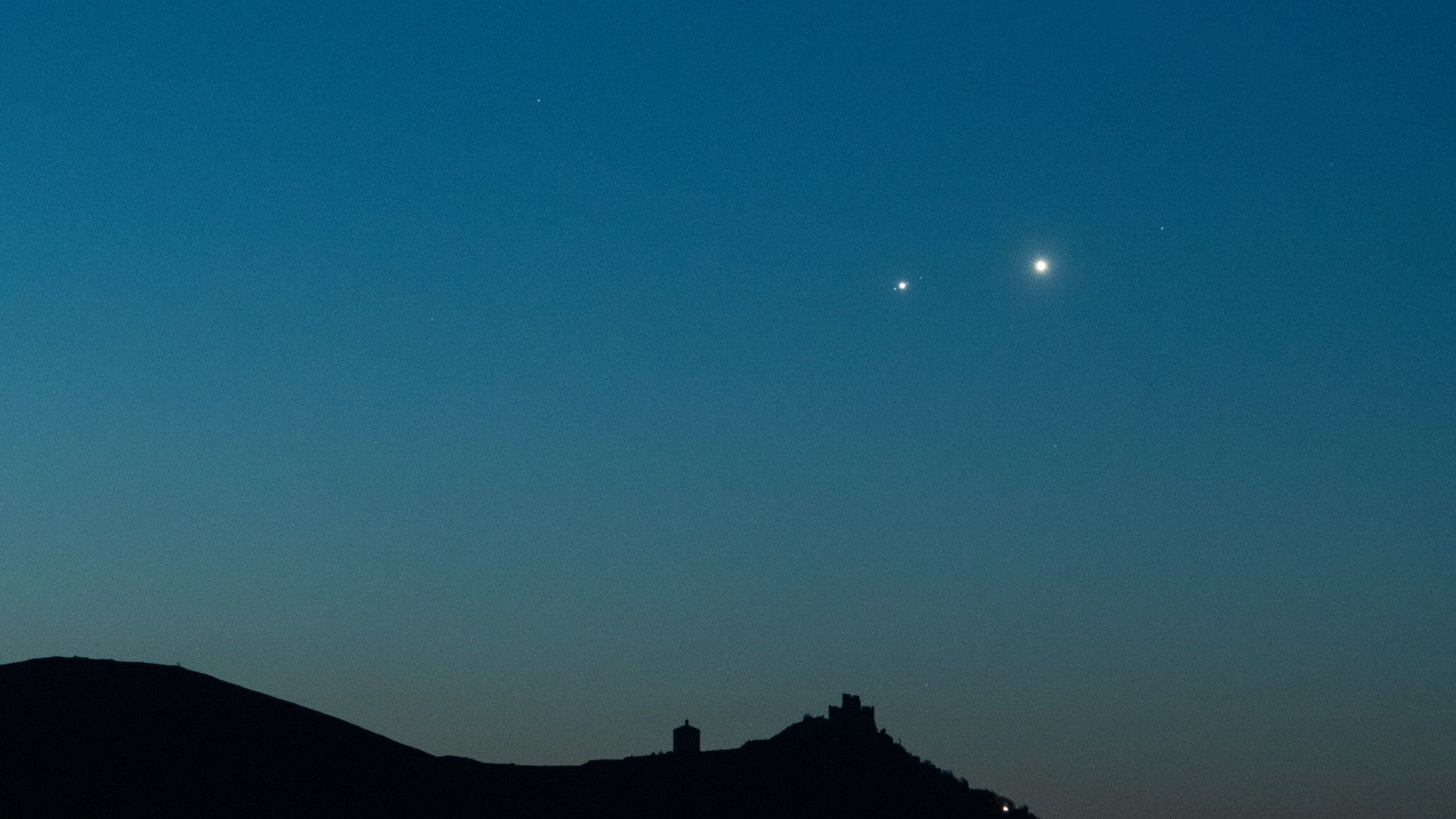
Jupiter and Venus approach conjunction behind Rocca Calascio castle in Italy on April 30, 2022.
(Image credit: Lorenzo Di Cola/NurPhoto via Getty Images)
Shortly after sunset on June 9, Venus and Jupiter will look very close together, in what is known as a planetary conjunction.Sunlight will reflect off the cloudy tops of Venus and Jupiter before journeying millions of miles to enter Earth's sky in almost the same place, making the planets appear very close to one another on Tuesday (June 9). But in reality, the two planets will be separated by at least four Earth-sun distances in space.A conjunction between Jupiter and Venus also happened just ten months ago, in August 2025. Before that, in May 2024, preceded by March 2023. Its occurrence roughly once every year is a sign of a wonderful arrangement of planets that may be absent around other stars. And as it turns out, the conditions that set Venus and Jupiter up for their conjunction are the same that are critical for life to survive on Earth.'Pie' in the skyThanks to the explosion of exoplanet discoveries over the past decade, planetary scientists like Kat Volk, who works at the Planetary Science Institute in Tucson, Arizona, know there are many distant worlds taking wonky and puffed-up loops around their parent stars. But the solar system is more like a pie of pizza.The flat-disk shape means that, although the sky is a huge dome above our heads, the planets can only appear in part of it.Venus, Jupiter, and their planetary siblings travel in almost concentric circles around the sun. That means that the planets appear just a handful of degrees above or below the sun's apparent path through the sky, called the ecliptic. (The ecliptic is really the Earth's orbital plane, but from our perspective it appears as though the sun is in motion.)The Earth's orbital plane is only tilted a little relative to the average plane of the solar system, called the invariable plane, Volk tells Space.com."That's why, as we're watching them in the sky, they're all kind of following a path along the ecliptic plane."It's all reflective of how the sun and the planets formed, said Volk."When the sun was being born out of some cloud of gas and dust, it was collapsing down to form the star. Then, angular momentum caused the material surrounding that [star], that didn't make it into the sun, to form a disk that is rotating and orbiting around the star. The really massive bodies in the solar system — the planets — tended to form within that disk," said Volk.