For the millions of visually impaired individuals worldwide, the lack of access to trained guide dogs represents a severe accessibility gap. While robotic alternatives exist, they have historically been limited by high costs and short battery life due to the heavy on-device processing required for autonomy.
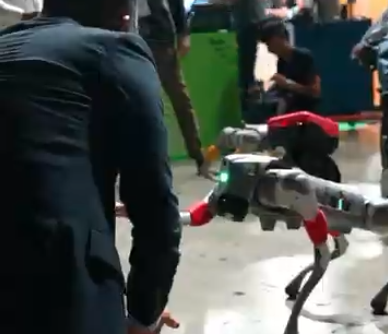
This year at DTW Ignite 2026 in Copenhagen, we are showcasing the Catalyst project, "The robotic dog: AI at the edge, sustainable revenue at scale." This Catalyst project demonstrates our collaboration with AsiaInfo, ATT, China Telecom, Netcracker, Omantel, and ZTE, and shows how intelligence is moved from the device to the edge to transform a standalone robot into a connected, intelligent service platform. This evolution demonstrates the power of an AI-native digital ecosystem.Why standalone robots fall shortCurrent autonomous robotic dogs operate as isolated devices, working in controlled industrial settings. To navigate complex environments, they must carry massive onboard compute power to process real-time spatial data and run large language models (LLMs). This leads to a "vicious cycle" of technical limitations:High energy consumption: Intensive on-device processing drains batteries rapidly, limiting the distance a user can travelStatic intelligence: Without a persistent connection to a more powerful "brain," these robots cannot easily update their models or adapt to new user-specific needs in real timeProhibitive costs: The sophisticated hardware required for full local autonomy makes these life-changing tools unaffordable for people who need them mostShifting intelligence to the edgeThe Catalyst project addresses these limitations by introducing the Intelligent Service Delivery Edge (ISDE). Instead of forcing the robotic dog to carry the weight of complete on-device processing, it moves intelligence and decision-making to a common cloud-native platform located at the edge of the network.This architectural shift delivers immediate value. Enhanced energy efficiency is achieved by offloading heavy compute tasks to the edge, which allows the robotic dog to function as a thin client and significantly extends battery life for longer distances. The ISDE also enables continuous learning and adaptability through real-time LLM updates, so the robotic dog can learn from every interaction and stay current with environmental changes.This approach also results in a reduced device cost, as lower hardware dependency means the robotic dog can be produced at a fraction of the cost, helping bridge the accessibility gap. Finally, this framework provides scalable intelligence by offering a repeatable model that can be reused across multiple physical AI devices and industries, not just robotic dogs.Beyond reactive commands: Multi-agent orchestrationThe Catalyst project introduces an AI orchestration layer that enables the robotic dog to act as a proactive companion. Through multiagent intelligence, the robotic dog coordinates with a broader digital ecosystem, including other devices, cloud services, and municipal infrastructure.The Catalyst project illustrates this with so-called mission scenarios that move from the home to the outside world. The social experience is shown when a user asks the robotic dog, "Hi Orbit, shall we go to the supermarket today?", and the robotic dog does more than just calculate a route, it also checks weather conditions, reviews the user's schedule, and identifies that essentials are running low.This intelligence leads to context-aware coordination, where the robotic dog can identify if friends are also planning visits to the store, turning a chore into a social outing at a nearby park. Furthermore, ecosystem integration is demonstrated as the robotic dog coordinates with supermarket partners to identify exclusive discounts and even pre-orders items before the person arrives.A new monetization frontier for service providersFor service providers, this Catalyst project represents the transition from being a simple connectivity provider to becoming an orchestrator of intelligent digital ecosystems. By providing the ISDE, service providers can move up the value chain and unlock new revenue streams, such as:AI-as-a-Service (AIaaS): Monetizing distributed AI capabilities delivered directly through the edge infrastructureBusiness-to-Business-to-X (B2B2X) models: Acting as a marketplace owner that connects hardware providers, LLM developers, and vertical industries like healthcare and transportPlatform-as-a-Service (PaaS): Offering existing operations support system / business support system (OSS/BSS) capabilities, such as billing, payments, and identity management, to ecosystem partnersPublic sector partnerships: Collaborating with governments and insurance providers to fund these services as part of social care and accessibility initiativesRed Hat provides the technical foundationMoving from vision to real-world deployment requires a foundation built on flexibility and trust. Red Hat provides the common cloud-native platform needed to manage these complex, distributed workloads across the core, edge, and public clouds.Our approach focuses on 3 critical pillars:Mastering economics: Red Hat OpenShift AI runs right-sized models efficiently, so the cost of delivering AI doesn't outweigh the benefit. The models run where they are needed. The platform supports service provider network services such as an AI-based RAN at the device edge, running locally on the robotic dog.Industrializing AI: Creating an AI factory that can reliably build, train, and deploy models across thousands of edge locations.Openness and trust: The system is transparent, auditable, and free from vendor lock-in, which is essential for services involving personal safety and sensitive user data.Final thoughtsThe technical innovation of this Catalyst project lies in its ability to decouple intelligence from the physical device. By leveraging an AI-native network and ISDE, a scalable blueprint is created for how physical AI will integrate into our daily lives. This starts with a robotic dog for the visually impaired today, but will move to other robotic assistants in the future.Visit us at our booth at DTW Ignite 2026 in Copenhagen to meet the robotic dog "Orbit" and see how we are transforming the future of the autonomous intelligent network. And don’t forget some treats!