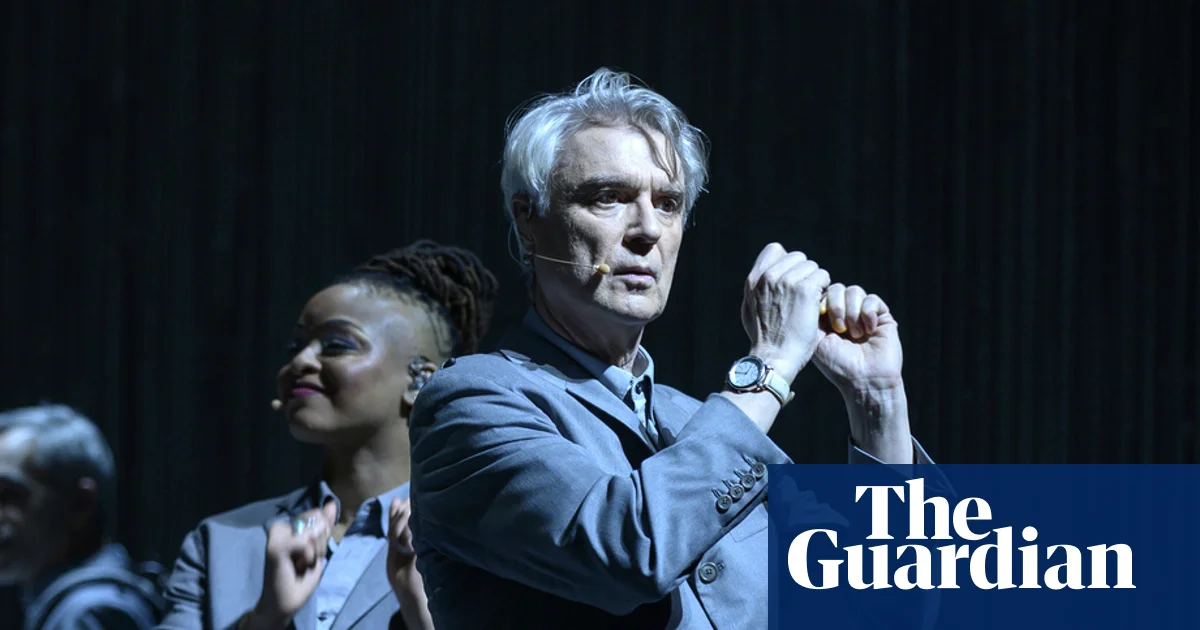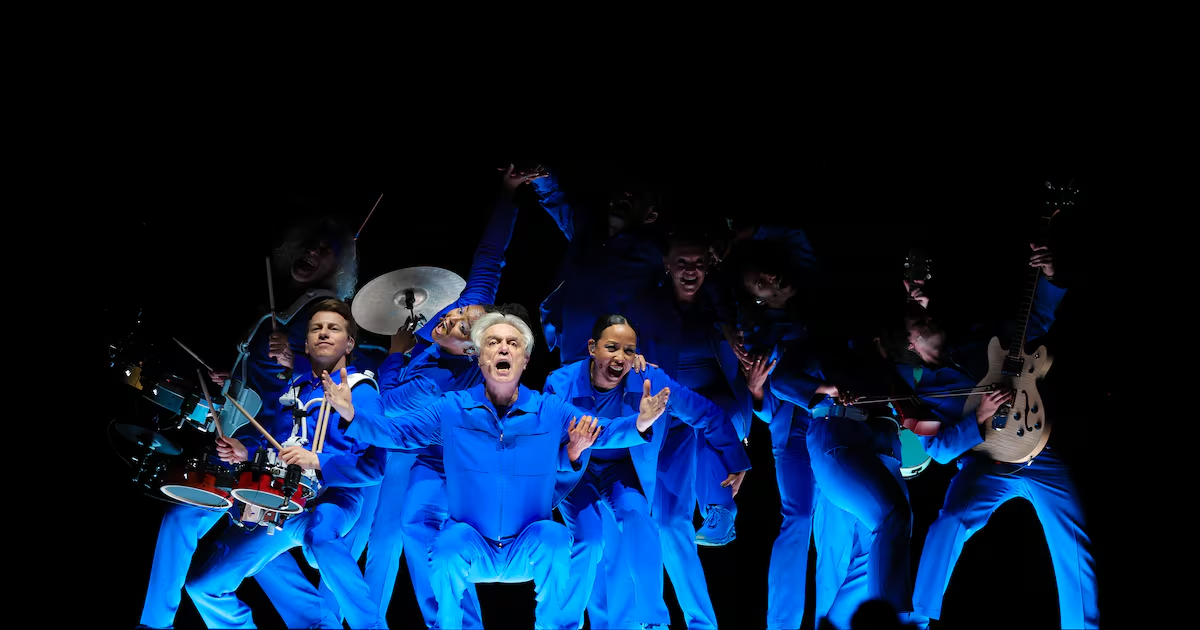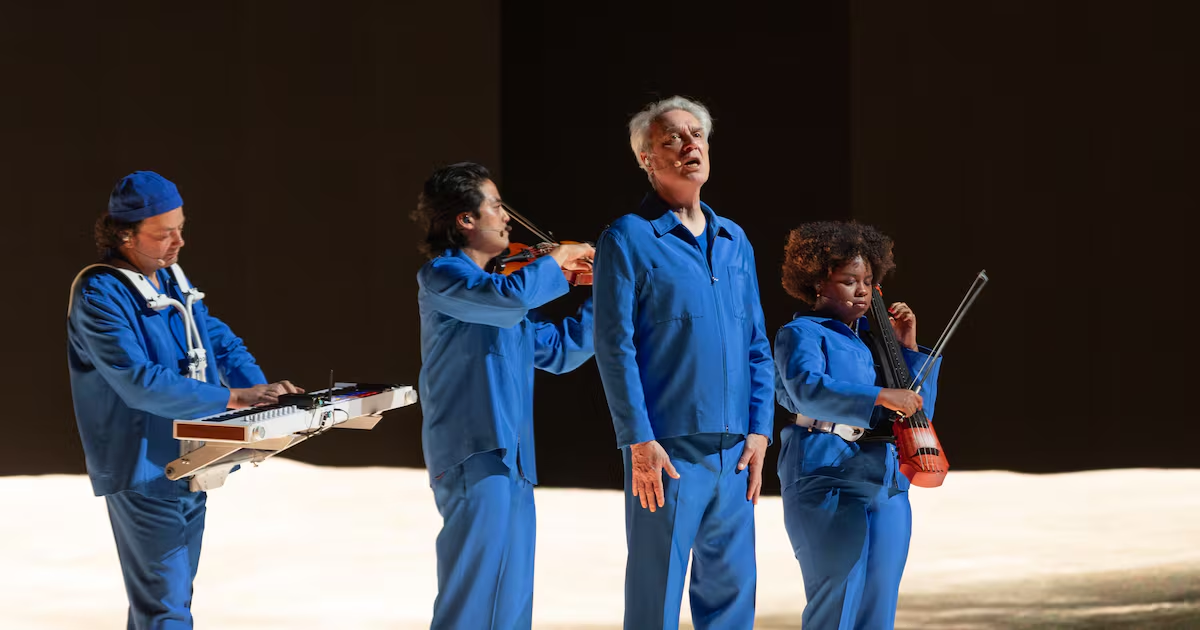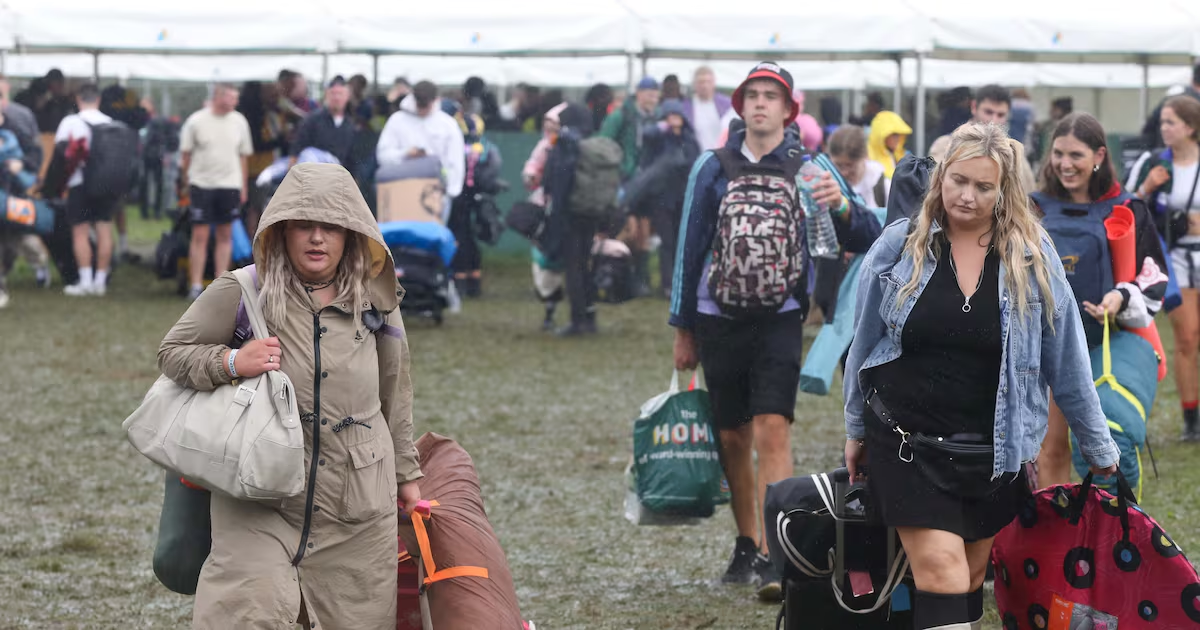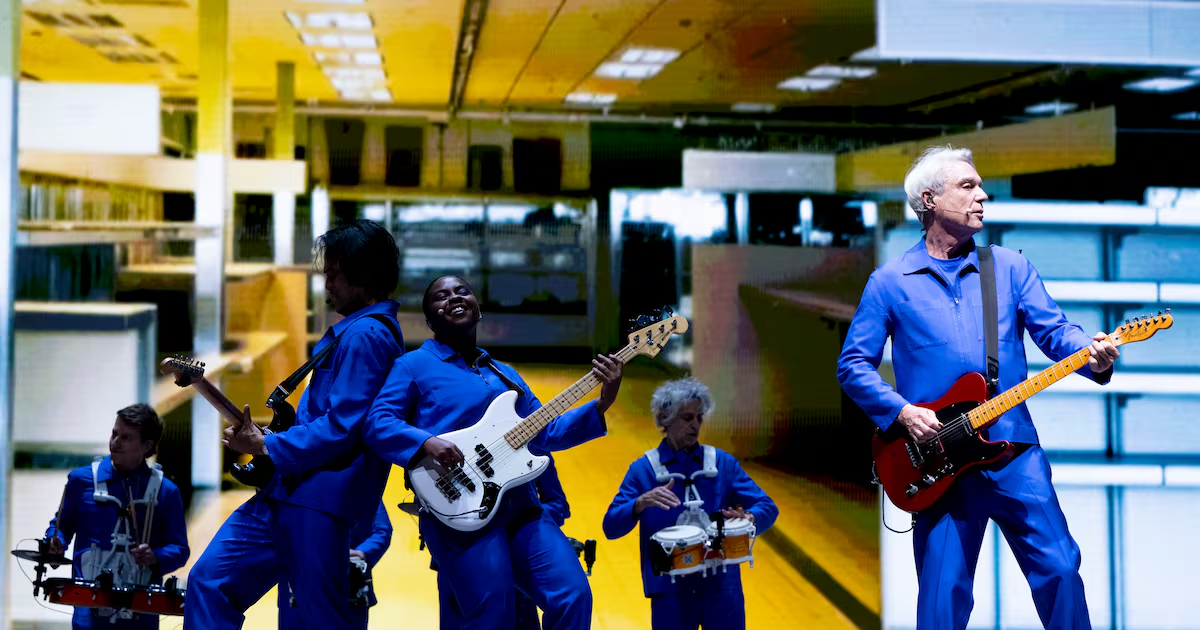
David ByrneSt Anne’s Park, Dublin★★★★☆A rainy evening at St Anne’s Park, and the stage is empty save for a projected moonscape. David Byrne walks on, followed by a troupe of musicians in matching blue suits, and delivers a sparse, haunting rendition of Heaven. As the song ends, a blue Earth slowly appears in the darkness.“There she is, our heaven,” Byrne says. “The only one we’ll ever have.”It’s a perfect introduction to an artist who, throughout a long and storied career in the avant-garde of pop music, including in Talking Heads, has remained committed to a strange and charming wholesomeness.Next he launches into Everybody Laughs, which thankfully proves to be a real bop when performed live. A large ensemble of musicians and dancers move constantly around the stage with no visible wires, amps or fixed positions, while projections show footage of people behaving strangely on the New York subway. The logistics alone are impressive, the choreography intricate and tight.Byrne has no interest in a greatest-hits package. Instead he has created a show that’s generous in a truer way, offering a peek inside his personal scrapbook. He projects photos taken during his stay in Dublin: a sign advertising a discount at a sex shop, the head of William Blake currently exhibited at the National Gallery of Ireland. Fragments of autobiography and philosophy are woven through the songs. During My Apartment Is My Friend we’re given a glimpse inside Byrne’s real apartment.At other moments he is almost professorial, explaining the depiction of the Buddha in certain sutras as having webbed feet while a slideshow presents different artistic renderings. Later he explains that the Enlightenment created a rift between humans and animals but that the rift is reversible. This leads into Like Humans Do, accompanied by projections of band members wearing animal heads and thrashing around.The mood throughout is happy and silly. On record, some of the material from Byrne’s album Who Is the Sky? can feel so determined to radiate positivity, so entirely shadowless, that it risks doing the opposite, becoming alienating and depressing. Live, however, the songs are infectiously fun.This is colourful, theatrical, whimsical art-pop that recalls the wacky psychedelia of the 1960s. The aesthetic is a little muddled when the utopianism narrows into contemporary liberal sloganeering. Projections of sweet but somewhat toothless messages including “Well-behaved women rarely make history”, “Arms are for hugging” and “Make America gay again”.Byrne offers an explanation of sorts: “Love and kindness are the most punk things you can do.”It’s not entirely convincing, but it’s a nice sentiment nonetheless.At 74, Byrne continues to push outwards into strange territory, building deeper into his own inner worlds. Not every idea lands, but that’s beside the point. He is still taking risks, still open and unpretentious, still trying to imagine better ways to be in the world. By the time the show draws to a close, with Burning Down the House, the rain is pelting down and the muddy field is transformed into a communal jig.
David Byrne at St Anne’s Park review: For Burning Down the House the sodden field becomes a communal jig
On record, the musician’s recent material can feel too keen to radiate positivity. Live, however, the songs are infectiously fun
496 words~2 min read