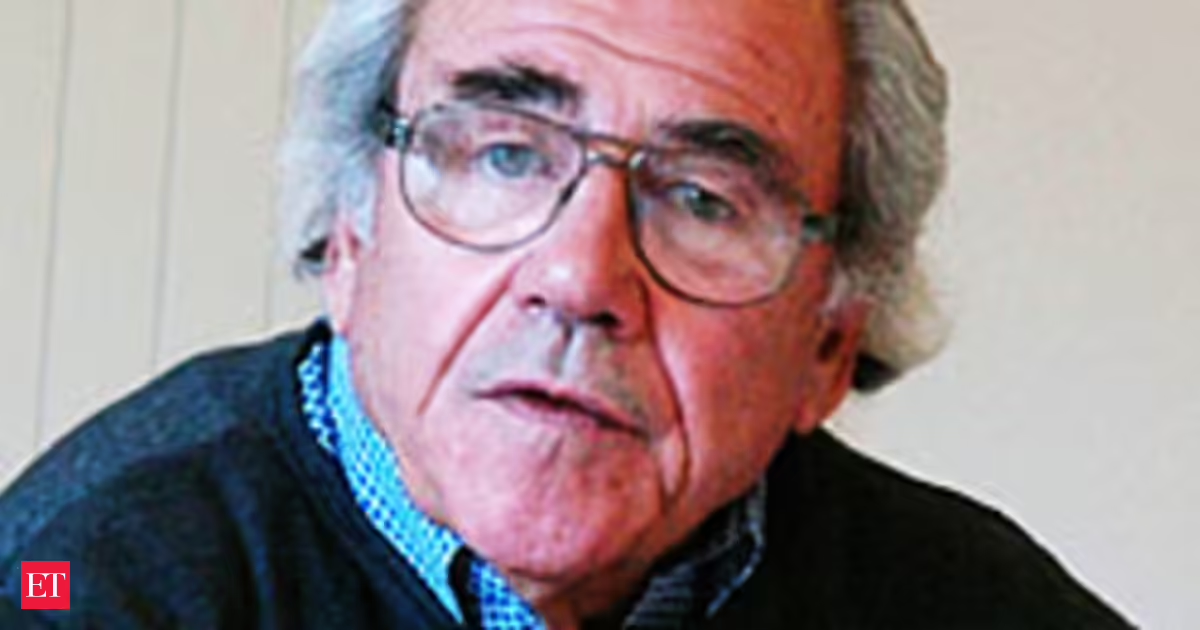
In the closing moments of The Truman Show, Truman Burbank gazes at the edge of the world he has always known, a world filled with perfect smiles, scripted encounters, and illusions that comfort. Everything around him appears flawless, yet under that polished skin of frames, director Peter Weir tried to depict a troubling question: if every image is carefully constructed, where does authenticity survive? He used Truman's journey to explore a timeless tension between appearance and reality, a theme that feels even more relevant in an age where lives are curated through social media feeds in an appearance-obsessed world.This duopoly also allows us to ask ourselves, have we become so skilled at presenting ourselves that we sometimes lose sight of who we really are? We are encouraged to look successful, happy, confident, and fulfilled, even when our inner lives tell a more complicated story. The result is a world where image can become a language of its own, one that often speaks louder than authenticity.Long before the rise of Instagram and influencer culture, French philosopher Jean Baudrillard was grappling with these very troubling questions going to become very relevant in the coming days. During his travels across the United States in the 1980s, he observed a society that fascinated him for its energy, optimism, and obsession with surfaces. Writing not as a critic standing at a distance but as a curious outsider moving through highways, cities, deserts, and shopping malls, Baudrillard sought to understand what modern culture revealed about itself through its symbols and appearances. One of his most memorable observations emerged from that journey, a remark that sounds humorous at first glance but carries touches on identity, consumerism, and the uneasy relationship between how societies present themselves and who they truly are beneath the surface.Quote of the Day by Jean Baudrillard: ‘Americans may have no identity, but they do have wonderful teeth’Also Read: Quote of the Day by Robert Frost: ‘There are two kinds of teachers: the kind that fill you with so much quail shot that you can't move and…’ - lesson on teaching and why the best mentors inspire rather than controlWhy Jean Baudrillard's quote on identity matters todayWhen Baudrillard wrote about America in the 1980s, he was not merely commenting on physical appearance. His remark was part of a broader exploration of a society he found fascinating, energetic, contradictory, and influenced by consumer culture.As explained in a review of America by The Guardian, Baudrillard viewed the United States as an "obsessional society" filled with striking contrasts. He was captivated by everything from the towering skylines of New York to the vast deserts of the American West. His observations were often provocative, humorous, and deliberately exaggerated to make readers think. The famous line about Americans having "wonderful teeth" was one such example, a witty way of questioning how modern societies define themselves.What Jean Baudrillard's quote means in real lifeOn a literal level, the quote sounds like a joke. But Baudrillard was rarely interested in literal meanings. He was pointing to a society that, in his view, excelled at presentation and image-making. The "wonderful teeth" symbolize outward perfection, while the reference to identity raises questions about what lies beneath the surface.Consider how many people spend hours perfecting online profiles, photographs, and public personas. These efforts are not necessarily dishonest, but they can sometimes overshadow deeper aspects of personality, values, and purpose. Baudrillard probably invited readers to ask whether modern culture places too much emphasis on appearances.At the same time, the quote is not merely a criticism of America. Throughout America, Jean Baudrillard wrote with a sense of fascination as much as skepticism, portraying the United States as a place where dreams, images, myths, and realities blur into one another. Part travel diary, part philosophical meditation, and what one reviewer memorably described as a form of "mental masturbatory travel-logging," the 1986 book captures Baudrillard wandering through highways, deserts, motels, and sprawling cities in search of the country's deeper meaning. He was captivated by America's energy, ambition, vastness, and relentless belief in progress, even as he questioned the culture's obsession with surfaces and spectacle.Also Read: Quote of the Day by Steppenwolf author Hermann Hesse: ‘Love your suffering. Do not resist it; do not flee from it. It is only…’ Why fighting pain often makes suffering worseJean Baudrillard's quotesSome of Jean Baudrillard's most memorable quotes include:“Democracy is the menopause of Western society, the Grand Climacteric of the body social. Fascism is its middle-aged lust.” "There is nothing more mysterious than a TV set left on in an empty room.""Philosophy leads to death, sociology leads to suicide."“History that repeats itself turns to farce. Farce that repeats itself turns to history.” "Never resist a sentence you like, in which language takes its own pleasure and in which, after having abused it for so long, you are stupefied by its innocence. ""Travel was once a means of being elsewhere, or of being nowhere. Today it is the only way we have of feeling that we are somewhere. "Who was Jean Baudrillard?Jean Baudrillard was a French philosopher, sociologist, cultural critic, and writer born in 1929. He became one of the most influential and controversial thinkers associated with postmodern theory during the late twentieth century.Throughout his career, Baudrillard examined how media, technology, consumer culture, and advertising shape modern life. He argued that contemporary societies increasingly live through signs, symbols, and representations rather than direct experiences. His work explored subjects ranging from politics and television to globalization and digital culture.Also Read: Quote of the Day by Margaret Thatcher: ‘Being powerful is like being a lady. If you have to tell people you are…’ The Iron Lady’s lesson on influence and confidence explains why real power speaks for itselfBaudrillard authored more than fifty books and developed a distinctive writing style that combined philosophy, social commentary, and cultural observation. His ideas often challenged conventional thinking and sparked debate among academics and readers alike.Although some critics found his theories difficult or overly abstract, his influence extended far beyond philosophy departments. His concepts helped shape discussions about media, virtual reality, consumerism, and the growing role of technology in everyday life.Jean Baudrillard's legacyJean Baudrillard's legacy rests largely on his ability to anticipate questions that would become central in the digital age. Long before social media and smartphones transformed communication, he was already exploring how images and representations could become more influential than reality itself.
Quote of the Day by Jean Baudrillard: ‘Americans may have no identity, but they do have wonderful teeth’ - French sociologist’s provocative take on identity in an appearance-obsessed world
Quote of the Day by Jean Baudrillard: “Americans may have no identity, but they do have wonderful teeth.” Decades before social media and influencer culture, the French philosopher used this witty observation to explore how image, consumerism, and identity intersect in modern society. His reflections from America continue to resonate in an era where appearances often compete with authenticity.
1,062 words~5 min read