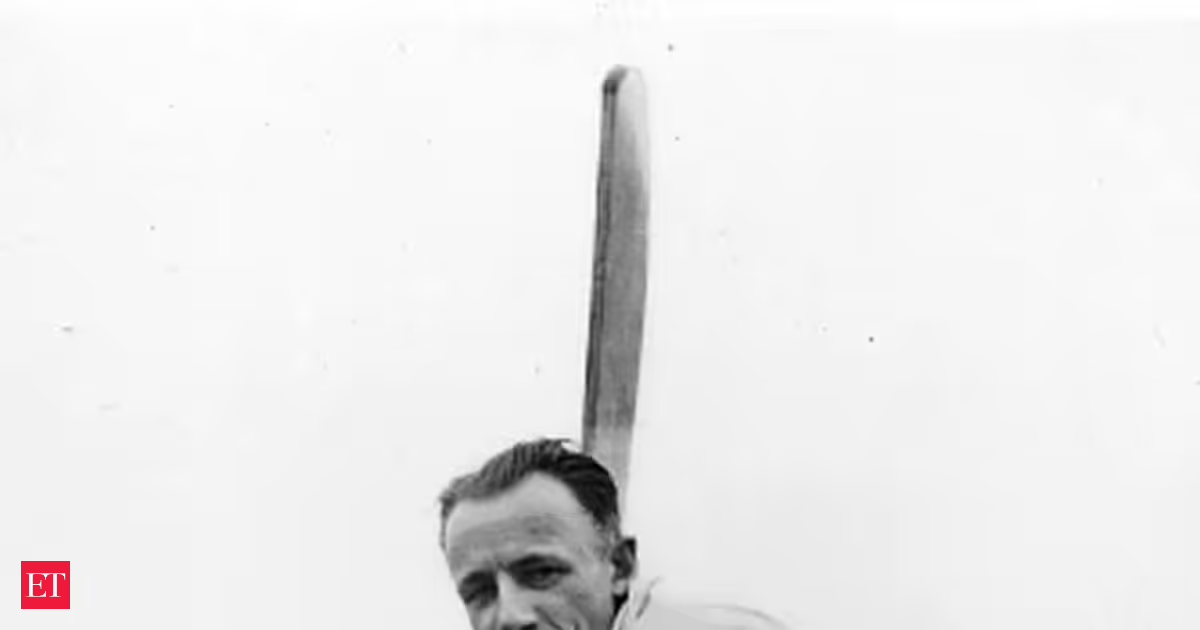
Whether in sports, business, politics, or everyday life, leadership is often tested not during moments of success but during periods of pressure and criticism. A leader must make difficult decisions, inspire confidence, and accept responsibility when things go wrong.Few people understood these challenges better than Sir Donald Bradman, widely regarded as the greatest batter in cricket history. Quote of the day: “A good captain must be a fighter; confident but not arrogant, firm but not obstinate; able to take criticism without letting it unduly disturb him, for he is sure to get it - and unfairly, too.”The quote remains a timeless lesson on leadership, resilience, and emotional balance.Who was Don Bradman?Donald Bradman, often known simply as "The Don," was born on August 27, 1908, in Cootamundra, New South Wales, Australia. Raised in the small town of Bowral, he developed remarkable hand-eye coordination as a child by practicing with a golf ball and a cricket stump, a training method that later became legendary.Bradman made his Test debut for Australia in 1928 and quickly established himself as a batting phenomenon. Over a career that spanned two decades, he rewrote cricket's record books and set standards that remain unmatched.His career Test batting average of 99.94 is widely regarded as one of the greatest statistical achievements in any major sport. To finish with a perfect average of 100, Bradman needed only four runs in his final Test innings in 1948, but was dismissed for a duck by Eric Hollies, leaving the famous average at 99.94.Bradman scored 6,996 runs in just 52 Test matches, including 29 centuries. During the 1930 Ashes series in England, he amassed a then-record 974 runs in a single Test series, a record that still stands. His dominance was so complete that England devised the controversial "Bodyline" tactic during the 1932-33 Ashes to restrict his scoring.As captain of Australia, Bradman led one of the strongest teams in cricket history. The 1948 Australian side, famously known as ‘The Invincibles’, completed an undefeated tour of England, a feat never repeated.In recognition of his contributions to cricket, Bradman became the first Australian cricketer to be knighted. Even decades after his retirement, he remains the benchmark against which cricketing greatness is measured.What this quote meansAt its core, Bradman's quote describes the delicate balance required for effective leadership.A leader must possess confidence because people naturally look to leaders for direction and reassurance. However, confidence can become arrogance if it is not tempered by humility. Similarly, leaders must be firm enough to make difficult decisions, yet flexible enough to adapt when circumstances change.Bradman also highlights another reality of leadership: criticism is unavoidable. Anyone in a position of responsibility will face disagreement, second-guessing, and judgment. In many cases, criticism may even be unfair.The deeper meaning The deeper lesson lies in Bradman's understanding that leadership is not merely about authority but about character.The qualities he describes are often contradictory. Leaders must project strength while remaining approachable. They must make decisions confidently while accepting that they do not have all the answers. They must defend their convictions without becoming stubborn.Bradman's advice ultimately points toward emotional maturity. Great leadership requires resilience, self-control, and the ability to remain steady under pressure.Why the quote remains relevant todayAlthough Bradman spoke in the context of sports, his message applies far beyond cricket.Business executives, coaches, teachers, politicians, community leaders, and even parents face similar challenges. They must make decisions that others may question and accept responsibility when outcomes are uncertain.In today's world of instant reactions and social media commentary, leaders are often subjected to constant public scrutiny. Bradman's observation that criticism is inevitable, and sometimes unfair, may be more relevant than ever.
Quote of the day by Sir Don Bradman: ‘A good captain must be a fighter; confident but not arrogant, firm but…’ – Greatest batter on leadership, criticism and strength
Leadership faces its toughest tests during pressure and criticism. Sir Donald Bradman, cricket's greatest batter, understood this well. His quote highlights the need for confidence without arrogance and firmness without stubbornness. Leaders must accept criticism, even when unfair. Bradman's insights on character and emotional maturity remain vital for leaders today, navigating constant public scrutiny.
606 words~3 min read