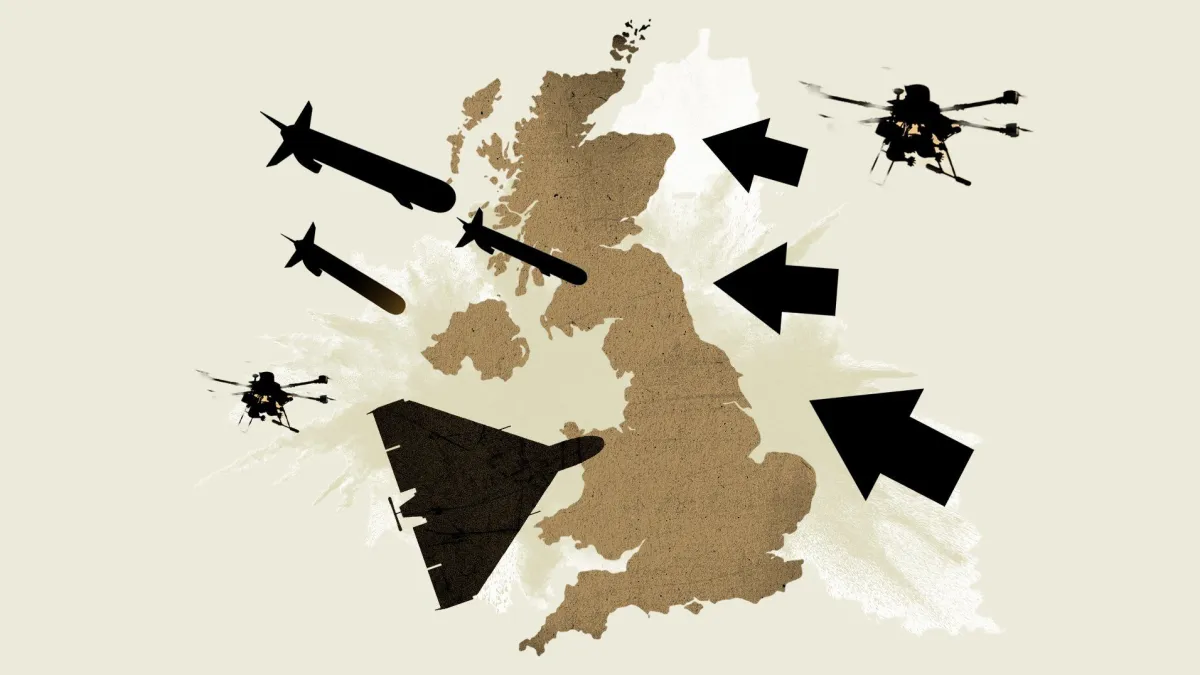
Not for generations has Britain faced the scale of the threat that menaces us today.Iran, which has already targeted our overseas bases, may already be able to reach London with hypersonic missiles, while Russia probes our defences weekly. At home, we have Chinese spies targeting Parliament, undefended borders and homegrown Islamists flexing their muscles.And yet the nation still awaits the Ministry of Defence's much-delayed ten-year Defence Investment Plan (DIP), which Westminster sources now say could be published this week.The DIP was supposed to swiftly follow Lord Robertson's milestone 'strategic defence review' last summer, which called for a £68billion investment in the Armed Forces. Although this amounted to only about a fifth of the annual welfare budget, the Government has failed to stump up the cash.After decades of assuming America would protect us, our Armed Forces resemble what Air Marshal Edward Stringer, former director-general of joint force development, calls a 'bonsai military': miniature, complex to maintain – and not great in a storm.In lieu of the Government's failure to produce a plan, I have interviewed multiple former and current senior military officials to ask the question: how could we begin to build back our military?According to them, the key lies in combining cutting-edge technology and cheap, mass-produced equipment, with an emphasis on AI and drones. This must be complemented by sufficient personnel.Make no mistake, this is the job of a generation. But here is what it might take to make Britain a serious fighting nation again...Royal Navy At the heart of the Navy – indeed, at the very core of our national security – lies our Continuous At-Sea Deterrence (CASD), which is armed with the Trident nuclear system. Currently, this takes the form of four creaking Vanguard-class submarines from 1993.Their replacements, the super-stealthy Dreadnought-class ballistic and nuclear submarines, are being built by BAE Systems in Barrow-in-Furness and are due to enter service from the early 2030s. A weapon of last resort is vital – but it is only one element of undersea warfare.To deter Russia in the North Atlantic and China's presence in the Indo-Pacific, Britain's fleet of smaller attack submarines, which do not carry nuclear weapons, must be expanded.On paper, we have seven Astute-class vessels, but shockingly, due to repairs and crewing backlogs, as The Mail on Sunday reported yesterday, none is currently deployable.To meet our obligations under Aukus (our trilateral security agreement with Australia and the US), we need up to 12 nuclear-powered subs. This would allow two or three to serve in the Euro-Atlantic and one in the Indo-Pacific, while the rest undergo maintenance.Similarly, our two aircraft carriers have become little more than prestige platforms.Only last week, HMS Prince of Wales had to limp into a Norwegian port due to a mechanical issue with her propeller shaft – the same problem that has plagued her sister ship HMS Queen Elizabeth.Maintenance cycles, crewing and aircraft availability must all be radically improved.If the Navy is to avoid sending our carriers to war with a mere 'token force' of jets, their 20 combat-ready F-35B Lightnings, Britain's short takeoff and vertical landing carrier-based strike fighter, must be expanded by 70, which would include a vital 'surge margin' (reserve capacity).Greater emphasis must be placed on drones in the Navy, too. Smaller unmanned vehicles such as the AeroVironment RQ-20 Puma, an ultra-light, scouting unmanned aerial vehicle (UAV) that can be used at sea, should be a baseline for all ships, as should the Peregrine or Wasp rotary drones.A handful of these are already in service, but the fleet must be expanded at least five-fold.Ukraine's Maritime Autonomous Guard Unmanned Robotic Apparatus (Magura) V5-types, which cost about £200,000 each, have damaged or destroyed many Russian warships along with their first person view (FPV) drones and loitering munitions.The Royal Navy entirely lacks this capability – a failing which must be urgently addressed.In addition, we need 30 larger, fixed-wing Vixen autonomous aeroplanes, which are launched from carriers and can carry out strikes, and 25 Proteus autonomous helicopters, which can conduct anti-submarine operations.Beneath the surface, the Excalibur Extra-Large Uncrewed Underwater Vessel, a mammoth artificial intelligence-driven submarine weighing 19 tons, can conduct endurance warfare and autonomous surveillance. The Royal Navy needs 20 of these; at the moment, it has only one. This weekend the Mail on Sunday revealed that all five of the UK's current fleet of Astute subs were currently not deployed due to maintenance and other technical issues Meanwhile, the traditional frigate remains vital for anti-submarine warfare and escort duties. Our current fleet of just ten Duke class vessels is weak, especially as only a small number are operational. To make matters worse, the ships, which date back to 1989, are due to be replaced more slowly than they are retired, creating a gap.As a rule of thumb, three vessels must be in maintenance for every ship at sea. Advances in technology mean that we might not need to return to the 60 frigates we had during the Cold War, but we must build back to a fleet of at least 28.A minimum of two KV Svalbard-style icebreakers are needed if our ships are to face Russian submarines in the High North.Similarly, our six ageing Type 45 destroyers should be doubled to 12. The humiliating story of HMS Dragon, which took weeks to deploy to the Gulf in March before being forced to limp off for repairs a few weeks later, must never be repeated.Our minehunters, meanwhile, are being phased out in favour of drones, which means the Royal Navy has been forced to deploy new, high-tech technology that has never been stressed at scale to assist with minesweeping in the Strait of Hormuz. Whether or not drones are the way of the future, the Navy needs eight minehunters as a reliable fallback. To rebuild our amphibious capability, in addition to our two ageing Landing Platform Dock vessels, we need two amphibious assault ships that can carry helicopters.In terms of personnel, the Royal Navy has about 29,000 sailors and officers, 6,000 Marines and about 5,000 reservists. In order to command, crew and service the new vessels and reinforce our industrial base, about 5,000 people must be recruited and trained – a lengthy and costly affair – and our pool of reservists must be doubled.Last but not least, the sailors of the Royal Fleet Auxiliary (RFA), the civilian support arm of the Royal Navy, have long been undervalued. Not only are many of their vessels elderly and inadequate, but tomorrow, RFA officers will stage a 24-hour walkout as part of a bitter and long-running dispute with the MoD over pay.ArmyThe war in Ukraine has shown the importance of developing battlefield drone technology. Britain is a long way behind.At present, the Army is retiring its fleet of Watchkeeper WK450 deep surveillance drones, which are operated by the Royal Artillery, in favour of the smaller and more numerous Corvus. And it is introducing the more tactical Stalker VXE30 and Indago 4 systems, as well as the Black Hornet micro-scout drone, which is small enough to fit in the hand.On the ground, it also has the T7 Multi-Mission Robot, which can be used for bomb disposal, and the throwable Dragon Runner, useful for detecting explosives. Taken together, we would need to quadruple our existing stockpiles of all of these to be battle-ready. Kyiv's defence against Russia has shown the importance of scalable, mass combat unmanned aerial vehicles, also known as strike drones – controlled at platoon level. Like the Royal Navy, the Army lacks these entirely, as well as the industrial capacity to replace them.To get us started, we would urgently need 8,000 cheap, domestically produced first-person-view attack quadcopter drones for use at short range; 1,200 American Switchblade-300 anti-personnel loitering munitions – 'loitering' systems often refer to 'suicide drones' that crash into targets – 480 Switchblade-600 anti-armour loitering munitions; and 100 Israeli Harop deep-strike loitering systems.As important as autonomous weapons, however, are boots on the ground, as the million Ukrainians under arms demonstrate. In 1989, at the end of the Cold War, the Army had a corps of four divisions, of which three were armoured. Today, after decades of exploiting the 'peace dividend' we have 73,000 regular troops in just two divisions, only one of which is a high-intensity combat formation (the other is light infantry).This means we would struggle to field even one warfighting division, as our full Nato duties would demand, especially as a second is needed for rotation.Only our Special Forces have not been cut to the bone.Restoring our credibility would mean adding at least one heavy division to the Army, which would mean recruiting 30,000 new soldiers. But this is no easy task.'The reductions have made us a tactical army, not a sovereign one, as Nato has to do the operational planning for us,' said analyst Andrew Fox, formerly a Major in the Parachute Regiment and a lecturer at Sandhurst.'Ever since the cuts of 2021, we have been unable to field a serious division. This is huge.'It means we lack independence in decision making in an era when allies are unreliable.'It costs up to £70,000 to train one British infantryman. Recruiting more reservists would carry costs of its own. The defence review suggested more cadets and open days to boost numbers of volunteers. But given our demoralised military, and the fact that according to recent polls, half of Britons say they would not fight if attacked, this is a cultural mountain to climb.Then there is the expense of restoring mothballed infrastructure, as well as providing arms and equipment.Britain's standard infantry rifles, the L85A3 and the older L85A2, have largely shaken off the disastrous reliability and design flaws of their SA80 predecessor. They are not fully ambidextrous, however, making them awkward for left-handers and cumbersome to reload.A full replacement programme is expected within the next five or ten years, which is likely to see British troops moving to a modern AR-15 derivative or hybrid. Replacing our 166,000 rifles would cost up to £1.5billion. British Army 3 Rifles soldiers use a phone-sized electronic screen display, which forms part of the Android Team Awareness Kit (ATAK), at an undisclosed training ground less than 50 kilometres from the Russian border in Finland on May 26, 2026An expanded Army would need vehicles. Shockingly, no modern, fully equipped and maintained British mechanised division is 'in readiness'. On a good day, about 40 ancient Challenger 2 tanks and 150 Warrior infantry fighting vehicles (IFVs) might be deployable. Yet we need at least one credible armoured regiment.If Britain is to field a war-fighting division, we would require 80 Leopard 2A8 tanks to complement the 148 Challenger 3 tanks on order; at least 400 more IFVs; and a fleet of armoured support vehicles from the Nato-friendly Leopard 2 system.The benighted Ajax tank project, that is costing over £6.3billion, remains severely troubled by ongoing safety hazards. A parliamentary public accounts committee report published on the weekend found that soldiers have been instructed to mitigate issues by conducting maintenance checks each time the vehicle stops. As the report concedes, this absurd proposal demonstrates how unlikely it is that Ajax will ever be battlefield ready.In terms of artillery, we have at our disposal only some 100 L118 light guns and even smaller numbers of AS90 self-propelled howitzers, as our donations to Ukraine have not been replenished. Similarly, our rocket artillery is strong on precision but weak in volume.We need 150 Boxer-mounted, remote-controlled Howitzer 155s as well as almost triple our 35 combat-ready M270 multiple launch rocket systems to give our forces proper deep-strike capabilities. Finally, we need a massive increase in munitions, including hundreds of thousands of 155mm shells and thousands of rockets.Andrew Fox echoed the salty observations of other commanders. 'Scaling back up again is far harder than cutting, even if there was the political will,' he remarked. 'We are completely f****d.'Royal Air ForceAs on land and sea, so in the air: the RAF's situation is woeful.The defence review suggested creating a new RAF, complete with F-35s, upgraded Typhoons, next-generation fast jets, and autonomous fighters to defend Britain's skies, but the glacial pace of procurement means planes are often out of date before they roll off the assembly line. According to General Sir John McColl, former deputy supreme allied commander of Nato: 'You end up with equipment that blows your budget out the water and doesn't work.'Air Marshal Stringer explained: 'We have decided we will only go to war in an American-led coalition, so we buy lots of bling kit that we can show off, like F35s and aircraft carriers, and hope the Americans will provide the glue to hold it together.'In reality, we need affordable mass as well as sophistication. This would require an arsenal of 200 cheap, long-range, heavy drones based on the Ukrainian FP-5 Flamingo which cost about £400,000 each. These new Flamingo equivalents must fit into a framework that includes 300 MQ-28 Ghost Bat 'loyal wingman' drones that support warplanes. At mid-tier, we need about 1,000 UAVs – and at the cheaper end, we need 8,000 loitering drones for saturation warfare.It's worth remembering that in Ukraine, cheap attack drones are used against enemy air defences, punching a corridor for bombers and heavy drones. When it comes to conventional manned aircraft, the RAF has no stealth bombers, which have caused such devastation in Iran and would form the tip of the spear in the Taiwan Strait if China attacked there, according to US wargames. Two squadrons of American B21s would do the trick. We need to expand our fleet of F-35Bs to 90, as discussed above.In 2021, our order of five E-7 Wedgetail Airborne Early Warning and Control aircraft was cut to just three, leaving just one deployable. This was a grave mistake; the Wedgetail is designed as the 'brain' of the Air Force in combat, able to detect the enemy at long range and coordinate aerial battles. Having only one in operational readiness presents a serious combat vulnerability.That order, the delivery of which is expected to commence later this year, should be cranked up to seven.Our stockpile of airborne munitions must also be massively increased. We need about 8,000 Advanced Medium-Range Air-to-Air Missiles (Amraams) and 2,000 longer-range Meteors, a high-end air dominance munition, in addition to 1,000 Storm Shadows, the RAF's deep-strike weapon of choice, which has been used to great effect in Ukraine. Completing the arsenal are 20,000 cheap glide bombs and 10,000 small-diameter bombs.Finally, RAF personnel must be increased by 15 per cent across a range of roles, with a further 5,000 reservists recruited.Air Defences Worryingly, aside from American air defences on the Continent, our skies are unprotected. In contrast, Israel has a sophisticated system, with an Iron Dome, David's Sling and Arrow 3, as well as the upcoming Iron Beam (a futuristic air defence laser), while Britain's equivalent, Dragonfire, is still in development.In April, Air Vice-Marshal Philip Lester demanded that the Government restore relations with Israel to help address gaps in our air defence capabilities.During the Cold War, nine Bloodhound surface-to-air missile installations defended vital sites around the country. Withdrawn in 1991, they could be replaced with Franco-Italian SAMP/T batteries, which fire Aster missiles, the same as our T45 destroyers. These cost about £400million each.In addition, the heart of London must be protected from big munitions, such as ballistic missiles, with at least four batteries of American Terminal High Altitude Area Defence (THAAD) systems, at £1.4billion apiece.
Revealed: Just how defenceless we would be if Putin DID attack Britain
Not for generations has Britain faced the scale of the threat that menaces us today. What are the biggest shortfalls in the UK's military capabilities? And what will it cost to get us back on track?
2,555 words~12 min read