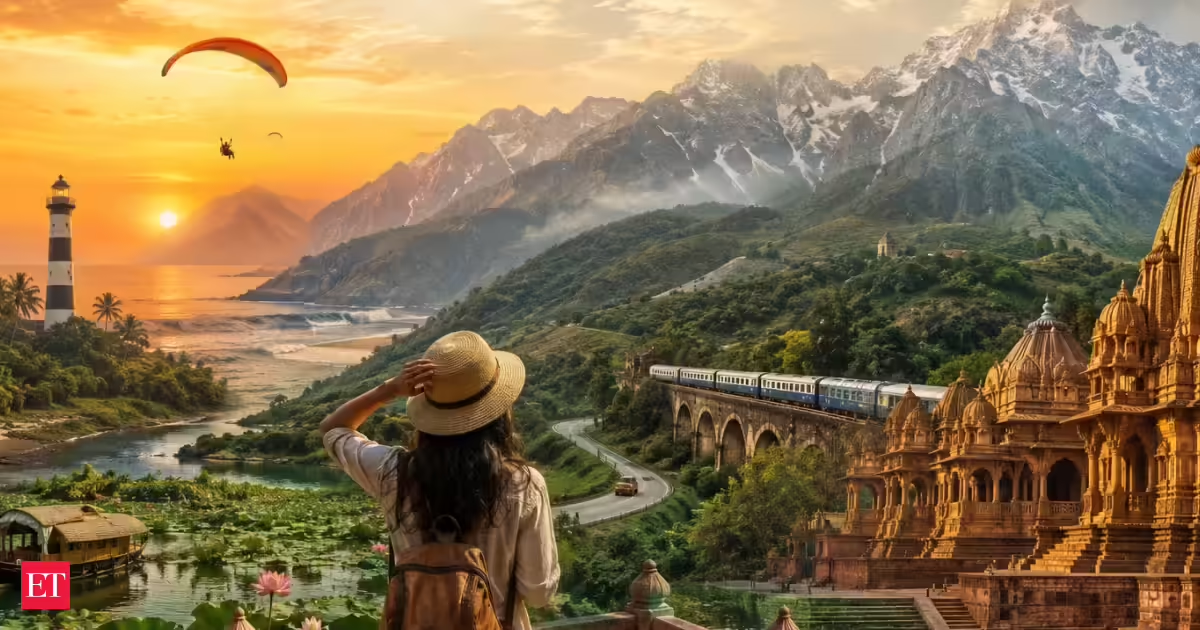
The US war on Iran has disrupted global supply chains, driven up energy prices, and intensified pressure on India's current account. Tourism is one of the fastest ways to earn forex and create jobs at scale.Unfortunately, over the last four years, India's overseas tourism marketing budget has been cut to near-zero. Result: in 2024, India recorded 9.9 mn international tourist arrivals, still roughly 10% below its pre-pandemic peak. While every major competitor has stormed back past 2019 levels, this country's still looking for an exit.Economics of tourism marketing are not subtle. A foreign tourist contributes $3,000 to India's GDP each visit, compared with $75 from a domestic traveller. An investment of $200 mn in overseas marketing will attract 1 mn additional foreign tourists, generating $3.6 bn in economic value, $400 mn in GST receipts, and 2.83 lakh new jobs.That is 18x return on every marketing dollar deployed. A mere 55,000 additional tourists-0.5% of India's current visitor base-would fully recover the marketing outlay. These are not projections. They are what the original 'Incredible !ndia' campaign delivered. Data from peer countries makes a stronger case: Malaysia spent $70 mn on tourism marketing in FY24 and saw international arrivals grow 31% to 27.3 mn, with tourism revenue rising 37.5% to $22 bn. Thailand spent $120 mn and delivered 26% growth in arrivals to 35.5 mn visitors, with revenues up 34% to $48 bn.Brazil spent $90 mn and grew arrivals 22%. Saudi Arabia welcomed 30 mn tourists and generated $41 bn in tourism revenues.The US, spending $240 mn through Brand USA, with 90% directed to digital channels, reports a $25 return for every dollar invested.Transformation of global travel is being driven by digital tech. This is precisely where India's absence is most costly. Today, 78% of all tourism sales happen online, 70% of bookings are completed on mobile devices, and 45% flow through online travel agencies. The battlefield has shifted to YouTube pre-rolls, social media algorithms, programmatic display, and influencer networks - channels where spend is measurable, targeting is precise, and ROI is trackable in near real-time.India has the raw infra but has failed to activate it. Incredible !ndia's social media presence-1.9 mn FB followers and 785,000 on Instagram-generates embarrassingly low engagement relative to peers. Saudi Arabia, with a similar follower count, generated 27 mn content views in a single month, compared with India's 3,88,000. The platform exists. India has been largely absent from global tourism marketing for almost a decade. This is costing the sector heavily.India must also deregulate tourism in mission mode. Hotels, restaurants, homestays, transport operators, and adventure providers face overlapping licences, renewals, and inspections. Projects completed in 18 months in competing Asian destinations often take far longer in India, driving up costs and eroding competitiveness. Unified licences, risk-based compliance, digitised processes, and automatic renewals should be implemented.A destination is not tourism-ready merely because it has attractions, roads, hotels, or signage. It is demand-ready when travellers can discover what makes it distinctive, assess its credibility, book experiences easily, transact seamlessly, and trust that the experience will meet expectations. Increasingly, tourism competitiveness will depend on whether destinations are creator-friendly, searchable, bookable, and trusted online.India must also treat the creator economy as a strategic tourism asset. Official campaigns generate awareness; creators generate trust. A credible traveller's video can often achieve what a brochure cannot.India's tourism proposition has never been stronger or more distinctive. The challenge is not discovering its potential but unleashing it. Tourism is one of the fastest ways to generate large-scale, geographically distributed employment. It earns foreign exchange without tariffs, trade disputes, or long gestation periods, while supporting MSMEs, women, artisans, farmers, transporters, and young entrepreneurs. It strengthens the rupee, broadens the tax base, and projects India's story to the world.(Disclaimer: The opinions expressed in this column are that of the writer. The facts and opinions expressed here do not reflect the views of www.economictimes.com.)
To bring the world, sell India better: The $200 million fix India needs to unlock a tourism windfall - The Economic Times
India's tourism sector faces challenges due to a near-zero overseas marketing budget. This has kept international arrivals below pre-pandemic levels, unlike competitor nations. A strategic investment in digital marketing and deregulation can unlock significant foreign exchange, job creation, and economic growth. India's tourism potential is immense, but it requires activation.
644 words~3 min read