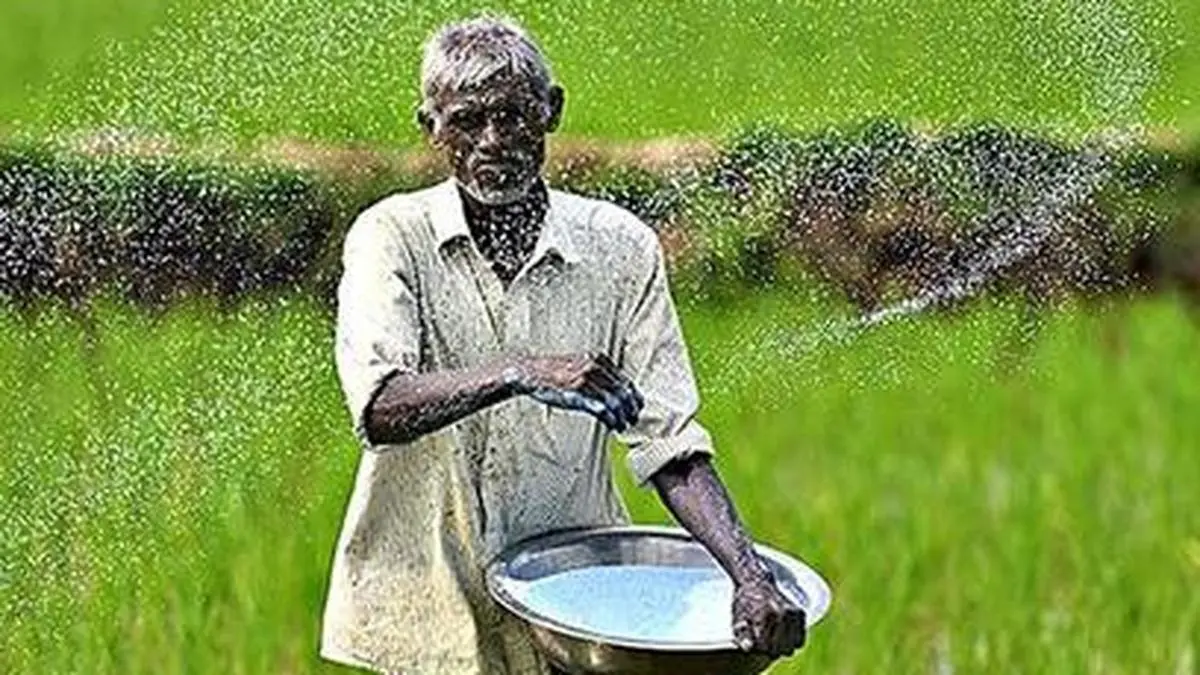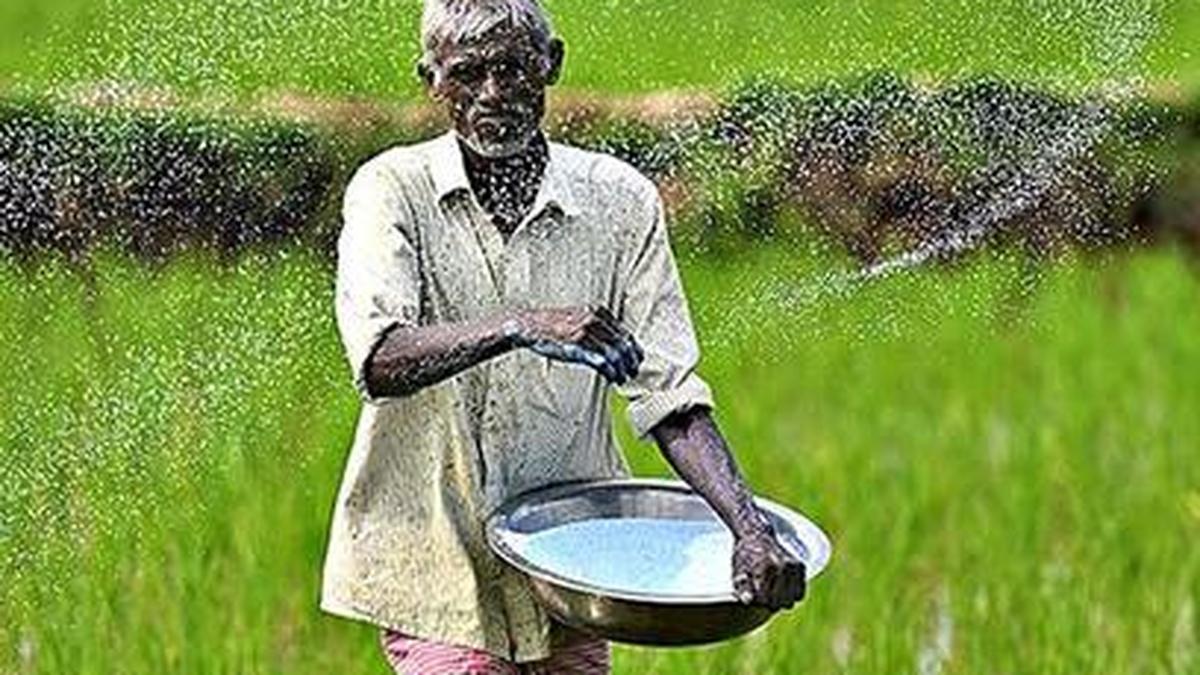
A farmer spraying urea on his paddy crop on the outskirts of Hyderabad
| Photo Credit:
Fertilizer sales data from March–April 2026 reveals a massive, unseasonal spike in fertilizer consumption that has exposed the structural fragility of the government’s land-record linked subsidy scheme. Following the outbreak of the US-Israel conflict against Iran, which severely disrupted global crop nutrient supply lines, farmers across major agricultural states like Maharashtra, Haryana, Punjab, Uttar Pradesh, and Karnataka engaged in intense panic-buying.In Haryana alone, Urea sales skyrocketed by 80 percent to 1.71 lakh tonnes (lt), while Di-Ammonia Phosphate (DAP) sales more than doubled to 0.37 lt compared to the same period last year.This sudden surge has largely undone the government’s highly touted victory of a pilot project achieved during the 2025–26 Rabi season. A successful pilot scheme in Haryana had previously restricted subsidized sales based on land records and crops sown, cutting Urea consumption by 1.26 lt and saving the exchequer over ₹700 crore in only one season.However, the post-war supply shock demonstrates that rigid, digitized demand-side rationing breaks down under market anxiety, failing to insulate domestic agriculture when critical geopolitical corridors are compromised.The government recently claimed it a success in Haryana when there was saving of nearly 3.4 lakh tonnes (lt) 2025-26 – 1.5 lt in Rabi and 1.9 lt in Kharif -- under a pilot scheme after farmers were sold the subsidised fertilizers based on their land records and crops sown.Under the pilot in last Rabi sowing season in Haryana, Urea consumption declined by nearly 1.26 lt and DAP consumption by 23,489 tonnes between October 8, 2025 and February 18, 2026, compared to the corresponding period of the previous year, resulting in an estimated subsidy saving of ₹700.53 crore, the government had told the parliamentary standing committee.The trend extended far beyond Haryana, with official data showing a widespread surge in both Urea and DAP sales across multiple states. Even in regions like Gujarat and West Bengal, where Urea sales experienced a marginal decline, panic over global supply lines triggered a massive run on phosphate-based fertilizers, with DAP sales skyrocketing by 71 percent and 77 percent respectively.The Department of Fertilizers had previously informed the Parliamentary Standing Committee that the pilot project was still in its early stages and would undergo an independent evaluation before any potential national rollout. Highlighting the data driving these reforms, Fertilizer Secretary Rajat Kumar Mishra noted in January that while 65 percent of Indian farmers purchased only 5–7 bags of Urea annually during 2024–25, 163 high-consumption districts accounted for a disproportionate 22 lakh bags (between 1 and 1.8 lakh tonnes) each.He underscored the policy’s early promise by citing a major Kharif 2025 breakthrough in Haryana, where consumption dropped by 1.2 lakh tonnes for Urea and 72,000 tonnes for DAP within just four months.By linking landholding sizes and specific crop choices directly to maximum fertilizer allocations, the government has consistently pushed for this technology-driven solution to curb the chronic issue of imbalanced crop nutrient application.Published on June 7, 2026