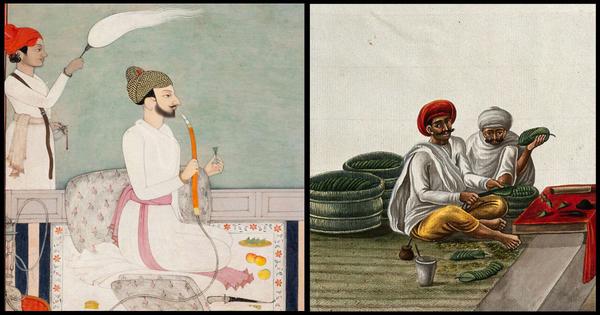
The 18th-century portrait of an East India Company official, by the artist Dip Chand, contains a detail that one might easily miss. The ornate hookah with its coiled pipe is obvious as the Englishman, likely to be William Fullerton, reclines on a richly carpeted platform, as Indian attendants, two of them holding fans, stand around him. But placed prominently before Fullerton is a pāndān, a spittoon and vessels, likely containing lime, areca nut, or aromatics, arranged with deliberate care. A rosewater sprinkler and itr container complete the ensemble. These objects signal that chewing paan was an accepted component of elite sociability. Credit: Dip Chand (artist), Public domain, via Wikimedia Commons.The spittoon, within easy reach, acknowledges the bodily process associated with paan while containing it within the codes of courtly decorum. In pre-colonial artwork of the late 18th and early 19th centuries, paan appears across canvases as an integral element of courtly culture and elite status. In these images, the paraphernalia associated with paan – the betel box (pāndān), spittoon (pīkdān) and implements used to prepare the leaf – are part of a carefully ordered constellation of objects that structured elite social interaction.Paintings and written accounts from the pre-colonial years show that European travellers to the subcontinent, growing in number as colonial ambitions expanded, were curious about social and cultural practices.Over the years, as colonial trade and exchange gave way to administrative control, English perceptions of hygiene, sanitation and conduct meant that paan was increasingly condemned by colonial officials as an unsanitary, “native” habit.Paan began to fade from social life and canvas, reflecting its trajectory from a practice of curiosity – that Europeans wrote of chewing and trying themselves – to an ethnographic detail and finally to a perfunctory observation.Paan in the royal courtsLike the image of Fullerton, a depiction of David Ochterlony, the British resident in Delhi’s Mughal court shows the pāndān and spittoon on the carpet while he smokes a hookah and watches a nautch performance. The painting seems like a deliberate attempt to capture the lives of “White Mughals”. However,the durbar scene with objects of leisure and opulence – the carpet, the nautch, hookah and the etiquette of paan – do hint at the significance of each of these seemingly innocuous objects. Credit: Public domain, via Wikimedia CommonsPaan is embedded in an environment of leisure and sensory refinement in both artworks. An early 18th-century painting of a courtly gathering shows writing implements, paper-trimming tools, floral offerings, and paan paraphernalia arranged on the carpet between the host and guests. Juxtaposing intellectual tools with objects of consumption signals a culture of etiquette in which conversation, hospitality and bodily pleasure were inseparable. Paan, in such images, is a part of sociability and cultivated leisure.
Paan once symbolised courtly status in India. Then it became an unsanitary, ‘native’ habit
Paintings and texts show that European travellers in the 18th-19th centuries were curious about the practice, accepting it as part of socialising.
1,636 words~7 min read