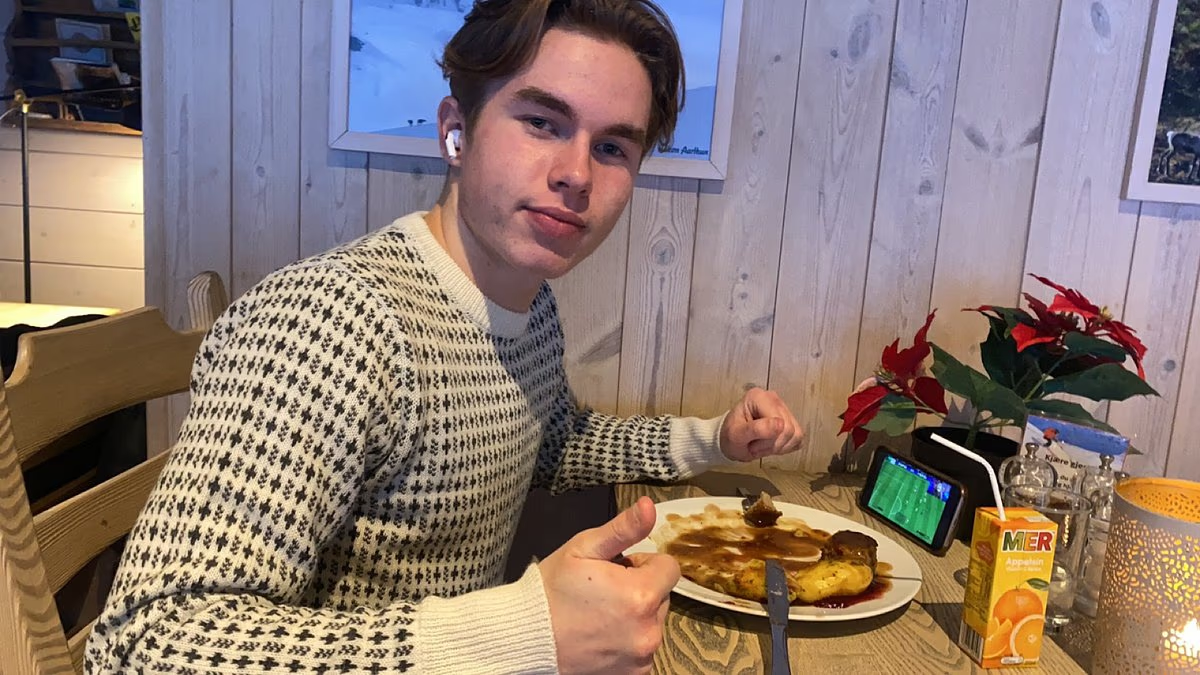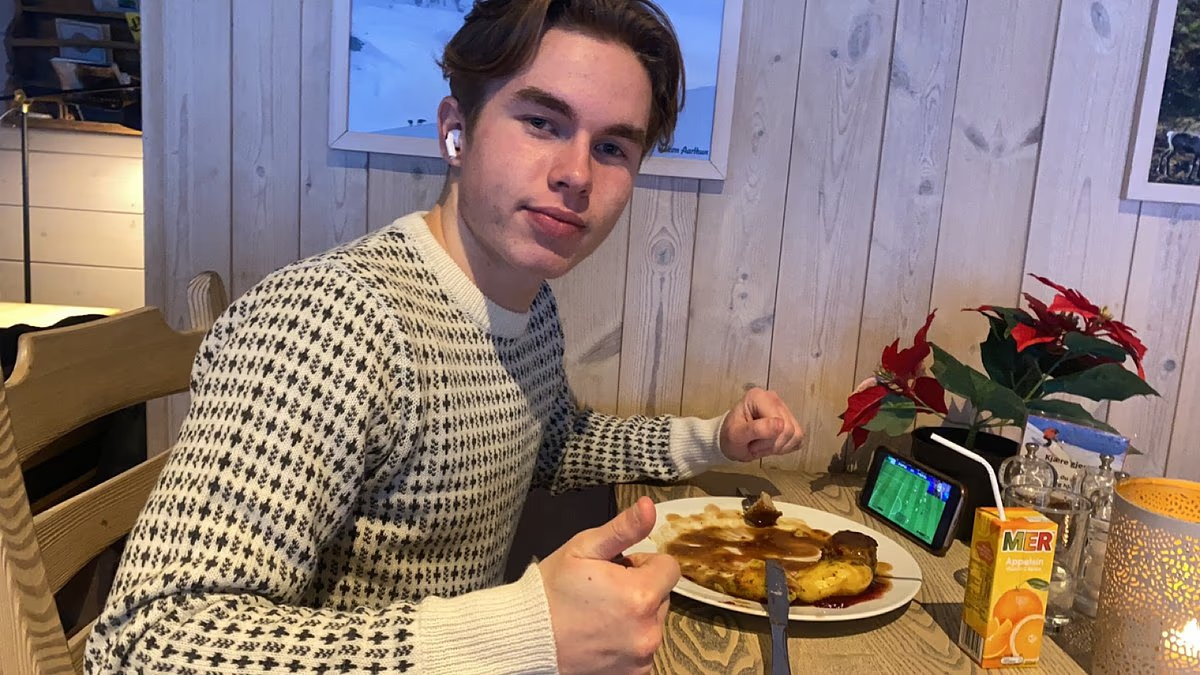
One late afternoon last September, a 17-year-old Dutch boy was just starting his homework in his family’s house in Rotterdam when there was a knock at the front door. When his father opened it, eight police officers wearing balaclavas rushed past him and stormed upstairs to the boy’s bedroom. They were there to arrest the teenager on charges of rendering services to a foreign country.The details that have emerged since have shocked both his family and Europe’s security community: the boy is accused of having been recruited by Russian agents on Telegram to spy on law-enforcement organisations in The Hague using a “sniffer” device, which intercepts wifi networks.Through interviews with police and intelligence officials in six countries across Europe and the Middle East, The Financial Times established that this 17-year-old is one of a growing number of teenagers who are being recruited online by hostile states for spying and sabotage.The boy – “an avid gamer who is good with computers”, according to an interview with his father in De Telegraaf – is now awaiting trial. His father, who described his son as “naive”, remains bewildered. “We raise our children to prepare them for all kinds of dangers in life: smoking, vaping, alcohol and drugs,” he told the Dutch newspaper. “But not for something like this.” Russia and Iran have long enlisted proxies to perform hostile acts on European soil, but targeting minors represents a new twist on their subversive gig economy.The tactic first emerged in Ukraine, where teenagers have been recruited online for sabotage, espionage and to spread propaganda. Moscow has since sought underage foot soldiers west towards Poland, the Netherlands and the UK. Tehran, spotting an opportunity to accelerate operations against Iranian dissidents in Europe and sow chaos in Israel, was quick to follow suit.“Hostile states are absolutely trying to target teenagers,” says Dominic Murphy, who stepped down six weeks ago as head of the London Metropolitan Police’s counterterrorism command, which oversees investigations into national security threats across England and Wales. “I was surprised by the scale of the challenge because it really seemed to come very suddenly, 18 months ago. I was then equally surprised by the volume of youngsters that were ready and willing to engage online ... and how quickly this was moving to real-world activity.”Ukrainian intelligence officials say 21 per cent of those arrested for collaborating with Russia in 2025 were teenagers. A significant proportion of the arrests made in connection with anti-Semitic attacks across Europe claimed by the Iranian-backed militia group Ashab al-Yamin – also known by the longer name Harakat Ashab al-Yamin al-Islamia, or Hayi – involve local perpetrators in countries such as Britain, France and the Netherlands who are under 18.The recruitments follow a similar pattern: young people are usually approached on online channels which are well hidden and hard to track: from Telegram to TikTok, Snapchat, Facebook and Discord. They are offered money, commonly cryptocurrencies, in exchange for completing tasks. Their recruiters depend on anonymity; many work for criminal groups which, like cyber hackers, may be independent from the state but co-opted by intelligence agencies for covert operations. Gaming sites – the most widely consumed entertainment media among 13- to 24-year-olds – have become an obvious hunting ground for potential saboteurs with a proven interest in problem solving.In Ukraine, the chat function in the popular online game World of Tanks is commonly used as a recruitment portal, from which agents then move the conversation to Telegram. Photograph: Getty Images In Ukraine, the chat function in the popular online game World of Tanks is commonly used as a recruitment portal, from which agents then move the conversation to Telegram. Some state-backed agents, especially those working for Russia, also invoke the mission format and “quest” mentality of online games to entice young people to move beyond the virtual battlefield to real-world action. It is, says one western military official, “like a game of Pokémon Go, but with air-defence systems”.Preventing minors from being drawn into this net has rapidly become a top priority for Europol, the European Union’s intelligence and crime-fighting agency. “We have a young generation which is slightly detached from their parents, that are educated online, often by social media or gaming platforms,” the agency’s director, Catherine De Bolle said in an interview conducted just before she stepped down from her post last month.“A young person who is still developing an ethical and moral compass, who hasn’t found their place in society, is psychologically more vulnerable to approaches by somebody who gives them attention, who gives them care, who engineers a way into their life and gains their trust,” she says.Yet the states view the teenagers they employ as disposable. There is little risk for them if the operations fail, and upside only if they succeed. Any connection to Russia or Iran is hard for European intelligence agencies to prove, and for the aggressor states, entirely deniable. The jeopardy lies with the recruits, such as the Dutch teenager, whose lives will be irrevocably changed if they convert online tasking into an actual mission.The result, according to police and intelligence officials, is that Russia and Iran are exploiting a generation of digital natives to further their aims in so-called hybrid warfare – the no-man’s land between peace and armed conflict.“The anonymity of the online environment gives [minors] the ability to engage in what they might see as edgy behaviour,” says one British security official. “They might not see the impact or real-world consequences.”A man walks past the headquarters of the Federal Security Service , the successor agency to the KGB, and Lubyanka Square in front of it in central Moscow. Photograph: Alexander Nemenov/AFP via Getty Images Just over a year ago, Ukrainian police arrested two groups of suspected Russian agents who were covertly photographing air-defence systems on the outskirts of Kharkiv. At first, this looked like standard espionage, directed by Moscow’s FSB spy agency to advance its conflict in eastern Ukraine. But the perpetrators were not Russian infiltrators or trained agents but local teenagers.The children, all aged 15 or 16, had been unwittingly recruited by the FSB to collect intelligence under the guise of a “quest” game – a citywide scavenger hunt in which participants compete to finish a list of challenges.They received geographical co-ordinates of the defence systems from their Russian handlers via a chatroom, according to details of the operation uncovered by Ukraine’s SBU intelligence agency. They were asked to travel to the area, take photos and videos and provide a description; Moscow later used this information to carry out air strikes on Kharkiv. Other tasks given to the groups included setting fire to Ukrainian military vehicles. SBU intelligence officials say that far from being the exception, Russia’s recruitment of minors, and even children – which began a year into the conflict – is now the norm. The Kremlin widened its net after Ukrainians who might previously have had some Russian sympathies became alienated by the war. Enlisting young Ukrainians had the benefit of destabilising the country internally, by co-opting the younger generation to subvert the national war effort.For Moscow, Ukrainian minors represent “the line of least resistance”, says Laura Brady, a Ukraine-Russia analyst at the Earendel Associates consultancy. “A younger person will be less curious, perhaps, about why they’re being asked to do something,” she says. “They’ll be cheaper to employ. There’ll be less caution about going through with an activity which might seem a bit odd. Children are fundamentally more impulsive.”Russian agents’ methods include positioning themselves as peacemakers. One SBU official describes how a Ukrainian teenager might be enticed to burn down local military recruitment offices and their vehicles on the basis that this would prevent their brother, father or other male relative from being forcibly mobilised into the army. According to the SBU, the youngest Ukrainians to have been recruited by Moscow were just 11 – one in Kyiv, the other in Odesa. These children, both boys, were tasked with burning cars and setting fire to electricity boxes in residential buildings. Older teenagers are typically given an escalating ladder of activities, akin to training. They might be asked to print anti-war leaflets and post them around their neighbourhood, then commit minor acts of arson, progressing to arson endangering life; and, finally, the construction and detonation of bombs. The results can be catastrophic, not least for the perpetrators. In March last year, in the western Ukrainian city of Ivano-Frankivsk, a 17-year-old boy died and his 15-year-old accomplice lost his legs after a bomb they had built exploded before they had reached their intended detonation site. The boys had been recruited by Russian agents on Telegram and offered $1,700 €1,470) to plant the device. SBU officials say they became unwitting suicide bombers, or what the Russian agents refer to as “single-use agents”.Teenage recruits can expect life-changing penalties if caught. Two 14-year-old boys who set off a self-made bomb near a police station in Kyiv three months ago at the behest of a Russian recruiter were swiftly caught by the SBU. Despite their ages – and the fact that no one was harmed in the attack – they face prison sentences of up to 12 years.The SBU now believes that Russia is scaling up its targeting efforts. Brady adds that young people who are successfully drawn into Russia’s sphere of influence are often challenged to recruit their peers through TikTok or Telegram or their gaming platforms, “so the recruits themselves are force multipliers”.A military police force member of Royal Netherlands Marechaussee stands guard near a Jewish school in Amsterdam following its reopening two days after an attack on the Jewish institution. Photograph: Jeroen Jumelet/ANP/AFP via Getty Images The first signs that Moscow’s hunt for young saboteurs was reaching farther into Europe were seen in the countries along Ukraine’s border.In Poland, teenage Ukrainians were caught spraying anti-Polish slogans on national monuments. In Latvia, Moscow has co-opted young people to distribute pro-Russian propaganda leaflets and to attack cars and buildings belonging to the Ukrainian diaspora. In Lithuania, a 17-year-old Ukrainian national, Daniil Bardadim, set fire to an Ikea store in Vilnius in 2024 on behalf of Russian security services. He pleaded guilty to arson and is currently serving a three-year prison sentence.Ukrainian intelligence officers, who have become adept at detecting the threat to minors, are now advising European allies on how to counter it. While Russia’s domestic intelligence agency, the FSB, was masterminding the approaches to Ukrainian teenagers, the GRU (its military intelligence directorate) and SVR (the foreign intelligence agency) are behind the operations to recruit minors further afield, the SBU believes.At the headquarters of Latvia’s VDD domestic security service in Riga, the agency’s director general, Normunds Mežviets, describes how Moscow’s agents guide novice recruits through a thicket of ever-riskier activities. The first task might be just to set fire to a car. “You need guts to do it at night time, when you are alone. You have to buy a liquid, to make this Molotov cocktail, then you have to look for the target, do some reconnaissance,” Mežviets says. “The risk is not very high, but there is lots of pressure. You are nervous about how to approach this target, you have to then run away, to hide yourself. It takes something from the person, especially if this person is not experienced.”Latvian saboteurs might graduate to targeting cars with Ukrainian number plates, then Ukrainian trucks, then set fire to a property belonging to a Ukrainian émigré. The next step would be attacking critical infrastructure – an army base, where there is a fence, surveillance and security staff. “By this time, you are emotionally and psychologically prepared to do it,” Mežviets explains. Often these more sophisticated attacks are reserved for older recruits in their 20s or 30s.Russian agents invent a range of cover stories to explain why a task needs to be done. “There is some kind of legend. They’ll say, ‘This is a bad person who owes money to someone ... so to punish him, here is €500. Why not burn down his car?’” says Mežviets.The VDD chief has little sympathy for those who are taken in. “If you are not a total blockhead, sooner or later you will understand very well what you are doing,” he says.Johannes Natland's passport, shown to the jury in the trial of Johannes Natland, a Norwegian teenager who it is alleged was recruited by a Swedish organised crime group used by the Iranian regime to murder someone in England. Photograph: Counter Terrorism Policing/PA Wire
Teenagers enlisted as agents of mayhem by Russia and Iran
Russia and Iran have long enlisted proxies to perform hostile acts on European soil, but targeting minors represents a new twist on their subversive gig economy
3,985 words~18 min read