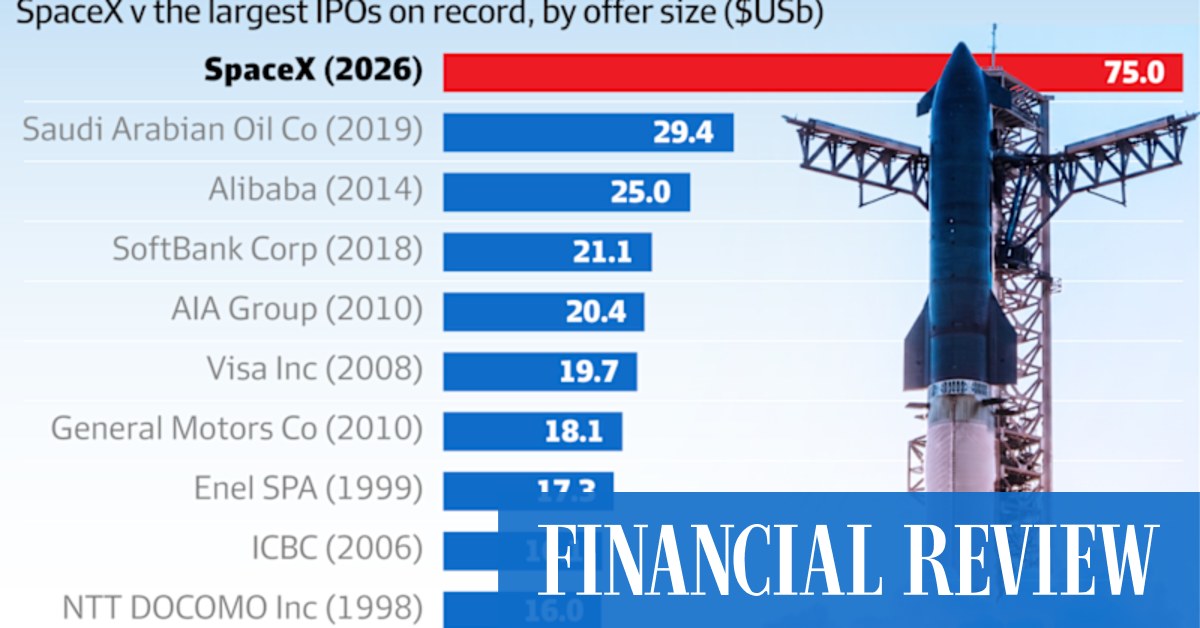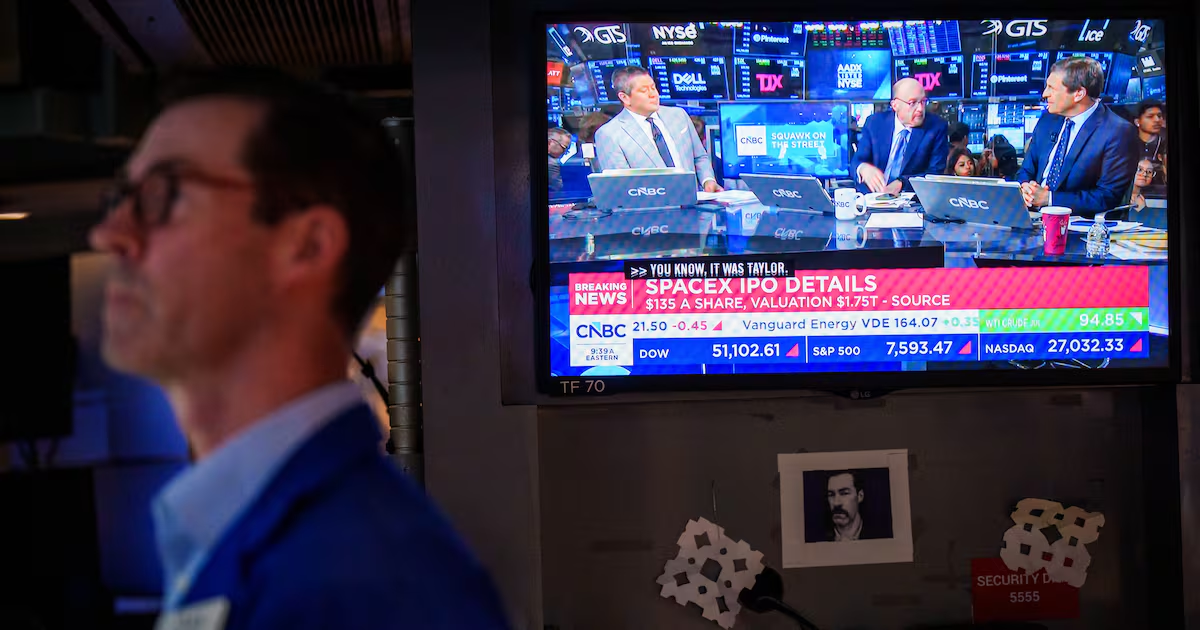
SINGAPORE - The prospect of blockbuster US listings by SpaceX, OpenAI and Anthropic dominated market conversations globally and in Singapore this week, with analysts warning that the trio's fundraising ambitions could soak up a significant amount of global investment capital and divert investor attention from other tech stocks.Sentiment already appears to be shifting, with US-listed AI names like Nvidia and Microsoft seeing a steep sell-off, and cryptocurrency Bitcoin falling below US$60,000, its lowest level in two years.In Singapore, the benchmark Straits Times Index also retreated, closing at 5,045 points on June 5, down from around 5,150 earlier in the week. Tech stocks listed on the Singapore Exchange also fell.Elon Musk’s SpaceX, which has priced its initial public offering at US$135 per share, valuing the company at around US$1.7 trillion, is widely expected to go public in June with the aim of raising US$75 billion in proceeds.The IPO would be the largest in the US stock market’s history and make billionaire Musk, who is already the world’s richest person and has majority ownership of the company, a trillionaire.Analysts warn though, that the SpaceX offering is looking overpriced.“We think the company has been significantly overvalued and investors will have opportunities to buy the stock at more attractive levels after the IPO,” Morningstar analysts wrote in a June 1 note. Meanwhile, Anthropic - the company behind AI chatbot Claude - said on June 2 that it had filed confidential paperwork with the US Securities and Exchange Commission (SEC) to go public, beating rival company OpenAI, which owns ChatGPT.The number of shares offered and the stock’s price have not been set yet, Anthropic said. “This gives us the option to go public after the SEC completes its review. The proposed IPO will depend on market conditions and other factors.”Confidential submissions allow companies to advance IPO preparations while protecting sensitive financial details from rivals and the public.The company’s filing comes days after it had raised US$65 billion in its latest funding round, putting its valuation at US$965 billion and ahead of OpenAI’s US$852 billion in March.OpenAI is also planning to go public in 2026, Reuters reported. Chief executive Sam Altman, in response to Anthropic’s announcement, said his company was in no rush to launch its IPO and will do so when “it makes sense”.Anthropic’s chief executive Dario Amodei, an OpenAI alumnus, set up the firm five years ago after leaving the firm due to disagreements with Altman. Their fierce rivalry in the AI world, stemming from the developments of similar technology, has sparked a global arms race for computing power and talent.Tech stocks in Singapore took a hit this week with sector favourites like AEM Holdings, Frencken Group and UMS Integration ending the week lower after enjoying a good run-up in their share prices.Singapore’s tech sector has seen a significant increase in investment from institutional investors since the start of 2026, leading to a huge rise in valuations.As at June 3, net institutional flows across the 49 technology stocks in 2026 totalled $582.5 million, according to the SGX.Investments were highly concentrated in 12 Singapore companies operating directly within the semiconductor production and testing chain, it said.The majority of these 12 companies are positioned in adjacent manufacturing, system integration, infrastructure, and software layers. They use semiconductors but are not involved in chip fabrication.This group includes the three most traded stocks in the sector this year: AEM Holdings, which has been re-rated on AI-driven demand for semiconductor test solutions; UMS Integration, which has seen stronger advanced packaging and semiconductor equipment demand; and Frencken Group, which supports operations in wafer fabrication, assembly and testing.As a result of increased global demand, consensus target prices have also risen about 80 per cent for AEM Holdings and 70 per cent for UMS Integration, while Frencken Group’s has gone up by about 30 per cent.Valuations of the three companies have surged, with investors willing to pay between 13 and 189 times their annual earnings for a stake in the businesses. Other companies that have seen their valuations increase include Nanofilm Technologies International, Micro Mechanics and InnoTek.SGX said InnoTek’s valuation has risen sharply from 14 times earnings to 85 times earnings as investors increasingly view the company as a beneficiary of the AI boom.The precision engineering firm has been gaining exposure to the AI server supply chain by supplying components used in server racks and related infrastructure, while expanding its production capacity to meet growing demand.SGX said the 12 semiconductor production companies are currently valued at an average of about 50 times their annual earnings, although the typical company in the group trades at around 32 times earnings,The exchange also noted that there is a growing base of advanced manufacturing companies in the region that are scaling and moving closer to going public. These companies, particularly across semiconductors, electric vehicles and automation industries, are capital-intensive and increasingly require long-duration funding for capacity, automation, and research and development.Public markets therefore are a natural next step in their growth cycle, it said.Semiconductor‑linked, precision engineering and AI hardware companies are more likely to list, as their earnings visibility and institutional participation are already established.The Indonesian rupiah slumped to a record low on June 4, falling through the key psychological level of 18,000 per US dollar and underscoring investor concern that persistently high oil prices are straining the country’s finances.Psychological levels are the price thresholds that draw significant market attention and often provoke a price reaction when tested.As at June 5, the rupiah had fallen 7.6 per cent to the Singdollar to date in 2026, trading at 14,046 per Singapore dollar. Against the US dollar, it has depreciated around 8 per cent to date.The weakening of the rupiah is fuelled by high dollar demand caused by the spike in oil prices and a narrowing trade surplus. Brent crude prices climbed through the week, hitting the week’s highest of US$88.43 per barrel on June 3.This also sent the benchmark Jakarta Composite Index plunging. Already on a decline since January and down about 35 per cent in 2026, the world’s worst performing major global equity index closed 8.7 per cent lower than the previous week.On June 4, Bank Indonesia confirmed it had stepped into currency markets, with the central bank likely to “increase the intensity of its interventions” to ensure orderly market functioning and maintain rupiah stability.The continual weakening of the rupiah has also stoked painful public memories of its collapse during the Asian Financial Crisis, when it fell from 2,500 to an all-time intraday low of16,800 per US dollar in June 1998.Meanwhile, the Japanese government has also vowed to take “decisive action” against excessive volatility, as the yen teetered on the key 160-per-dollar threshold.The yen has fallen 2.3 per cent against the US dollar since January. On June 5, it broke through the threshold for official intervention, falling to as low as 159.85 per dollar.Against the Singapore currency, it has also fallen 1.9 per cent to date, trading at 124.19 per Singdollar.Mainboard-listed Thomson Medical Group (TMG), which is controlled by billionaire Peter Lim, announced new leadership for its Singapore operations on June 1.Cassandra Loh, 36, currently chief commercial officer of Thomson Medical Singapore, will take on the role of acting chief executive officer on July 1. She will take over from Lee Suen Ming, 51, who will be stepping down from his role after close to three years.TMG’s filing with the SGX noted the reason for Lee’s resignation was to “pursue personal interests”.Loh, who joined the company in November 2025, will continue to oversee her chief commercial officer responsibilities, bringing closer alignment between the commercial strategy and overall leadership of the Singapore operations, the group said in a statement.Loh brings a strong mix of commercial discipline, healthcare experience, partnerships, operations and growth. She previously held roles in partnerships and hospital operations at healthcare organisations including Intellect, Cigna Singapore and IHH Healthcare.The leadership transition comes as Thomson Medical Singapore moves into the next phase of its transformation, following the foundational work initiated in 2022, it added.In recent years, the Singapore operations have expanded its healthcare specialties beyond its core business of fertility and maternity care, as well as paediatrics, to include orthopaedics, oncology, ENT, and general surgery among others.It opened its second fertility centre in United Square in May.Loh said: “My focus will be to work closely with our teams and partners to strengthen how we execute, grow with discipline, and continue building services around the real needs of patients and families.”Shares of TMG briefly fell on June 2 following its announcement, and closed the week 1.8 per cent lower at 5.5 cents.Del Monte Pacific on June 2 submitted a group capital and financial recovery plan to regulators in the Philippines and Singapore to address its debt obligations, which totals about US$1.2 billion.The company is known for its canned and packaged fruits, among other food and beverage products.Its US subsidiary Del Monte Foods had filed for bankruptcy protection in July 2025. As a result, Del Monte Pacific recognised a full impairment loss of US$703.5 million on its investment, which led to a negative stockholders’ equity position.Under the Philippine Stock Exchange (PSE) guidelines, companies with negative equity are required to submit a formal recovery framework.Del Monte Pacific is listed on both the PSE and the Mainboard of the Singapore Exchange.The group also noted that its current liabilities exceeded current assets by about US$769.4 million. It said that its financial difficulties are structural rather than operational and do not affect its operations outside the US.Its restructuring framework spans four entity levels within the group structure, and will involve the refinancing and restructuring of Del Monte Philippines’ existing credit facilities.It will also restructure group-level loans to match its actual cash flow, as well as settle special investor shares at Del Monte Philippines.This will run in three phases from July 2026 to sometime in 2027.Shares of Del Monte Pacific remained flat when it announced its filing, and closed the week 3.4 per cent lower at 8.4 cents.Volatility is expected to persist in the coming weeks as investors reposition their portfolios ahead of SpaceX’s IPO, with both US and Singapore tech stocks likely to remain under close scrutiny. South Korea's technology-heavy stock market could also face further pressure as capital flows towards the highly anticipated listings.Meanwhile, uncertainty stemming from the conflict in the Middle East, now in its fourth month, is expected to continue weighing on markets. Oil and gold prices are likely to remain volatile, while the rupiah and yen could come under renewed pressure.The US, which this week saw job growth surge past expectations in May with the unemployment rate remaining steady, will be releasing inflation numbers for the same month on June 10.
Tech tremors: Overpriced SpaceX IPO roils markets, Singapore tech stocks not spared
Elon Musk’s SpaceX has priced its initial public offering at US$135 per share, valuing the company at around US$1.7 trillion. Read more at straitstimes.com. Read more at straitstimes.com.
1,772 words~8 min read