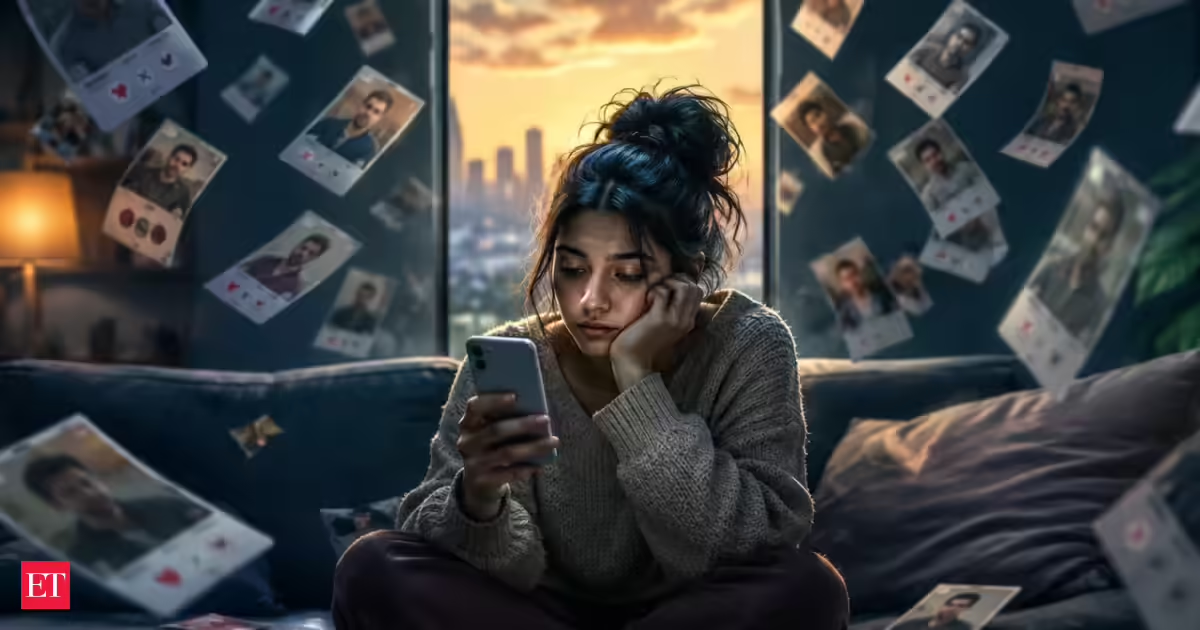
Kiara Aroda, 27, should not be single.At first glance, it makes zero sense that a woman like her armed with a master’s degree from a university with less than 5% acceptance rate, eye-watering tax returns, generational wealth and a “face card” that is consistently ranked “fire” on Instagram — should describe herself as “chronically single”. In desi marriage mafia-speak, she is a catch. And yet, her last meaningful relationship was almost five years ago. “My besties and I are going to Bali to celebrate the fifth incel anniversary,” she says.Devang (name changed), 30, is in a somewhat similar situation. A first-generation entrepreneur from Pune, he is his middleclass community’s crown jewel. His annual income runs into seven figures. He reads extensively, travels often and geeks out on all things NASA. He’s been on dating apps since 2017 and, by his own estimation, has been on at least 200 first dates. Still, Devang has yet to experience the delights (and disputes) of a committed relationship — a crucial one being physical intimacy. He does not believe in casual sex and is, therefore, a virgin. “I’ve been cruelly mocked at as an incel. At one point, I seriously considered hiring an escort just to get it over with,” he admits.Also Read: Dating in the time of AI: Are you swiping right on a guy, girl, ChatGPT, or Gemini?Technically, it’s true. Given that both are single and celibate but would prefer not to be, Kiara and Devang are involuntarily celibate or incel. Before we co-opted the word to mean the sexual entitlement and rage of men who loathe women for rejecting them romantically, the portmanteau belonged to the (now defunct) 1997 Involuntary Celibacy Project in Canada. It was a benign online forum for lonely people struggling to find love to speak freely without fear of ridicule.Kiara and Devang are also part of a growing cohort of young people experiencing romantic loneliness, despite almost every advantage to the contrary.According to a 2025 survey by Paris-based dating app, Happn, 29% of Indian singles feel lonely. And 31% of Gen Z singles feel loneliness more acutely when not in a relationship.SWIPE, SPEND, SUBSCRIBEAs distressing an emotional state as it most often is, romantic loneliness is good for the economy. It’s got great financial potential, given that loneliness and social isolation were declared global public health threats by the World Health Organization in 2023. We are now able to shake our heads gravely over humanity’s shared struggle to perform the mating dance without seeming like pearlclutching, hand-wringing alarmists. All the while we don’t have the foggiest clue on how to fix the darn thing. And so we are throwing everything at the wall, hoping something will stick — dating apps (with over 100 million users in India, projected to cross $1,000 million in revenue by 2030) and matchmaking startups (more than 2,500, likely the highest in the world); platforms, professionals and coaches offering one-on-one romantic guidance; self-care, wellness, emotional and mental-health support tailored to one’s spending and subscribing capacity; community-building platforms and third spaces for real-life connections; digital tools and AI companions that simulate intimacy. The choices are endless, the results largely dubious.Yet, Indians swipe, spend, subscribe hopefully.I spoke to two dozen singles between 25 and 35 years for this story, including Tara, a 29-year-old CA from Chennai; Anant, a 25-year-old animator from Mumbai; Gunjan, a 34-year-old lawyer from Delhi; Kevin, a 28-year-old product manager from Bengaluru , Rimjhim, a 32-year-old interior decorator from Chandigarh and Samarth, a 35-year-old businessperson who lives between Surat and Dubai.All of them are active daters, hoping to find a long-term partner. Each one has spent years on a smorgasbord of dating apps: Bumble, Hinge, Tinder, Feeld, Raya, T he League, QuackQuack…. All have attended multiple singles mixers that cost `3,000-20,000, depending on the level of exclusivity. Three have bought subscriptions to personalised dating services and relationship consultants that cost between `50,000 and an astounding `8 lakh. They come from different social and financial back.Also Read: 39-year-old lawyer earning Rs 2 cr a year says she can’t find a husband. But as she revealed her ideal partner checklist, the internet was left stunnedgrounds, life circumstances and define “long-term partnerships” differently but all are exhausted of the “dating hamster wheel”, as Gunjan likes to call it, and “miserably lonely on the really bad days”, according to Kevin.“On the surface, we are doing everything to ‘solve’ loneliness. But how many of those choices are being made by us and made for us?” is the question Bengalurubased psychotherapist, Prerna Gupta, wants daters to ask and answer honestly. “When we scramble to try everything, we eventually spiral because everything feels outside of our control. Accepting your reality helps you realise that you do have agency and take responsibility for your choices,” she says. “For example: Once you realise that for whatever reason you can only dedicate two hours a week to finding someone, you can now decide whether you’ll spend that time on the apps or a mixer. You can also stop chasing people who can’t meet you where you are or who you can’t keep up with because of an expectation mismatch. Dating fatigue is intractable given our complex lives, and we can avoid a lot of misery once we stop feeling like we have no control.”HIT SINGLESKiara decided to take charge and make serious changes about two years ago. She’d rather be single and lonely once a week, than miserable all the time with the wrong person. “I realised I was low-key being a pick-me for super cringey men,” she says wryly. “I’d constantly downplay my success, answer sexist questions, and listen to men prattling on about their lives without any interest in mine. It was a weird combination of feeling grossed out that I’m doing this, but also helpless because ‘that’s just how heterosexual dating works’. Ew, right? Now I pour my affec- tion and energy into my girlfriends, who are my soulmates. I’m a sucker for love so I do hope to meet the right man someday. But even if I don’t, my life is already filled with love—it just looks different.”The 2020s have been a decade of bringing “main character energy” to everything in life, including dating. We’ve been assured, repeatedly, that it is okay to want what we want, to have preferences, to reject anyone for any reason without having our feelings (or lack of them) endlessly litigated.There is some merit to that. The right of rejection presupposes individualism and galvanises us into exercising the (often) atrophied personal agency muscle, especially in family-first, duty-bound cultures like ours. It also shocks society’s sensibilities with the radical idea that being single is not, in fact, a curse. And it dismisses marriage as a default for successful adulting. The assurance that it’s all right to have personal standards is particularly important for women, given that most of us have had lifelong training in minimising our needs, shrinking our persons and personalities, taking what and how much is rationed instead of articulating what we truly desire. Not to mention that there are, of course, some excellent reasons to be single: like when your dating pool is crawling with angry, mouth-breathing men who can’t fathom why the women they want to date refuse to coddle and cook like their mommies; or delusional women yas queening their way out of accountability.FANTASY CREATURESBut at what point does main character energy stop being a tool for self-priming and turns, instead, into the fuel that powers a theatre of exaggerated selfworth? We can reject anyone for any reason , but … should we? Especially when loneliness is the price we pay for it? According to Mumbai based clinical psychologist, V arkha Chulani, standards are great, but only as long as we hold ourselves to them, too. “The commitment of a relationship comes with some tradeoffs with individualism. But if every tradeoff feels outrageous and like we’re being cheated out of our birthright, it’s very likely that dating won’t result in the meaningful relationships so many folks think they want,” she says. “I don’t mean this as a moral science lecture but you have to ask yourself: What do I bring to the table? Why should the person I believe I deserve pick me? You may think you deserve the moon, but the harsh truth of life is that the world does not owe you anything.”Let’s go back to Devang. His single status has been a source of great frustration for him and increasing exasperation for his mother, who says, “I could get Devang married tomorrow, but have you seen his list of requirements? He will have to build such a girl in a factory because I doubt she exists in the real world.”Devang says his mother might have a point, “I suppose, I could compromise on how the girl must look.” What Devang really wants is this: a woman with a master’s degree, no older than 25, at least 5’4” but no taller than 5’6”, weighs 50-55 kilos, with long hair, dresses conservatively, earns at least a quarter of what he makes but ideally less than half, politically moderate with a slight lean to the right. She must also be in possession of a sharp, curious mind and a small friend circle — three-five close friends instead of lots of casual friendships. And, a virgin, of course. “Like me,” he emphasises pointedly.I’m starting to see his mother’s point about a factory-built wife for him. It is telling that a man of Devang’s substantial girth and limited vertical reach firmly believes that he deserves a tall, waif-like, virginal wife who is independent, but only as much as the guardrails that guarantee his comfort will allow. And that relaxing the rules feels like a compromise instead of a realistic adjustment of expectations anchored in what he brings to the relationship table. I suspect Devang might benefit greatly from the counsel of a friend who will say what others won’t: Why would a girl like that want to be with a controlling, insecure, objectifying, fat dude like him? More ruthless self-assessment and less me-me-me vibes might make Devang more attractive to the women he hopes to attract. It will certainly improve his chances at beating loneliness.DATING OLYMPICSLet’s also go back to the 24 I spoke to.One demanded a witty opening gambit because “(I’ve) got no time for dullards who can’t differentiate themselves from the crowd.” But witty is also an ephemeral quality—what’s witty on a lazy weekend evening can be cringey after a difficult day at work.For another, the style of messaging was a deal-breaker: “Long enough to know they are interested and intentional, but not so long that they seem self-absorbed or entitled to my time. Also, timing matters -- shorter messages in the day, longer ones at night. And voice notes once we’re talking somewhat regularly, but not so many that it starts to feel like over-familiarity.”One’s very specific requirement was that he be intimately familiar with all four phases of a woman’s menstrual cycle. One insisted that anyone they date must be fluent in therapy-speak. One spoke passionately about hard and soft social media launches, like having detailed strategies and schedules were perfectly normal rites of romantic passage. Another would not consider dating someone who had a Snapchat or Telegram account because “they’re for cheaters. I’m protecting my peace”.And then there is the terrifying ick— the sudden irreversible evaporation of attraction that can strike at any time; an unguarded moment of eccentricity that can so intractably grate on someone’s nerves that it undoes months of flirtation in a hot second.A compelling argument can be made that precise behavioural requirements are great proxies for personality traits one desires in a match. There is an equally forceful argument to the contrary: dating should be a challenging, but ultimately enjoyable, process of discovery; not a Takeshi’s Castlestyle obstacle course with body blows and sudden deaths.Tanya Sachdev, a counselling psychologist from Delhi, finds that the illusion of endless choice that dating apps afford their users is, paradoxically, crippling their ability to make one. “We set impossibly high standards while offering the barest minimum of ourselves because there’s always someone else a few swipes away. We bolt at the first sign of a challenge because dealing with someone’s baggage is hard work. And bolting is easier because we’ve hedged our bets before the conversation even starts. We talk to multiple people but in a detached, impersonal manner. It’s easy to dismiss someone without a twinge of regret or a pause of reflection when you are chatting with them while scrolling through Instagram in the middle of a dinner with friends. We think of compatibility like it’s magic, but actually the alchemy of connection is born out of understanding which comes from deep communication.”All of these mental calisthenics before one even gets to the actual messiness and murderousness of a committed, you’re-my-personand-I’m-yours type of relationship. Who is going to tell them that for all the endless screening, when (if?) they do find their person, it’s likely that some of their biggest relationship fights will still be over insipid nonsense like who should be given access to the family Netflix?I spoke to two dozen singles between 25 and 35 years. Each one has spent years on a smorgasbord of dating apps. All have attended singles mixers that cost `3,000-20,000. All are exhausted of the “dating hamster wheel”.What Devang wants is this: a woman with a master’s degree, no older than 25, at least 5’4” but no taller than 5’6”, weighs 50-55 kilos, with long hair, is politically moderate with a slight lean to the right and a virgin—like him.According to a 2025 survey by Paris-based dating app, Happn, 29% of Indian singles feel lonely. And 31% of Gen Z singles feel loneliness more acutely when not in a relationship.
Expired dates? Young Indians face dating burnout despite spending more on finding love
Amid the bustling life of young urban Indians, an ironic trend emerges: individuals thriving in their careers are still finding themselves romantically adrift. While dating apps promise a myriad of prospects, they frequently lead to more heartache than happiness. With an emphasis on looks and an all-consuming quest for perfection, the chance for real intimacy dwindles.
2,303 words~10 min read