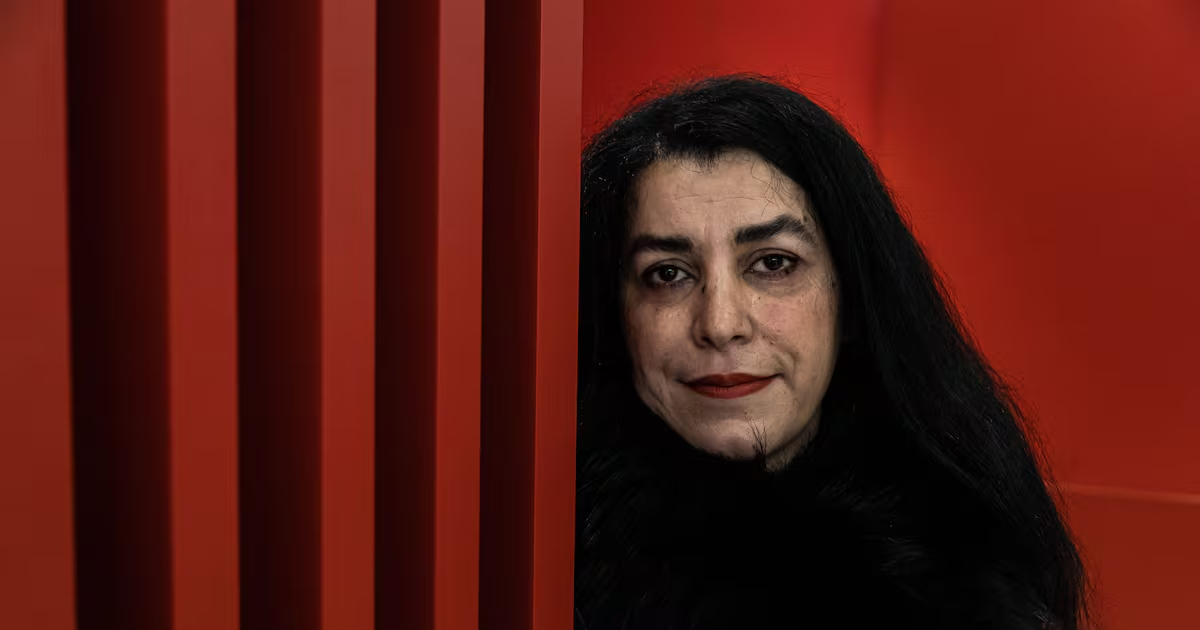
She died of sadness, her close ones reported. Marjane Satrapi had spent her entire working life insisting that sentiment was not the opposite of seriousness – that love, properly understood, was a form of intelligence about the world. The news reporting that she had died of grief after the death of her husband, the Swedish producer Mattias Ripa, confirmed that the maverick artist, wilful till the end, had earned the right to name her own death.A screenshot of her instagram profile, mourning the loss of her husband and longtime creative collaborator, Mattias Ripa.She is survived, of course, by Persepolis. The graphic memoir, first published in French by the small Parisian collective L'Association between 2000 and 2001, was later translated into English (in 2003 by Ripa and Blake Ferris), and in 2004 (by Anjali Singh). It has now achieved that peculiar afterlife reserved for books that become shortcuts for entire historical epochs. L'Association had built a reputation for avant-garde memoirs that disrupted Franco-Belgian convention, and the four French Persepolis instalments sold well enough to keep the collective afloat through difficult years.The covers of the original French editions of Persepolis. Credit: L’Association.The collected graphic novel (a term Satrapi famously rebuked) now instantly conjures an understanding of the 1979 Iranian Revolution, the Iran-Iraq War, the compulsory veil, and the so-called moral police. Its two volumes span a journey from innocence to experience premised on the claustrophobia of being a rebellious teenager in a regime that has flattened religious deference into state policy. This is an extraordinary burden for any book to carry in any age, and Satrapi, who drew herself as a girl named Marji with a mouth perpetually on the verge of insolence, never pretended otherwise. The book found its way to millions of readers across the globe, neatly slotting into and arguably globalising the American underground tradition of autobiographical comics that stretched from Harvey Pekar's American Splendor (1976–2008) to Art Spiegelman's Maus (1980–1991).The weapon of childishnessYou would never guess this from how she wielded the form. The black-and-white woodcut-simple cartooning that became her signature remained childlike in its economy throughout her comics, even in the rare splash page where she broke into the painterly lushness of the European bande dessinée tradition. “Before humans started talking, they started drawing,” she realised early on. Comics let her feel closer to what she remembered, remaking it all in her own image.Excerpt from Persepolis (2003-2004) by Marjane Satrapi. Credit: Pantheon Books.What the average reader was not prepared for, in those early years after the English translation appeared, was the humour. The impish, irreverent, morally inconsistent Marji became the lens through which the arc of history was refracted. Tehran in her eyes refused to exclusively become a site of ceaseless tragedy or misery. The regime was rigid and terrifying but it was also a city where her parents threw parties with contraband alcohol and debated the finer points of Marxist dialectics, where memories of her larger-than-life grandmother stuffing her bra with jasmine flowers dispensing worldly wisdom about the importance of not being vengeful against the regime coexisted. People fell in love easily, told jokes, listened to illegal ABBA tapes, and even complained about their mothers-in-law. To depict tyranny without also depicting the texture of everyday life that tyranny attempts to suppress is to concede victory to the tyrant. Satrapi refused to concede till the end.A lineage for Indian comicsThis defiance is what her work also bequeathed to the generation of Indian graphic novelists who came in her wake, a debt few hesitate to acknowledge. The Goa-based illustrator Pakhi Sen recalled first reading Persepolis as a young artist: “What drew me like a magnet was Marji herself – the sheer force of a self that felt so unfettered, honest, and spirited. Throughout the book, she responds to people, places and upheavals with a true fidelity to her own experience.”Sen pointed to the way Satrapi refused to be reduced to a victim: “The work itself is far more nuanced, intimate and expansive than that. Marji's relationships with God, family, politics, love, Iran, and France are expressed with extraordinary vulnerability and complexity.” That capacity to hold depth and levity simultaneously, Sen said, is a superpower: “When you speak from the heart, you give others permission to do the same. Persepolis did that for me.”[From left] Covers of the Kannada translation (Chanda Pustaka, 2022) and Hindi translation (Vani Prakashan, 2021) of 'Persepolis'. Indeed, it is difficult for this author to imagine Amruta Patil's Kari (2008) that haunted, watercolour-drenched exploration of queer desire and urban anomie – without Satrapi's precedent of the female autobiography protagonist who refuses to be boxed in. It feels impossible to read other modern classics like Malik Sajad's Munnu: A Boy from Kashmir (2015) or uneasily laugh at Orijit Sen’s many provocations without hearing an echo of Marji's bewilderment at a world that has decided, before she has had a chance to decide, that she belongs to one side of an unbridgeable divide. Similarly, the early satiric work of both Sarnath Banerjee (2004) and Vishwajyoti Ghosh (2010) draw on both Satrapi’s irreverence as well as her willingness to let the political erupt from the personal. Persepolis gave these cartoonists leave to effortlessly treat their lives as historical documents, preferably without the stifling, performative (read: literary) solemnity.The cartoonist Ita Mehrotra traces Satrapi's influence back to first encountering it two decades ago. “It first showed me the magic that can happen when words and images come together on a page to shape a language of their own,” she said, “not one that is flying into fantasy far away from this world, but one that reshapes how we see the world by carefully bringing together the personal and political one panel at a time.” In her own teaching and practice, she has returned to Satrapi's work repeatedly, using it to show students what the comics can do at their best in an increasingly polarising world: “tell anecdotes and stories passed down generations of a family, like in Embroideries (2005) and Chicken with Plums (2006) that seem to be just that, but also hold together the ethos, culture, political shifts and histories of an entire nation.”Excerpt from 'Chicken with Plums (2006). Credit: Pantheon BooksAnand Shenoy, who publishes the delightfully bizarre Zoo (2020–present) comics anthologies, notes how Satrapi's life also eventually came to mirror her own comics. “In Chicken with Plums, the protagonist Nasser Ali decides to die when he sees that the love of his life has forgotten him,” he said. “In a heartbreaking way Satrapi's life mirrored that of her character.”For Shenoy, as for many of this emerging generation of artists, Satrapi's books provided the scope for what one could do with the medium. “Anyone who read her work in their adolescence probably carries her stories, and tries to achieve the beauty of her storytelling in some way,” said Shenoy.The secular liberal has a long history of demanding that dissident intellectuals from Muslim-majority societies perform a specific function: confirm prejudices, provide authentic testimony, and not complicate the narrative. The immigrant Satrapi felt the expectation of this role constantly. Should she speak about the veil in France? Should she speak about her own class position and its privileges: the elite Tehrani family, the French-language schooling, the parents who could afford to send her to Vienna at 14? What about the recirculation of regimes in West Asia and its imperialist repercussions across the world? Her answers, and how they changed in her work, have defined much of how her politics have been debated.From panel to screen and beyondWhat also distinguished Satrapi from almost every other cartoonist of her generation was her effortless command over filmmaking. The list of comic artists who have successfully adapted their own work is vanishingly small. Satrapi co-directed the animated Persepolis (2007) with frequent collaborator and friend Vincent Paronnaud. Their film won the Jury Prize at Cannes and an Academy Award nomination. Marji comes to life on screen but moves, is shot, and speaks differently from how she is on the page, acknowledging how different film can be as a medium that also weaponises spectacle. Rarely has a character had such a fluid life across transmedia adaptations, without one regime of depiction overpowering the other completely.
Goodbye Marjane Satrapi (1969-2026): Your graphic odes to unceasing rebellion are everlasting
The Iranian-French cartoonist and filmmaker who taught a generation how comics could be both confession and weapon recently died at 56.
1,896 words~9 min read