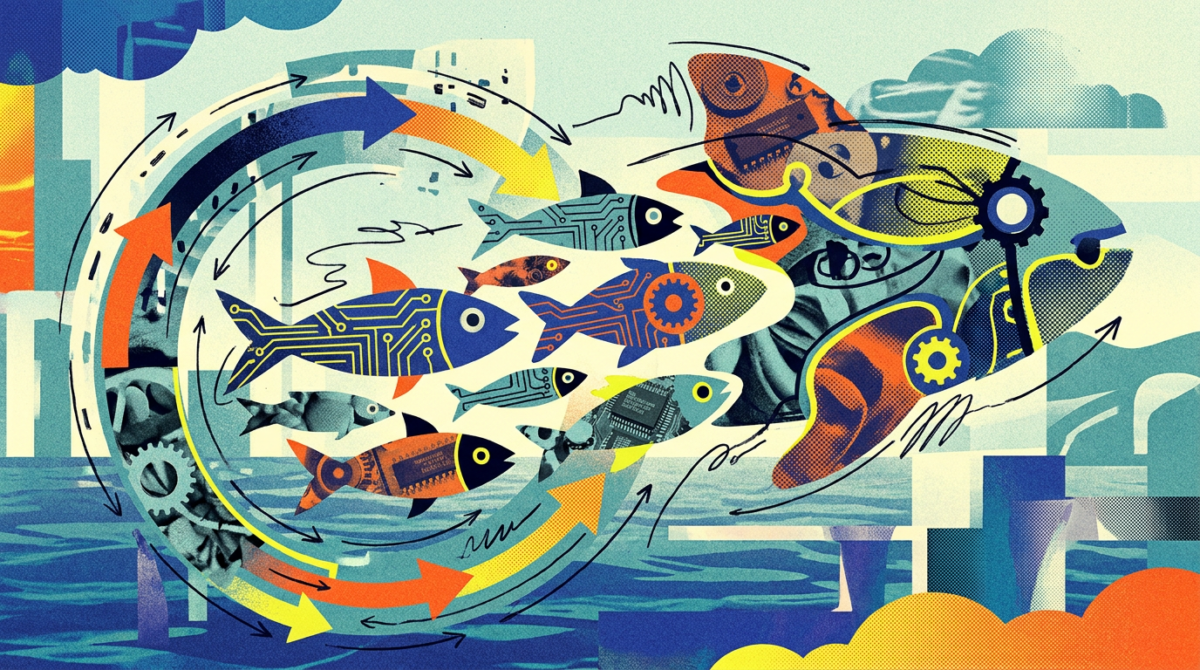
Sakana AI has launched a research lab focused on recursive self-improvement (RSI), the idea that AI systems can iteratively redesign and improve themselves, creating a compounding cycle of progress. The startup sees RSI as a potential way beyond the compute arms race.
Japanese AI startup Sakana AI has created a new research group exploring how AI can speed up and improve the development of new AI systems. The Sakana AI RSI Lab builds on the company's earlier work. Since its founding in 2023, Sakana has focused on evolutionary, adaptive AI systems and, more recently, on practical steps toward recursive self-improvement.
In its announcement, Sakana points to several research milestones from the past two years. These include LLM-Squared, where language models design better training methods for other language models, and the Darwin Gödel Machine, which generates, tests, and iterates on variants of its own codebase.
With ShinkaEvolve and ALE-Agent, Sakana also highlights work on evolutionary program optimization and agents that derive new strategies from trial-and-error loops. Another key project is The AI Scientist, a system for automating parts of scientific research. A later version wrote a paper that passed peer review, according to Sakana. The underlying research was published in Nature in March 2026.