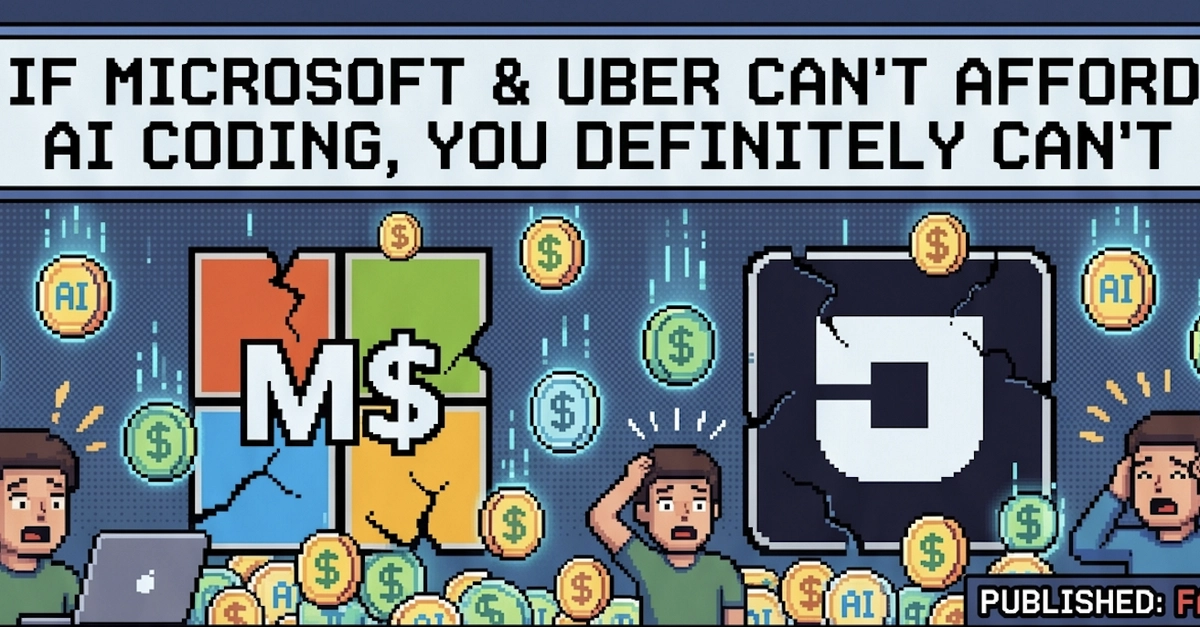
In December 2025, Microsoft opened the doors for thousands of its engineers to use Anthropic’s Claude Code — an AI coding assistant — as part of an internal experiment to benchmark the best tools available. That test worked too well as some employees decisively chose it over Microsoft’s own AI coding assistance — GitHub Copilot CLI.Then, by May 2026, the software giant began cancelling most of those Claude Code licences, instructing teams behind Windows, Microsoft 365, Outlook, Teams, and Surface to migrate back to Copilot CLI before June 30. That day is apparently the last day of the company’s fiscal year. While it has called this rollback a “toolchain unification,” the financial reality, per multiple reports, suggests that engineers had used Claude Code a little too much.This is the paradox of enterprise AI adoption in 2026. To understand this situation better, it helps to go down the memory lane on how software companies operated earlier. Before OpenAI’s ChatGPT arrived in late November 2022, the dominant tools in a developer’s toolkit were a code editor like VS Code, a version control system like Git, documentation wikis, Jira boards, Slack threads, and an occasional Stack Overflow lookup.Open-source and bounded productivityMost of these were open-source tools or flat flat-rate subscriptions that cost essentially nothing. An engineer could work all day without the company spending an extra rupee. Productivity was bounded by human typing speed and human thinking speed, and both of those were, if nothing else, fiscally manageable.Then came the chatbots like ChatGPT, Claude, Gemini, Llama, and a cascade of capable successors. GitHub Copilot, which had been available since 2022, gained significant traction as models improved. By 2024, engineering teams were routinely asking AI assistants to write boilerplate, review pull requests, suggest fixes, and generate test cases. As these interactions were short and mostly conversation, the costs were modest.But the arrival of agentic coding tools disrupted the way engineers worked as they didn’t just answer queries but took a series of actions. These AI agents could read files, run tests, check for errors, revise code, read the context again, and loop through all of this autonomously. Claude Code, Cursor, and their peers work this way.The “token maxxing” problemThe problem, which developers on Reddit and engineering forums have been vocalising for months, comes down to what is called “token maxxing.” Every action an agentic tool does consumes tokens — the unit of text a language model processes. And crucially, each new action in a long session carries the accumulated weight of everything that came before it.A session that starts at five thousand tokens per call can balloon to two hundred thousand tokens per call by the time the agent is fifty turns deep. As one detailed analysis documented, a developer who tracked token consumption across 42 agentic runs found that roughly 70% of tokens consumed were effectively waste. The agent was re-reading files it had already processed, exploring dead ends, and re-verifying things it already knew.The corporate toll of this wastage is becoming public in uncomfortable ways. Uber’s CTO Praveen Neppalli Naga disclosed that his company had exhausted its entire 2026 AI tools budget by April. Monthly per-engineer costs have also climbed to between $500 - $2,000.Accelerated bills and counter-perspectiveAn internal leaderboard that ranked teams by AI usage volume had accelerated adoption, which accelerated bills. Uber’s COO Andrew Macdonald, on a podcast, admitted that drawing a line between rising token consumption and actual consumer feature delivery was proving elusive. “That link is not there yet,” he said.An unnamed enterprise client, according to an AI consultant quoted by Axios, reportedly ran up a $500 million Anthropic bill in a single month after deploying Claude with no usage guardrails.But those who are heavily invested in the AI boom story are sharing a counter view. For instance, Nvidia’s Jensen Huang floated the idea that if an engineer earning half a million dollars a year was not spending a comparable amount in tokens, something was wrong.Box CEO Aaron Levie has argued that this is merely the start, and that the same token consumption problem will eventually spread from engineering into legal, sales, and every other knowledge-work function.Goldman Sachs, in a report released earlier this month, projected that global token consumption could increase 24 fold by 2030 as agentic AI becomes standard practice.It is unclear when these perspectives will converge. But, for now, it is clear that companies are becoming thrifty when it comes to token usage. Microsoft may frame its Claude Code license drop as a “toolchain unification”strategy, but the timing, landing precisely on fiscal year-end, speaks louder.Agentic AI tools are becoming an infrastructure cost that scales with every autonomous decision an agent makes. And organisations that do not implement usage controls, token budgets, and honest ROI benchmarks are not adopting AI, but are funding it.
How are organisations reckoning their AI addiction
Agentic AI tools are becoming an infrastructure cost that scales with every autonomous decision an agent makes.
798 words~4 min read