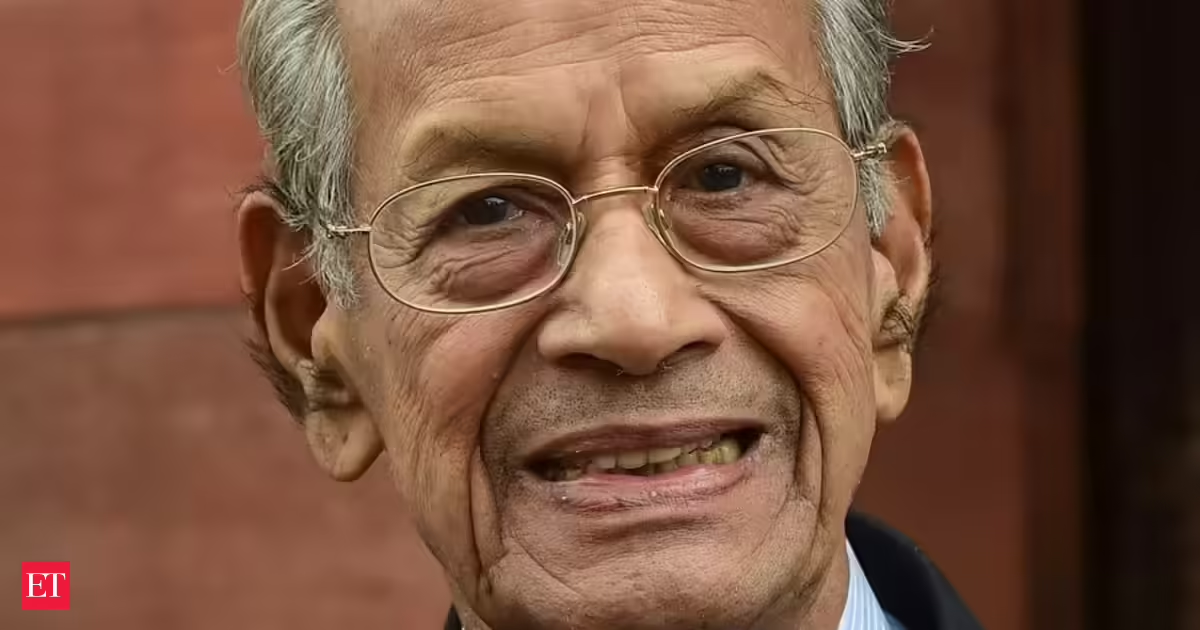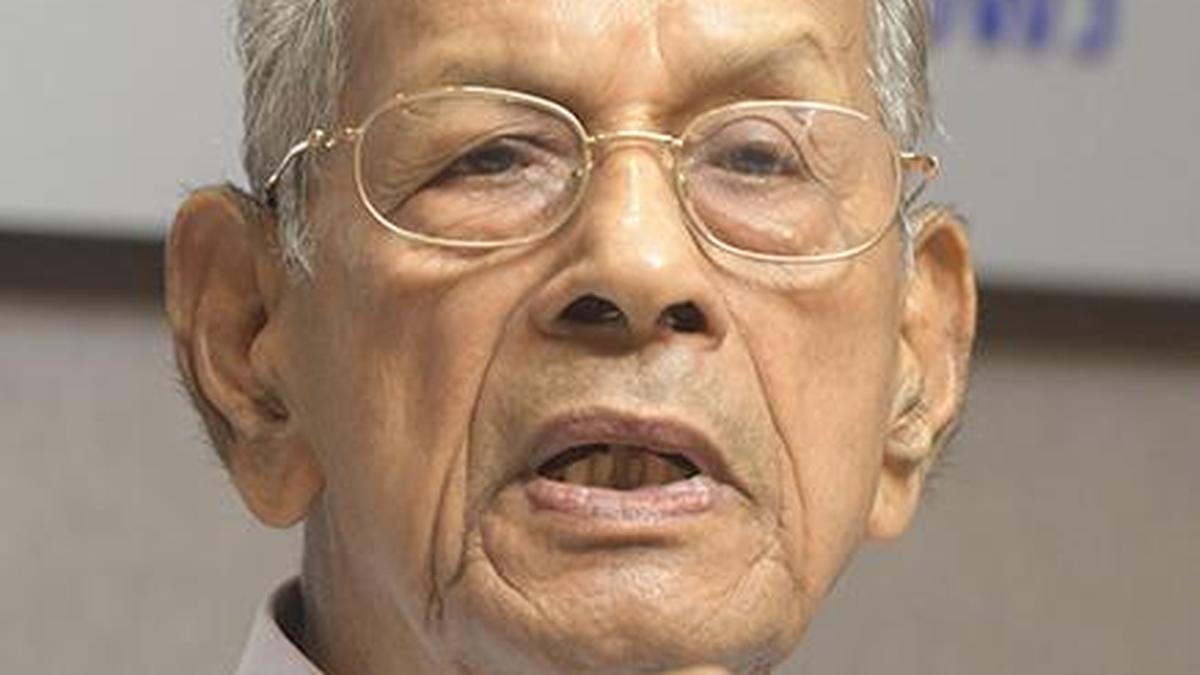
Veteran technocrat E. Sreedharan
| Photo Credit: K.K. MUSTAFAH
The Kerala government is considering a proposal submitted by the Delhi Metro Rail Corporation (DMRC) for a high-speed rail corridor linking Thiruvananthapuram and Kannur.The project, named Kerala High Speed Railway (KHSR), was prepared by veteran technocrat E. Sreedharan as an alternative to the previous Left Democratic Front (LDF) government’s K-Rail proposal.A four-member expert committee has been constituted to examine the technical, financial and environmental aspects of the project and submit its recommendations within three weeks.Transport Secretary K. Biju will serve as convener. J. Vinayan, C. Veeramani and Sreedhar Radhakrishnan have been appointed as experts in railways, finance and environment respectively. N.S.K. Umesh, officer on special duty to Chief Minister V.D. Satheesan, will assist the committee.A government order issued on June 5, 2026, said the panel would assess the project’s technical feasibility, financial viability, environmental impact, implementation challenges and socio-economic benefits.The proposed 473.2-km double-line corridor will connect Poojapura in Thiruvananthapuram with Mundayad in Kannur through 23 stations. The alignment will be elevated throughout, except for a 6.5-km underground section in Thiruvananthapuram city. Travel time between the two cities is estimated at 3 hours and 30 minutes.The standard-gauge corridor will serve three of Kerala’s four airports directly, while Kannur airport will be connected through a dedicated 10-km access road.According to the DMRC’s interim report, the use of standard gauge would permit a lower axle load of 15 tonnes compared with 25 tonnes on broad gauge, reducing construction and operating costs.The average distance between stations is 21.5 km. Trains will have a design speed of 200 kmph, an operational speed of 180 kmph and an average commercial speed of 140 kmph.Services will initially operate with 12-coach trains accommodating 800 seated passengers. Platforms will be designed to accommodate future expansion to 16 coaches.During the initial phase, trains are proposed to run every 20 minutes during peak hours and every 40 minutes during off-peak hours, with a daily carrying capacity of 54,400 passengers. Capacity could be increased to 2.28 lakh passengers a day through higher service frequencies. All travel will be on reserved seating.The project proposes acquisition of a 20-metre-wide corridor for construction. Surplus land may be leased back to original owners after construction, subject to specified conditions.The entire power requirement is proposed to be met through a captive solar power system, with surplus electricity supplied to the Kerala State Electricity Board (KSEB).Estimated costThe project cost is estimated at ₹60,000 crore. Of this, ₹36,000 crore is proposed to be funded through equity contributions from the Centre and the State in a 51:49 ratio, while the remaining ₹24,000 crore is proposed to be raised through crowdfunding. The average construction cost is estimated at ₹127 crore per kilometre.According to Mr. Sreedharan, the project can be completed within five years of approval.Future plans include extending the corridor to Kasaragod and developing branch lines linking Kozhikode and Kalpetta, Pattambi and Palakkad, and Thrissur and Palakkad. Published - June 06, 2026 02:20 pm IST