READ MORE: Analysis of 45 notorious murders uncovers four common traits See more Daily Mail on Google - save us as a Preferred SourceBy XANTHA LEATHAM, EXECUTIVE SCIENCE EDITOR Published: 09:05 BST, 6 June 2026 | Updated: 09:05 BST, 6 June 2026
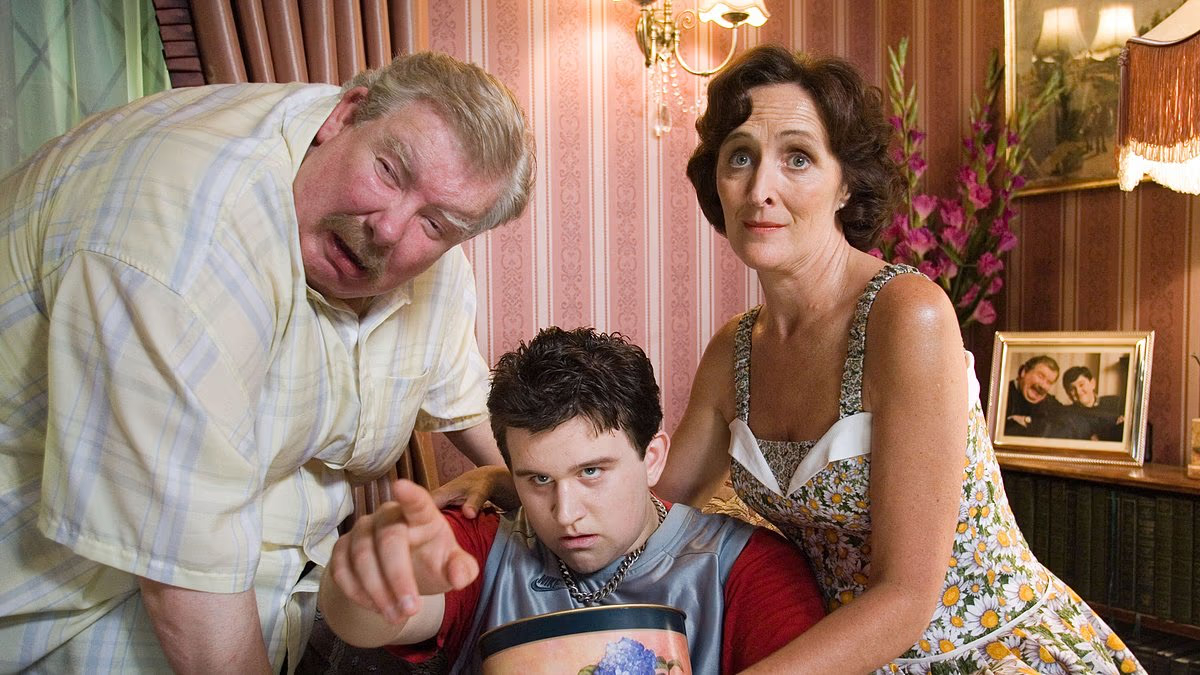
Many parents are guilty of spoiling their children. But a new study has warned that doing so could turn them into psychopaths.Scientists from Oakland University asked people to recall how much their parents spoiled them when they were younger.The results revealed that children who were overindulged grew up to display higher levels of psychopathic traits, such as being mean and aggressive.In contrast, participants who remembered being praised and encouraged by their parents were more likely to have more beneficial personality traits, such as feeling in control.'Our results indicate that perceptions of praise and indulgence are associated with most dark traits in opposite ways,' the team wrote in the journal Current Psychology.'Praise was linked with more socially beneficial characteristics, whereas indulgence was connected with more socially aversive ones.'The team said their findings 'offer a cautionary message about the risks of overindulging children' – as it suggests the building blocks of psychopathic traits begin in early childhood. Dudley Dursley, from the Harry Potter franchise, is the textbook definition of a spoiled child who was given virtually everything he desiredFor the study, the team asked more than 700 undergraduate students in the US to complete a series of online questionnaires.These had been designed to measure their memories of how their parents treated them during childhood, as well as their current personality traits.Analysis revealed being spoiled as a child was associated with higher levels of narcissistic antagonism, psychopathic meanness, and psychopathic disinhibition.This meant they were more likely to be overtly hostile, aggressive, extremely competitive, mean and act on impulses without thinking about the consequences.Participants who scored high for these traits were likely to agree with phrases such as 'It doesn't bother me to see someone else in pain' and 'My impulsive decisions have caused problems with loved ones.'Those who remembered having highly indulgent parents also reported lower levels of ambition and less forward planning.On the other hand, those who received lots of praise from their parents were more likely to have socially beneficial characteristics such as feeling in control and being confident.These children were also less likely to be hostile and impulsive. Veruca Salt is the most spoiled and demanding character in Charlie and the Chocolate Factory. Her defining trait - encapsulated in her iconic song 'I Want It Now' - is her entitlement 'The fact that high indulgence and low praise seem to predict higher levels of pathological traits and lower levels of the more positive traits points to the importance of providing children with affirming feedback without engaging in over-indulgence,' author Jennifer Vonk told PsyPost.The study concludes: 'These results offer a cautionary message about the risks of overindulging children – a practice often presumed to be widespread in contemporary Western societies.'Recently, a separate group of researchers revealed the jobs that attract the most psychopaths.For their study, a team from the University of Illinois at Urbana-Champaign enlisted more than 600 participants who were quizzed about their dark personality traits as well as their interest in eight career areas.People with psychopathic traits were more drawn to hands–on and practical work activities, they found.In terms of specific careers, this includes mechanics and engineers.WOULD YOU KNOW HOW TO SPOT A PSYCHOPATH? Psychopaths display different traits depending on their disorder.Common signs include superficial charm, a grandiose notion of self-worth, the need for stimulation and impulsiveness, pathological lying, the ability to manipulate others and a lack of remorse and empathy.But despite the popular association, not all psychopaths become killers.Experts claim people usually find psychopaths intriguing, but can't put their finger on why. This is down to incongruous behaviour because psychopaths tend to do a lot of acting to deceive, or mimic normal reactions, sometimes changing their views and reactions quickly.For example, Self-professed psychopath Jacob Wells said that upon meeting someone, he tries to become 'the most interesting person they know' and presumably adopts suitable interests and responses to do this.His response also gives away another common trait - a grandiose notion of self-worth - in that he can be the most interesting person in the room.Psychopaths occasionally tend to exhibit unconvincing emotional responses, with slip-ups including tone of voice or body language.This may be because they are unable to understand emotions such as fear and love, but can mimic them. Psychopaths display different traits depending on their disorder, but common signs include superficial charm and the ability to manipulate others. Despite the popular association, not all psychopaths become killers (stock image)Generally psychopaths' 'emotions' are shallow and short-lived and there is a manipulative ulterior motive to showing them.For example, Mr Wells said he offers to do favours and tells false secrets to people to gain their complete trust.He also displays insincere charm - another trait associated with psychopaths.He says: 'I keep secrets, and tell them fake secrets to further gain their trust, and once they trust me enough, I ask for favours, reminding them of the favours I did them. I can get literally anything from them, which is incredibly useful.'Psychopaths typically display an incredible ability to manipulate others and sometimes take pleasure in doing so. Psychopaths often have an air of superiority about them, perhaps shown by Mr Wells' belief he can spot other psychopathsEven expert Dr Hare, who came up with the Hare Psychopathy Checklist-Revised (PCL-R) used as a diagnostic tool to determine where someone lies on the psychopathy spectrum, warns that anyone can be duped during a short interaction with a psychopath.