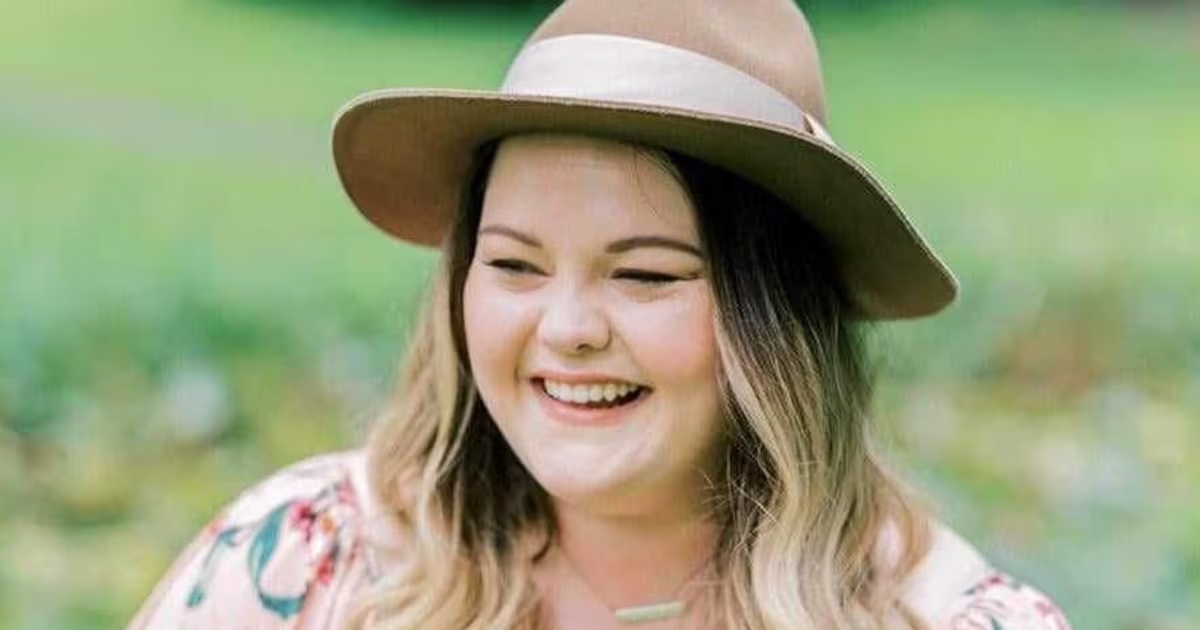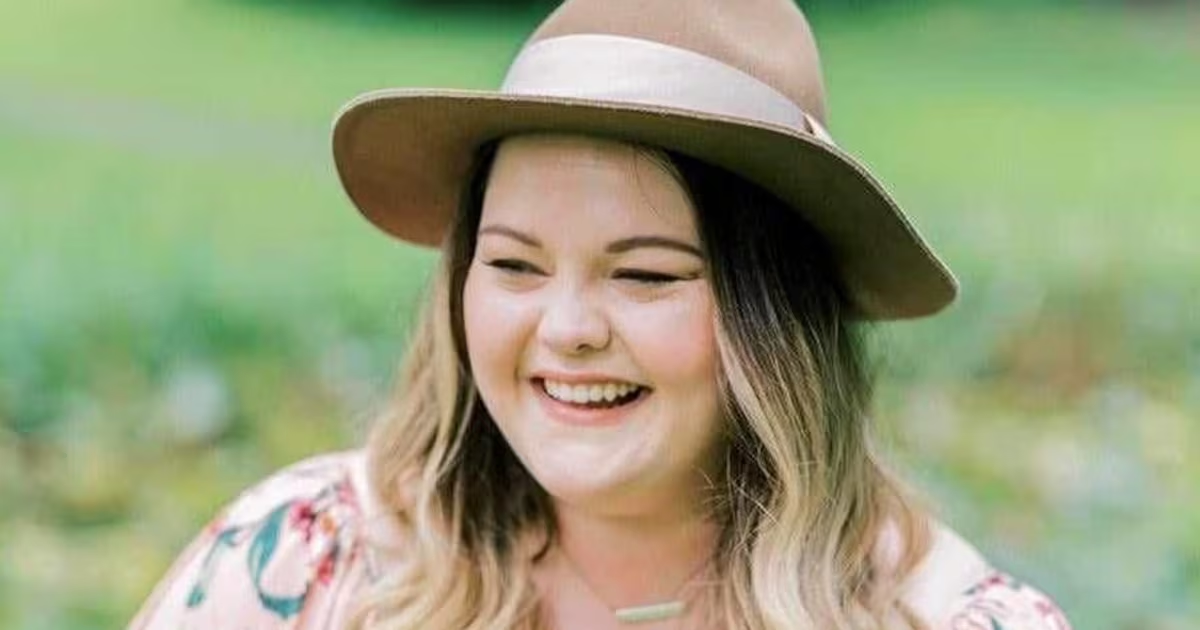
By the time Naomi James (38) was pregnant with her fourth child, she was disillusioned with Ireland’s maternity services. Already the mother of a girl and twin boys, all born by Caesarean section, she wanted a vaginal birth for her baby boy, due in June 2024.But doctors and nurses had warned her against a vaginal birth because of the risks in her particular case. It is common for medics to caution that a vaginal birth after multiple C-sections can carry a risk of complications, including uterine rupture. The Co Louth woman, who ran her own photography business, felt the two previous C-sections were “unnecessary interventions”, her brother Adam Boyle says.“If you were to talk to Naomi, she would just tell you: ‘I never felt heard, I never felt listened to’,” Boyle tells The Irish Times. “That pushed her towards a side of the internet that made her feel heard, seen, valued.”Her brother says Naomi was adamant about how she would proceed with her latest pregnancy.“Naomi got in her head that, firstly, she should have a vaginal birth and then, I think, eventually, that it was her right to have a vaginal birth, despite the medical advice,” he says. The “side of the internet” Adam refers to is the online world of birth activism that he says his sister immersed herself in: a world where the birth choices of women can enjoy supremacy over risk factors and medical advice. Naomi was active in online groups that promote “freebirthing” and had also followed prominent influencers who promote it. She had shared her frustrations online about how difficult it was for her to get a doctor to agree to let her have a vaginal birth for her fourth baby. “So far I haven’t had any support from the consultants. They’ve told me [vaginal birth after Caesarean, known as VBAC] won’t be an option. But I’m planning to wait for labour to start and I’ll be labouring at home for as long as possible. So I’m almost past the point of caring what they think,” she said in a post in March 2024. Naomi James, a mother of four, who died in 2024 after giving birth to their youngest child. Photograph: RIP.ie Some birth activists encourage women to go outside of the medical service for unassisted “free births” – the term for when a woman chooses to give birth without a doctor or other registered healthcare professional present. A free birth is entirely different from a HSE home birth, where strict guidelines have to be met. A HSE midwife is in attendance and an ambulance is on standby.But the free-birth movement appears to resonate with some women who have had negative hospital experiences or who believe medical interventions such as inductions and C-sections are too common.Naomi gave birth at her home in Drogheda on June 23rd, 2024. There was no midwife present. Her healthy baby boy came quickly. Her brother Adam Boyle imagines that in the moments after the birth of his nephew, his sister must have been proud. “I think there were a few very blissful moments for Naomi where she thought: ‘I’ve done it. I’ve defied the odds. They all told me it couldn’t be done, but I did it.’ And I’m sure that those were wonderful moments,” Adam says. “But what she didn’t see coming around the corner were the complications that can come at any point in this journey. And I don’t know that she had a plan for that, and that’s why she’s not here today.” Adam Boyle and his late sister Naomi James Naomi started to haemorrhage and was rushed to Our Lady of Lourdes hospital in Drogheda. Within three hours Adam received a call confirming his sister had died, leaving behind a husband and four children. Four months later, in October, the most senior midwives in the State agreed it was “crucial” to raise major concerns about the “notable rise” in free births in Ireland. The directors of midwifery at each of the State’s 19 public maternity hospitals and units signed a policy paper confirming that women and babies have died in Ireland and been left at risk of life-threatening complications from a rise in free births. They explicitly linked free births in Ireland with “perinatal and maternal mortality and severe morbidity”. The paper, which was shared with the HSE unit that oversees maternity policy, was an unprecedented step for senior midwives, who acknowledged their professional ethos is based on “women’s autonomy and informed choice”.According to a forum of senior Irish midwives, it is “essential to recognise and validate the reasons why some women choose unassisted free birthing”. A delay of just minutes can mean the difference between a healthy baby and one with lifelong disability— Prof Afif El-Khuffash“Women have the right to make decisions about their bodies and their births, and this includes the choice to give birth unassisted deliberately,” the policy paper stated, adding that midwives “must support women in making informed decisions, even when those decisions differ from conventional medical advice”.But the midwives warned that “supporting autonomy does not equate to supporting all choices without reservation”. In the paper, which was released by the HSE to The Irish Times under the Freedom of Information Act, the midwives blamed a “distrust” of the medical system and a “desire for autonomy” as some of the leading motivations for women who choose a free birth. The number of free births happening in the State is understood to be small but increasing. The true scale is not known. In the UK, only 142 free births were recorded by the NHS between April 1st, 2023, and March 31st, 2024, but this figure is understood to underestimate the number of free births there. In the majority of cases in both the Republic and the UK, the health service will only become aware of a free birth if something goes wrong. Prof Afif El-Khuffash, a consultant neonatologist at the Rotunda Hospital in Dublin and a clinical professor of pediatrics at the Royal College of Surgeons in Ireland, says a rise in free births is “definitely something that we’re increasingly getting concerned about”. “Because even if the absolute numbers are small, the stakes are very high,” says El-Khuffash, who is co-host of Irish podcast The Baby Tribe.Prof Afif El-Khuffash: 'If women are turning away, we have to ask why.' Photograph: Dara Mac Dónaill “From a neonatologist perspective, we do see the consequences when things don’t go to plan. So a delay of just mere minutes can mean the difference between a healthy baby and one with lifelong disability.” El-Khuffash says women may choose a free birth because they “feel that they won’t be listened to in a hospital, that their decisions will be made for them rather than with them, or the birth will become very medicalised, with the risk of lots of seemingly unnecessary interventions”.He says “the system has a responsibility”, and “if women are turning away, we have to ask why”.Fiona Hanrahan, director of midwifery at the Rotunda and one of the signatories of the policy paper, says she “firmly believes that no woman sets out to harm herself or her baby”.She explains a free birth could be chosen by someone who would “love” a home birth, but has been refused one by the HSE due to exclusion criteria or lack of midwife availability. The Republic only has two midwifery-led units and a limited number of HSE home birth providers. Women can also be excluded from the home birth service based on risk factors such as their distance from a hospital, a twin pregnancy or previous c-sections. Hanrahan says hospital-based medical staff need to be able to talk openly and clearly to women, to reassure them or allay any fears or concerns they may have. “Women should be very clear who they’re taking their advice from. Online, people can be very persuasive, but have no qualifications,” she says.“Be very careful who is giving advice outside of the hospital because those people will run to the hills if anything happens.”Fiona Hanrahan, director of midwifery at the Rotunda Hospital in Dublin. Photograph: Dara Mac Dónaill Adam Boyle describes how he and his family are still under a “blanket of grief” following the death of his sister. “It’s hard for me, a man, to tell any woman what they should or shouldn’t do when it comes to pregnancy and delivery,” he says. “The one thing I can say is I may not know all the answers, but there’s a lot of people with a lot of confidence on the internet who also do not know the answers, but they are speaking like they do and they’re putting women and babies’ lives at risk unnecessarily.” The HSE said, in a statement, that it shares the concerns raised by the national directors of midwifery, pointing out that unassisted births run a higher risk of complications. Such births are not insured by the State.[ I took the ‘easy way out’ and gave birth by Caesarean. And yes, it was easierOpens in new window ]The national directors of midwifery forum says more than 98 per cent of births in the Republic take place in a hospital. In 2023, the latest year for which figures are available, there were 292 home births in the State, accounting for just 0.5 per cent of total births that year, according to the Central Statistics Office.Despite the minority of births taking place in the home, there is a growing online movement that is highly critical of hospital births and medical interventions in labour.The Irish Birth Movement (IBM), which describes itself as a “grassroots movement of birth activists” and is mainly based in the midwest, campaigns for more birth choices for women and increased access to home births in Ireland. It promotes what it calls “undisturbed” or “physiological” births. IBM co-founder Su Huschke has previously said on social media that between 2019 and 2023, she had not seen “a single positive, intervention-free physiological birth in hospital”. She said she would not attend any more planned hospital births. “Home births (with or without medical assistance) only from now on.”[ Home-birth system is a ‘risk to patient safety’, audit findsOpens in new window ]The Irish Times asked the IBM if it agreed with the concerns raised by the directors of midwifery across the State about free births. In a statement its co-founders Huschke and Sandra Healy, and barrister Leigh Brosnan, who co-edited a book on the IBM with Huschke, say: “The Irish Birth Movement emphasises all women and birthing people’s right to bodily autonomy, as legally defined in the HSE Consent Policy. The right to make any kind of decision about your own body is not a matter of opinion or belief that can be debated, it is a legal right.” The HSE national consent policy says a patient has a right to refuse or withdraw consent to a procedure. The IBM says it endorses the right of women to refuse treatment in maternity hospitals.Last March, Huschke, who lives in Co Tipperary, wrote a piece, published by the RTÉ website, saying medical professionals “have to respect” a woman’s refusal of treatment “even if the refusal may have adverse consequences, including death”. “It is the right of the birthing person to make these decisions,” she wrote. The HSE says that, in the context of unassisted births, it is researching how to advise women and medical professionals “to navigate care planning when decisions diverge from clinical guidance”.The IBM has received some political support and media coverage for its campaigns. There is no known connection between the IBM and any free birth that resulted in an adverse incident. Healy, who is a midwife, told a Limerick news outlet at a demonstration by the IBM in the city last October that the organisation is “not against hospital birth”. At another protest outside Leinster House that same month, Healy told The Irish Times that accessing a home birth was “like a postcode lottery in that there are pockets of Ireland that have no access to home-birth service”.A book written, edited and self-published in 2024 by the IBM, called Giving Birth in Ireland, includes a number of claims and criticisms about giving birth in a hospital. [ Women being ‘short-changed’ due to lack of birthing options, campaign group claimsOpens in new window ]An introductory chapter by Healy, Huschke and Brosnan claims, without providing evidence, that having a Cesarean section means “you will not be able to pick your baby up after birth”. Dr Geraldine Connolly, a former consultant obstetrician at the Rotunda, says this claim is “untrue”.“I had two C-sections and managed many women who had C-sections,” she says.The same chapter also suggests women who avail of pain relief are “not fully present” during the birth of their baby. Connolly says this is a “sweeping, opinion-based statement”. The book warns women that if they disagree with doctors and midwives, they could be met with “contempt, anger and coercive practices”.On her social media, IBM co-founder and doula (a non-medical companion who provides advice during pregnancy and birth) Huschke goes further and compares medical professionals to priests and police officers. “One of the things I like to ask pregnant mamas is: what is your relationship with authority? Medical authority in particular, but also other kinds of authority: teachers, priests, fathers, police, sometimes male partners … “The reality is that many people who give birth in Ireland face authority figures, and end up repeating experiences of disempowerment. Being told to agree and told what to do and how to breathe and where to lie and how to push.”Neither IBM nor Huschke responded to questions about these comments and claims. Huschke and Healy were both members of the now defunct Private Midwives, a UK-based group that operated in the Republic without any clear State regulation. On its website, the only regulation Private Midwives cited was the Care Quality Commission, which regulates health and social care services in England only. It said that all of its Irish midwives were members of the Nursing and Midwifery Board of Ireland (NMBI). Women who had been refused a HSE home birth – except in cases of a twin pregnancy, a known breech or after two C-sections – were able to book antenatal care and a home birth with a private midwife for €6,800 through the website. Private Midwives said it was “not restricted” by the memorandum of understanding covering the HSE’s home birth rules and regulations, which a midwife must follow if her practice is going to be covered by indemnity insurance provided by the public health service. On its website, Private Midwives, which said it had “full appropriate professional indemnity insurance for all elements of the care we offer”, described the trend of deliberately unassisted births as follows: “These mothers may simply wish to experience birth this way or they may be excluded from accessing a planned home birth due to strict inclusion criteria.” Last August, Private Midwives suddenly announced its closure, partially blaming the “current financial and political climate”.Huschke, who is not a medical professional, had her services listed on the website under the title “midwife support worker”.She did not respond to a question about whether she ever acted in this role. She has previously said on social media that she is not “a medical professional”. She has also said on social media that she has been accused of “over-stepping” by medical professionals during hospital births she has attended as a doula.Huschke’s professional social media account follows – through her Instagram “rewilding.birth.doula” account – the Free Birth Society, a US-based multi-million-dollar social media campaign promoting unassisted births, which has been linked with stillbirths and neonatal deaths. She did not respond to questions about her interest in this society.One of the IBM’s campaign aims, which has been covered by local and national media, has been for the restoration of HSE home-birth services in the Limerick and Clare region. The campaign does not mention that one of the IBM founders was involved in a case that resulted in the HSE home-birth service in the region being suspended.The case involved a 36-year-old woman named Laura Liston from Croom in Co Limerick who died during a HSE home birth in June 2022 that was supervised by Healy. Liston had been approved for a HSE home birth in advance of the due date of her first baby. Healy was her community midwife. Liston’s case was not a free birth. After giving birth to her baby boy just before 11pm on June 4th, 2022, Liston collapsed and fainted, experienced blood loss, low blood pressure and vomiting. Healy told an inquest earlier this year that “in hindsight” she could have called for a transfer to hospital at the point at which Liston had fainted, but Liston appeared alert and Healy believed it was “reasonable” to wait at that stage. [ ‘We fought hard for this lady. And we still lost her’: How new mother died after home birthOpens in new window ]An ambulance was eventually called after midnight. Liston was pronounced dead at 2.15am at University Hospital Limerick. The inquest heard expert evidence that if this had happened in a hospital setting it would have been treated as an emergency and a multidisciplinary team would have been called. In the immediate aftermath of Liston’s death, the HSE suspended home births in the midwest region covering Limerick, Clare and north Tipperary.Healy and the IBM have since campaigned for the restoration of HSE home-birth services in the midwest and Healy has said women in the region have been “deprived of choices”.In response to queries, the IBM asked The Irish Times in its reporting to “ensure that you state our names and affiliations correctly”. It requested that Huschke and Healy would be referred to under the academic title of “Dr”. It said Healy should be titled a “lecturer at the School of Nursing and Midwifery, University of Limerick”.Huschke is listed on the University of Limerick website as “Dr. Research Grades, School of Medicine”. Healy is not listed as a staff lecturer or member of faculty at the University of Limerick, according to online college records, though she has provided temporary sick leave teaching cover from December 2025 to June 2026. She did not respond to questions from The Irish Times.At an Irish Birth Movement demonstration outside Leinster House in October last year, Healy told The Irish Times that with private midwifery services closing and home-birth services being suspended in the midwest, women in certain areas are “left with two options: a hospital birth or a free birth option that they may not have wanted”.
‘Free births’ in Ireland: Concern grows for women choosing births without medical help
Doctors and midwives are concerned about a ‘notable rise’ in medically unassisted home births in the State. Do expectant mothers know the risks?
3,097 words~14 min read