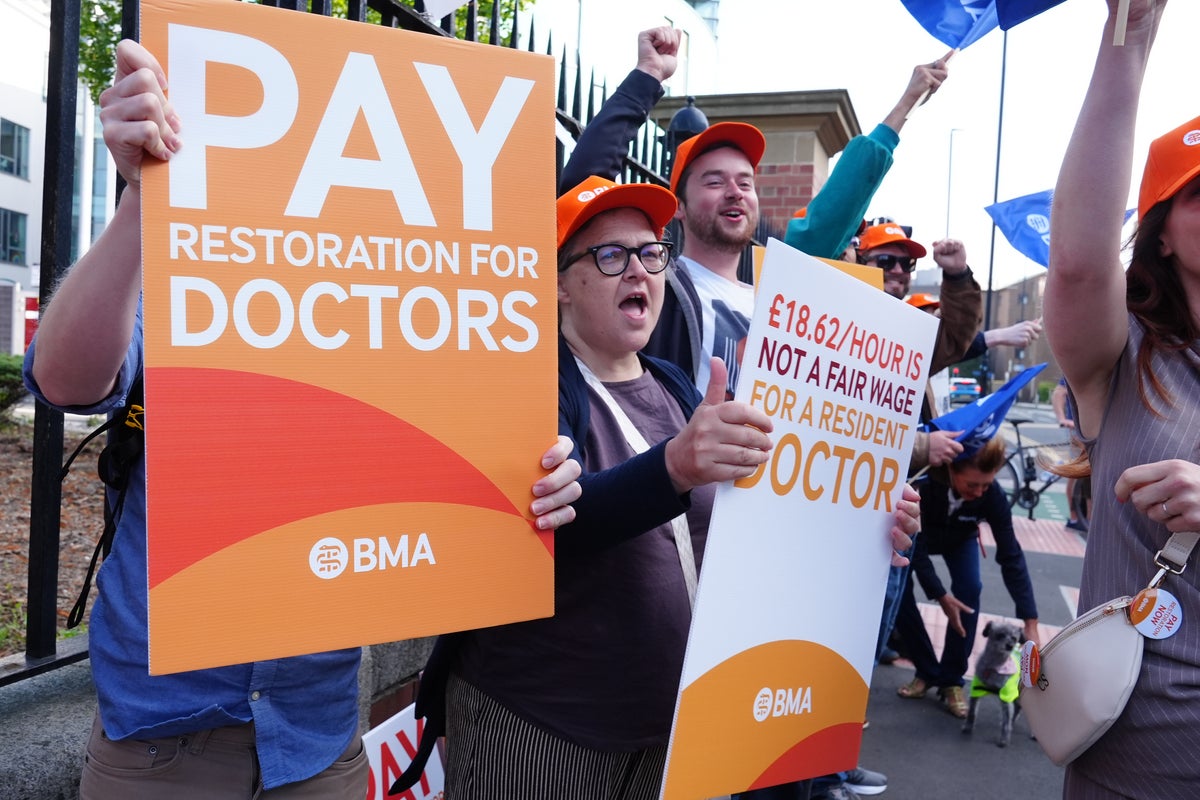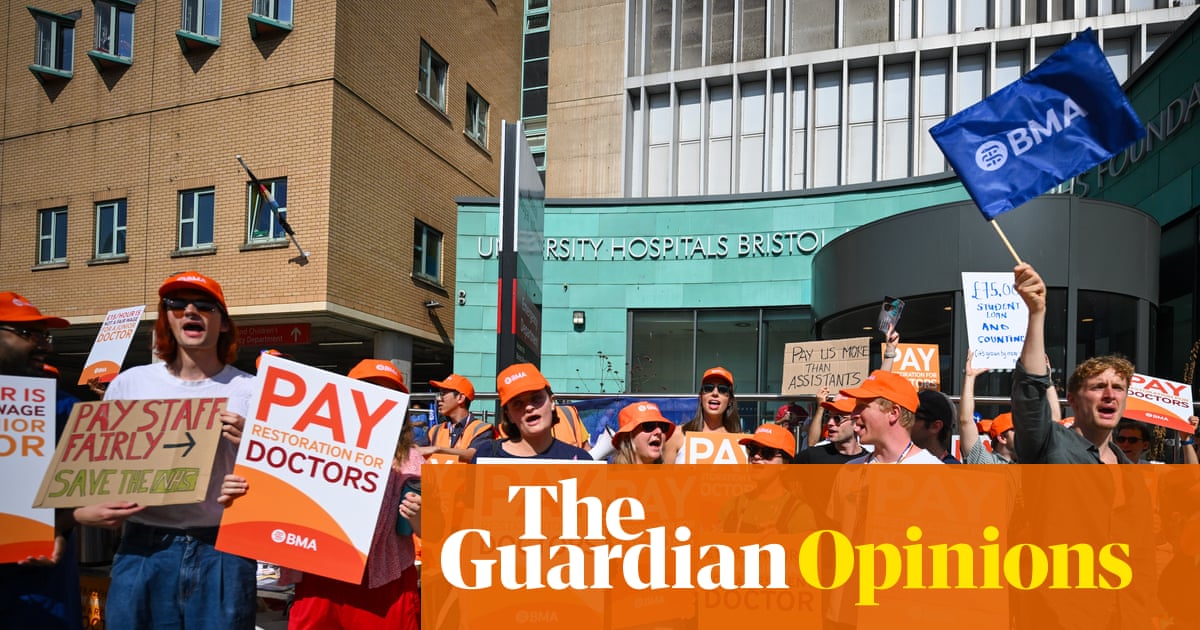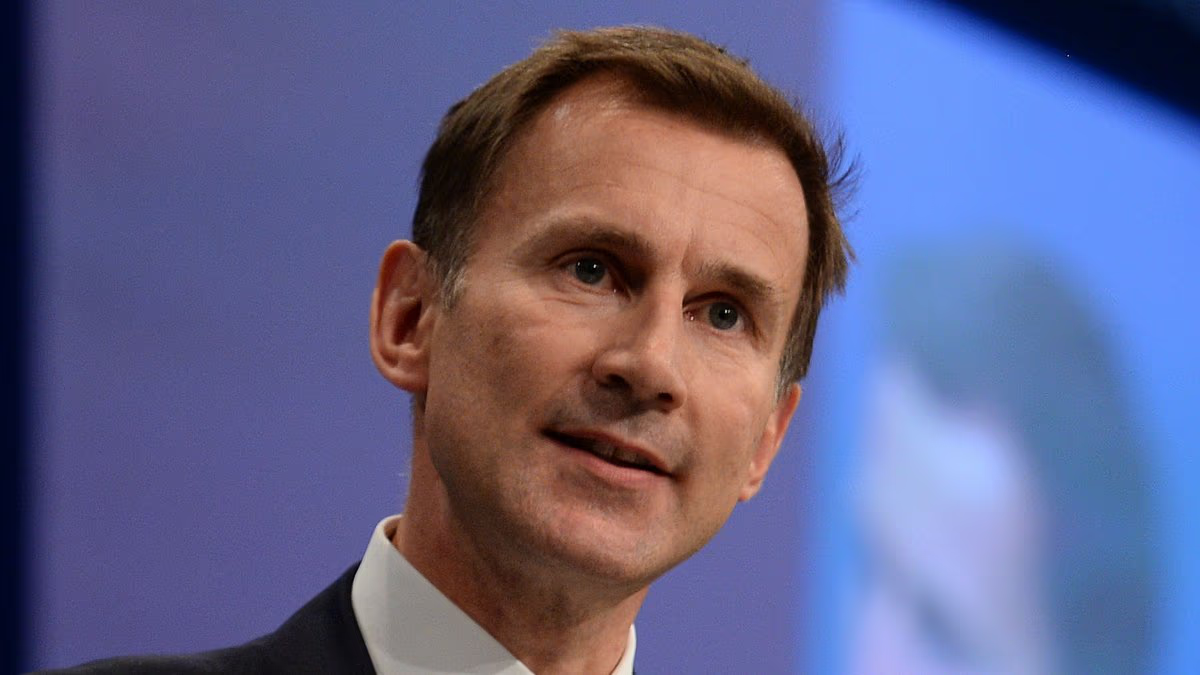
I was the most disliked person in the country, with an approval of minus 48 per cent, according to an opinion poll, making me the most unpopular politician (of an already unpopular bunch, it has to be said).The occasion was the junior doctors' strike of 2015–16, and, as Health Secretary in David Cameron's government, I was in the firing line of what turned out to be the most draining political battle I have ever fought.Protesters climbed on top of my car and covered it with flour. At weekends there were marches of 20,000 doctors shouting, 'Hunt, Hunt, Hunt must go.' Radio presenters routinely mispronounced my surname with a C at the beginning instead of an H.During all this I had a plan to get away for a short break. It was the Easter holidays and, with the kids off school, the idea was to spend a week with friends in America.On the day we were due to fly out, the BMA, the doctors' union, announced another wave of strikes.I was at home, having rushed back from Parliament for some last-minute packing, when the doorbell rang. I assumed it was a taxi I'd ordered to take us to the airport. Instead, standing there was a BBC news crew wanting a comment.I knew instantly it would be disastrous for me to be filmed heading off on holiday at the very moment the doctors were threatening to walk out. 'I learnt the hard way just how difficult it is to improve public sector productivity,' writes Mr HuntSo I went back inside, changed into a suit and called my government driver. When he arrived, I left the house, did a quick clip to the cameras and climbed into the car as if I was going to work.In my hand was a plastic bag full of holiday clothes. Around the corner, we stopped and I changed back into jeans and waited for my family to pick me up in the taxi. With frayed tempers and just minutes to spare, we only just scraped through security at Heathrow in time. I was not a popular dad.From my battle with the doctors, I learnt the hard way just how difficult it is to improve public sector productivity – even if the need to do so is blindingly obvious. But trying to do something about it could be stressful and unpleasant.In my case, I had noticed that the death rate of patients admitted to hospital over the weekend was 15 per cent higher than those admitted on weekdays.That amounted to 6,000 potentially avoidable deaths every year. I therefore wanted to get more doctors working on Saturdays and Sundays and I announced plans to change their contracts.The junior doctors were outraged, their opposition to the suggestion fuelled by their union's wrongful assertion that the changes would mean a pay cut. In their strike ballot, an overwhelming 98 per cent supported industrial action.But now I'd started the argument, I had to win it. In politics, backing down publicly can destroy your reputation – and your career. Also, my focus was to reduce the number of avoidable deaths caused by incorrect or poor treatment. Who could disagree with that? I locked horns.From the outset, the NHS establishment was deeply nervous about my determination to reduce weekend death rates. Even though it was senior figures who had alerted me to the spike in those rates – indeed, had encouraged me to tackle them – they stopped supporting me the moment they realised how unpopular the changes were.A senior civil servant reminded me how Michael Gove had become the 'enemy' when he took on the teaching unions and was reshuffled out of his job as Education Secretary as a result. He had crossed the line and if I did the same there would be no going back. My predecessor, Andrew Lansley, had also been demoted when NHS reforms got too hot to handle. I might win the battle, but would I win the war? Despite the warning, I crossed that line.The only way I would lose the battle was if the prime minister lost his nerve. So I sent him a private note just before the strikes started, saying that if he didn't want them, this was the last moment for compromise. He told me to stand firm. Striking junior doctors protest outside St Thomas's Hospital across the river from the Houses of Parliament in February 2016But the BMA was a clever opponent. Far from being class warriors in the style of miners' leader Arthur Scargill, they were the bright offspring of middle-class parents.Every doctor who appeared in the media was instructed to appear reasonable and sympathetic. The strategy worked: public support for the junior doctors never wavered.I concentrated on appearing determined and unyielding, in the hope that the unions would give up. After one strike concluded I immediately used my legal powers to impose new contracts. In other words, I doubled down.But so, too, did the junior doctors. The BMA not only announced another wave of strikes but raised the stakes by threatening to withdraw emergency care. They also made sure the strikes were happening on a Wednesday, so that the prime minister would be asked about them at Prime Minister's Questions. I then had to spend hours the day before working out the best lines.That he included me in those meetings was a good sign that he still had my back, but it didn't help that the strikes were dragging on, not least because I had been appointed to 'calm things down' in the NHS.My office also became more nervous. In the street outside, there were daily protests with placards and an empty chair to signify my alleged refusal to negotiate.Occasionally, I would invite some of the protesters into my office to discuss the issues, but I soon realised that anything I said would get twisted into a social media 'moment'.One evening, I cycled down Whitehall and saw large crowds milling around the entrance to Downing Street. I assumed it was a demonstration against human rights abuses in some distant country. As I got closer, I saw my name on the placards and I executed a speedy U-turn. Thankfully no one recognised me in my bicycle helmet.Perhaps most difficult of all was having to put on a brave face for the civil servants and special advisers in my private office. If you reveal any inner doubts, it erodes their confidence. So you keep your worries bottled up, which can make the job feel very lonely.Sometimes, however, you just can't hide what you are feeling. When the third wave of strikes came we were desperately hoping the turnout would fall. But support among the doctors was unwavering. Some junior ministers came into my office, and I couldn't hide the tears in my eyes. One of them brought in a pot plant later to cheer me up.Then the BMA upped the ante even more – they would strike for a whole week, instead of 48 hours and withdraw emergency care from A & E departments for the first time ever. Putting patients at risk to such a degree was a step too far for their colleagues. Senior doctors and Royal Colleges spoke out against the strikes. The union lost its nerve and cancelled further action.But that warning from a senior civil servant turned out to be right. I had won the battle but turned the NHS against me. Further reform became much harder.Looking back, I was right to take steps to improve weekend care. But it was also true – as the junior doctors pointed out – that we didn't have enough doctors in the first place. So after the strike collapsed, I increased the number of doctors, nurses and midwives we trained. That will take time to make itself felt on the front line. But when it is, alongside the contract changes, we should finally start to see weekend care getting safer. But only after a long, painful and expensive journey.For me, the junior doctors' strike demonstrated why public sector reform is the toughest challenge a minister can face. The physical and mental exhaustion involved is one reason why the reform we so desperately need often ends up being ducked or dodged by ministers.The fact is that public sector productivity has declined by an average 0.3 per cent every year between 1997 and 2019, whereas over those same two decades productivity in the private sector increased by 1 per cent a year. We need to get our public services – which make up a fifth of our output as a nation – onto a similar trajectory.The NHS, the country's biggest employer accounting for around 40 per cent of all government spending on public services, is one of our most inefficient services, with productivity still nearly 8 per cent lower than pre-pandemic levels. What's more, demand for its services is rising by around 3 per cent a year and we will need to increase its budget by the same percentage if things carry on as they are. But if productivity in the NHS matched the private sector, spending need only increase by 1 per cent annually.Repeated across the public sector as a whole, such a change would transform our public finances by keeping both taxes and debt down, allowing us to reap all the benefits associated with a more lightly-taxed economy.There is too a bigger prize to play for. When I was Chancellor of the Exchequer I saw projections that the national debt – the borrowings on which we as a country make huge interest payments – would increase from around 100 per cent of GDP (gross domestic product) currently to an impossible 300 per cent by the 2070s.I asked Treasury officials what the impact on our national debt would be if we raised public sector productivity to a level closer to that in the private sector.When the analysis came back, it was startling. If we raised public sector productivity growth by just 0.7 per cent a year – still well below the long-term private sector average of nearly 2 per cent – our national debt would stop increasing. And the debt might even start to go down. Put bluntly, more efficient public services could help us head off bankruptcy.But is there the will to reform our public services? One of my successors as Health Secretary, Steve Barclay, had his battles with health unions but he didn't back down – unlike the incoming Labour government under Keir Starmer in 2024, which did, handing out generous pay rises. It is easy to see why unions think it is worth digging in.A good example is the railways. Train driver contracts are notoriously out of date – not least in the case of driverless trains, which are perfectly safe and indeed operating on London's DLR. We should obviously expand their use, including to Tube lines.Likewise with track repair, where the regulations date back decades: instead of sending one person to do repairs, two – an electrician and a track engineer – are sent, often refusing to travel in the same vehicle as a result of demarcation or safety rules.A job that could take one person three hours can end up costing an eight-hour shift for four separate people. Such Spanish practices are ripe for reform but it needs a Transport Secretary to be left in post for long enough to see through any battles.Even committed prime ministers make things harder by reshuffling ministers too frequently.In the last decade, we have had no fewer than seven transport secretaries. Compare that to the train drivers' union ASLEF, which has had just one leader – Mick Whelan – over that period. Unsurprisingly, in 2024 he secured a 15 per cent pay rise with no productivity concessions from the incoming Labour government.The failure to reform can also be laid at the door of my old department, the Treasury, our most powerful ministry responsible for spending £1trillion of taxpayers' money.It has often not helped by taking a foolishly short-term approach to balancing the books. When a department overspends, the Treasury insists it 'consumes its own smoke' – in other words, finds offsetting savings from its own budget.The Treasury also incentivises government departments to waste money. Any budget that is unspent at the end of the financial year is clawed back. The result is a wasteful and almost comical effort to 'get money out of the door' before a year end.If we want more efficient public services, careful use of money should be rewarded not penalised. Departments should be allowed to roll over underspends at the end of a financial year. They would then have a strong incentive to deliver transformations, and with the autonomy to make them happen.It is clear to me that we need far-reaching structural reforms across the civil service. Nowhere does this matter more than in the NHS, where micro-management and a tractor-factory obsession with targets are a big problem. Hospitals have 18 monthly operational targets, and GPs have 44 annual targets, far more than in any other health system.As a result, patients are treated like statistics rather than human beings, and managers end up being box-tickers, focused on internal processes rather than outcomes for patients. All national NHS targets should be abolished, replaced by clinical accountability, in which there is an individual doctor responsible for every patient.That used to be the case with the old GP list system, when local doctors had a personal list of around 2,000 patients for whom they were responsible. But in 2004 those lists were abolished, replaced with a system that is less personalised and more expensive. Doctors who don't know their patients are more likely to send them to hospital, increasing the pressure there.Even inside hospitals, the priority given to impersonal targets means less accountability, more mistakes and ultimately more money spent trying to put things right. We now spend nearly as much on settling litigation claims for maternity services as the entire cost of running them.Until we scrap structures that turn patients into numbers, we will pay the price with demoralised staff, distressed patients and disappointed taxpayers.It is time to be bold. As Chancellor, I asked officials what investment in technology would allow the NHS to deliver annual productivity growth of 2 per cent. The answer was a whopping £3.4 billion to transform the NHS's creaky IT systems.After difficult negotiations with No 10, I found the money, in return for a public commitment to increase productivity by two per cent annually for five years, matching the long-term average for the private sector and exceeding other parts of the public sector.The new government has kept the plan in place, and it is starting to work. All GP practices now have digital telephony, meaning that patients don't get an engaged tone and can ask for an automatic callback. Most hospitals either have or are in the process of installing modern IT systems.Genomic testing is now being used to scan for 200 cancers and 7,000 rare diseases. A total of £9 billion was saved through efficiencies in the first year of the programme. Hospital productivity went up by 2.7 per cent, more than double the previous rate.If the NHS, with all its pressures, can engineer that kind of change, so too can other public services.Of course, it will need political courage. Health unions will always try to block changes to doctors' contracts. Rail unions will never like driverless trains. Teachers will oppose innovations from AI.Many will welcome efficiency improvements in theory, but oppose them in practice – especially if they involve workforce reductions.But if we take a longer-term, more strategic approach to efficiency in public services, the prize is more fulfilling jobs as well as better value for taxpayers.Unlocking a positive can-do mentality in our public services would make work far more rewarding for people on the front line who are often as frustrated by their inefficiency as the people who use them. It would fire up dynamism in the 20 per cent of our economy that the public sector represents.Most importantly, we would finally start to escape the endless cycle of governments running out of money and forcing austerity cuts on services that are already stretched.- Adapted from Can We Be Rich Again? by Jeremy Hunt (Swift Press, £25), to be published June 4. © Jeremy Hunt 2026. To order a copy for £22.50 (offer valid to 13/06/26; UK P&P free on orders over £25) go to www.mailshop. co.uk/books or call 020 3176 2937.
Jeremy Hunt on the only way to save Britain from Bankruptcy
The occasion was the junior doctors' strike of 2015-16, and, as Health Secretary, I was in the firing line of what turned out to be the most draining political battle I have ever fought.
2,742 words~12 min read