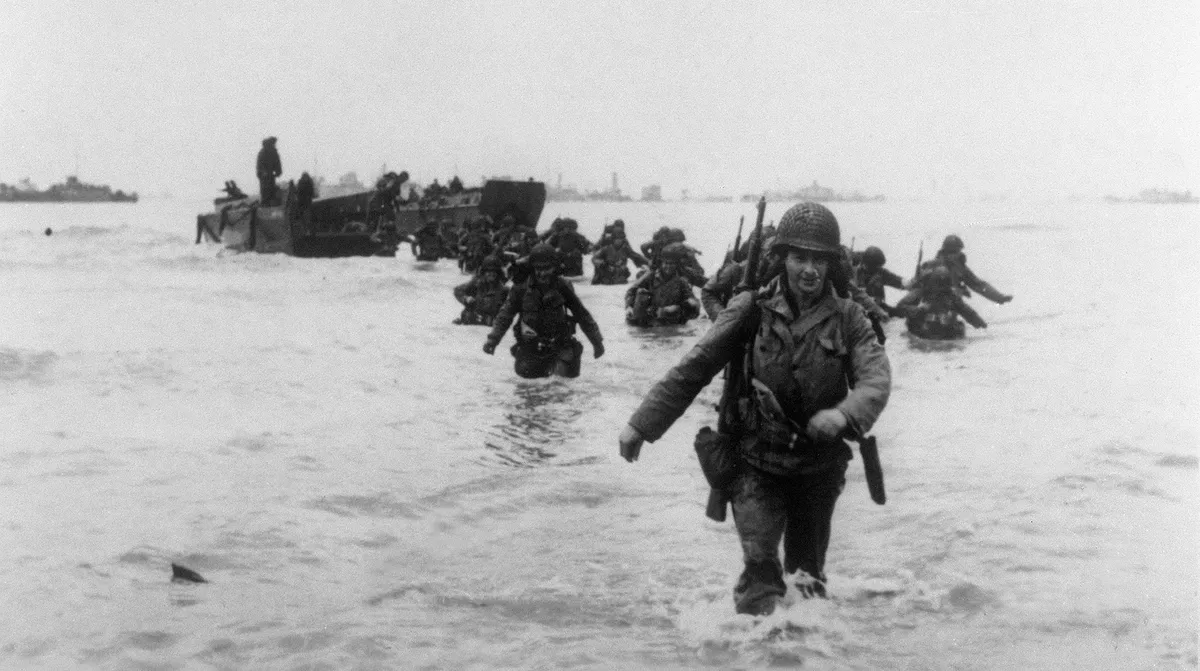
It was 82 years ago that Gen. Eisenhower's chief meteorologist made one of the most important weather forecasts of all time.Show Caption
To go or not to go?June 2026 marks 82 years since Gen. Dwight D. Eisenhower's chief meteorologist, Group Capt. James Martin Stagg, made one of the most important weather forecasts of all time. Defying his colleagues, he advised Ike to postpone the invasion of Normandy by one day from June 5, 1944, to June 6, because of uncertain weather conditions.This important decision is the subject of the new movie "Pressure" starring Brendan Fraser as Ike, now out in theaters. The real-life D-Day was a herculean effort to reclaim a critical part of Europe from the Nazis and turn the tide of the most horrific war the world had ever seen.Stagg − who was actually a geophysicist by training − and his fellow British and American meteorologists were operating without any of the technology and equipment that today's forecasters take for granted, such as satellites, weather radar, computer modeling and instant communications.Relying mainly on surface observations from military and civilian weather observers in the British Isles and in western Europe and a few military observers at sea, predicting the weather more than a day or two in advance in that era was unrealistic.Additionally, weather prediction in England and Europe − especially before the advent of satellites − was much trickier than forecasting in the United States. In America, even in that era, weather systems could be tracked for days after hitting the West Coast and moving east, while European forecasters were often operating "blind" with the empty ocean to the west.Predicting the exact timing, track and strength of these storms put Group Capt. Stagg and his colleagues under almost unimaginable pressure and conflict, according to the book "The Forecast for D-Day," with the fate of the war and perhaps the world hanging in the balance.What troubled the meteorologists in the days leading up to D-Day was a parade of storms that barreled across the Atlantic and into the British Isles, any one of which would have stirred up the dangerous waters of the English Channel where the fleet was gathering, and provided unwelcome cloud cover for the aerial assault of Normandy.The invasion was originally scheduled for the morning of June 5, but the weather forecast was bad enough for Stagg to advise Ike to postpone it by one day, despite protests from his fellow meteorologists, who felt the weather would be good enough for the mission to take place.Why was the weather forecast so crucial for the invasion?According to meteorologist and weather historian Sean Potter, like many military operations, the success of the Normandy landings on D-Day hinged heavily upon the weather. D-Day, however, was no ordinary military operation. Each component of the invasion − naval, air, and land forces − had its own weather requirements."A forecast that might mean ideal conditions for the bombers, for example, might not take into account the needs of the seaborne invasion," Potter told USA TODAY via email. "The invasion also depended on a narrow combination of tides, moonlight, cloud cover, wind, and sea conditions that occurred only during a limited window of opportunity."How challenging was the forecast with 1940s technology? How would it compare to a forecast today?While weather forecasting had seen vast improvements in the two decades before D-Day − most notably with the development of the polar front theory of how storms develop − there were still limitations that made forecasting for D-Day a real challenge, Potter explained."Forecasters today have advantages of radar, satellites, and other advanced technologies, including numerical weather prediction, to help them make accurate predictions. None of these were available to the D-Day forecasters," he added.Another challenge was that one of the three Allied forecasting teams that contributed to the D-Day forecast − led by American Irving Krick − relied primarily on a technique known as analog forecasting, where they compared the weather situation at hand with similar scenarios in the past to determine what might happen."By 1944, analog forecasting was viewed with skepticism by many meteorologists and was largely being replaced by other, more modern methods," Potter said.Looking back, how accurate was the forecast?In the end, the forecasters did identify a crucial break in the weather that allowed the invasion to take place, though conditions remained rough and far from ideal, and not entirely as predicted.Potter explains: A 2020 paper published in the Bulletin of the American Meteorological Society suggests the forecast for D-Day was essentially “right for the wrong reason.”The author of the paper, Swedish meteorologist Anders Persson, reviewed transcripts of telephone discussions between the Allied forecasting teams and concluded that, while forecasters accurately predicted a break in the weather on June 6, they misunderstood why it would occur. They believed the storm system that had delayed the invasion would move away and be replaced by higher pressure and improving conditions.Instead, the storm lingered over the invasion area but weakened slightly, producing weather that remained marginal yet still acceptable for Eisenhower’s decision to proceed.How accurate is the new movie in depicting the events of that time?Overall, the movie is very accurate in its portrayal of the role weather played in planning for D-Day and the challenges forecasters faced in predicting it, Potter said."It did take some liberties, such as suggesting that James Stagg, Eisenhower’s chief meteorological adviser (played by Andrew Scott), didn’t get involved in the forecasting for D-Day until several days prior to the invasion. In fact, he had been involved for months. It also likely overdramatizes the tension and conflict between Stagg and his American counterpart, Irving Krick," Potter said."There were disagreements, but they were kept mainly professional. One thing the film does a very good job of is conveying the sense of uncertainty that Stagg had in the forecasts he presented to Eisenhower. Understanding forecast uncertainty is still an important part of making decisions when weather is a factor."What if they had delayed D-Day?As noted, while far from perfect, the weather on the morning of June 6 was good enough for the invasion to proceed successfully.Had the mission not gone on June 6, the next window would have been a full two weeks later, when tides and moonlight were right. On that day, two weeks later, a completely unforeseen gale would have caused the invasion to fail.In the book "The Forecast for D-Day," author John Ross said that had the invasion failed, the secrecy about when and where the Allies would land would be lost, victory in Europe would have been delayed for a year, and the Soviet Union might have taken control of the continent.Years later, during their ride to the Capitol for his inauguration, President-elect John F. Kennedy asked President Eisenhower why the Normandy invasion had been so successful.Ike's answer: "Because we had better meteorologists than the Germans!"Contributing: Phaedra Trethan and Janet LoehrkeDoyle Rice is a national correspondent for USA TODAY, with a focus on weather and climate.