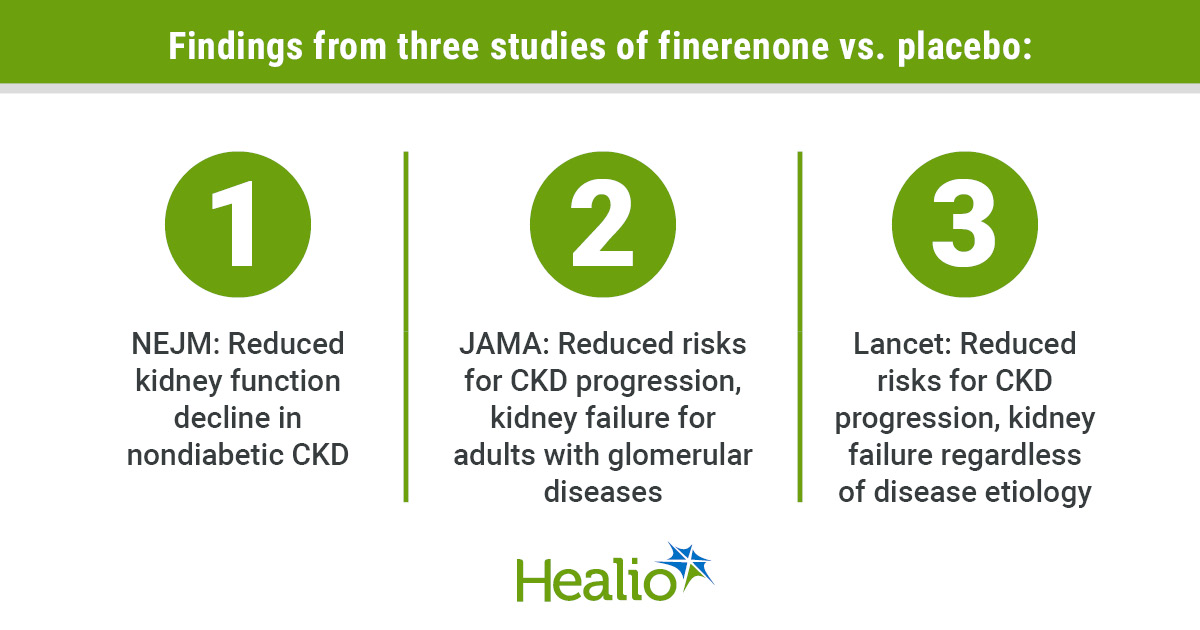
Finerenone (Kerendia) slowed the decline of kidney function in adults with chronic kidney disease (CKD) who did not have diabetes, the large randomized FIND-CKD trial showed.
By month 32, the mean annual rate of change in estimated glomerular filtration rate (eGFR) was -3.3 mL/min/1.73 m² in the finerenone group and -4.0 mL/min/1.73 m² in the placebo group (P<0.001), reported researchers led by Hiddo Heerspink, PhD, of the University Medical Center Groningen in the Netherlands.
The treatment benefit -- a difference of 0.7 mL/min/1.73 m² versus placebo -- matched the level of eGFR slowing previously seen in CKD patients with diabetes, according to findings reported in the New England Journal of Medicine and simultaneously presented at the European Renal Association annual congress in Glasgow, Scotland.
"The magnitude of the effect of finerenone in the current trial was similar to the magnitude previously reported with other kidney-protective drugs, including RAS inhibitors and SGLT2 inhibitors, which reduced the annual rate of decline in the eGFR by 0.5 to 1.0 mL/min/1.73 m²," Heerspink and co-authors wrote.
"The reduction in the mean annual rate of change in the eGFR from baseline to month 3 with finerenone suggests that the total eGFR slope may be an underestimate because finerenone, by means of its mechanism of action, initially decreases the eGFR," they added.