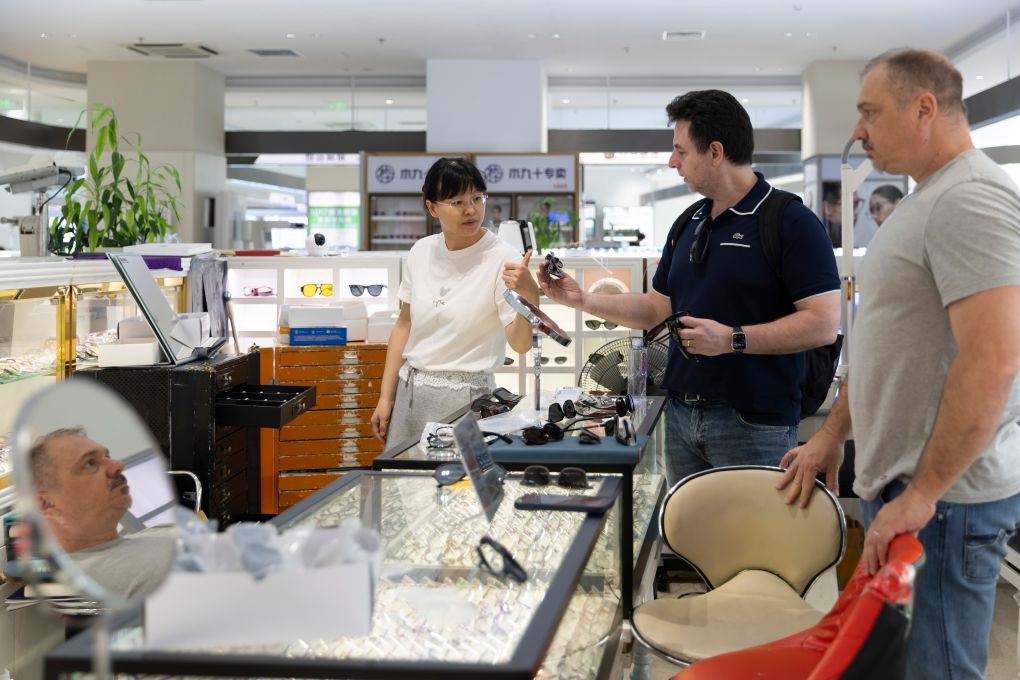
Swiss tourist Mia Bernauer’s first trip to China in mid-May included a stop that may seem unexpected to many: getting prescription glasses in Shanghai. She bought glasses for myopia in two different styles to switch between.While planning her trip to Shanghai, Bernauer found through online research that the city offers affordable, high-quality eyewear. She was also influenced by TikTok videos featuring foreign tourists sharing their shopping experiences at the Shanghai International Glasses City, located in the heart of the city.“The shops here have a really nice selection, and they have world-famous brands that are good quality. But the price is half, or even less, than in Switzerland,” says Bernauer, 24, who spent five days in Shanghai.“It’s a great bonus that some of the shop managers speak English,” she says.Bernauer is not alone. Many international tourists are adding the eyeglasses market to their Shanghai itineraries these days, alongside traditional attractions, such as custom-made qipao at the clothing market near the Bund, and trying local delicacies like xiaolongbao (steamed buns).On TripAdvisor, a popular travel review site, the four-story Shanghai International Glasses City on Zhongxing Road ranks among the city’s top five landmarks, following the Bund, Yuyuan Garden, and Xintiandi. Opened in 2007, this eyeglasses market, which began in wholesale markets, offers retail prices generally half of those at other optical shops and has recently gained popularity on overseas social media platforms.New Zealander Chris picks eyeglasses frames at the Shanghai store, during his visit there on 16 May (GAO ERQIANG / CHINA DAILY)Many shop owners at the market noted an increase in foreign customers starting last year, with more this year. They said some foreign tour guides have been spontaneously bringing tour groups in.In 2024, China significantly upgraded its visa-free transit policy. By 2025, the number of countries with unilateral visa exemptions increased to 48, and the number of countries with mutual visa exemptions expanded to 29, with 65 ports allowing 240-hour visa-free transit.Riding this wave of inbound travel, Shanghai has continued to establish itself as a first stop for international tourists arriving in China. According to the Shanghai Municipal Administration of Culture and Tourism, the city received over 9.36 million inbound travellers last year, a nearly 40 per cent increase year-on-year, setting a new record. In the first two months of 2026, international tourist arrivals in Shanghai reached nearly 1.15 million, up 21.4 per cent compared with the same period last year.Hua Xiaochun, owner of one of the eyeglass shops in the market, says that the number of visitors arriving from Russia increased noticeably at first, and now international customers hail from around the world, mainly from Europe, North America, and Southeast Asia.According to foreign customers, what attracts them is not just the price but also the quality and the speed of service. They praise the shopkeepers at the market for their friendliness and professionalism, and they also appreciate the wide range of options available.There are hundreds of shops in the market, each with a different selection based on the shop owner’s buying preferences. Hua says his preference focuses on trendy styles.“Foreigners usually have a different aesthetic preference from our local customers. They prefer trendy, bold designs. Most Chinese customers accept recommendations from shopkeepers, but foreigners are often confident in their own choices,” he adds.Getting glasses at the market usually takes only 30 minutes to an hour from order to pickup. During this time, shopkeepers recommend that customers visit the shopping centre across the street, and many return with bags full of items, such as blind box toys, hair accessories, power banks, and hairdryers.More complex lenses, like progressive and multifocal, take two to three days to customise. Some customers return to pick them up, while others opt for express delivery to their hotel to save time.
Travellers take in city through new lenses
THE ARTICLES ON THESE PAGES ARE PRODUCED BY CHINA DAILY, WHICH TAKES SOLE RESPONSIBILITY FOR THE CONTENTS
624 words~3 min read