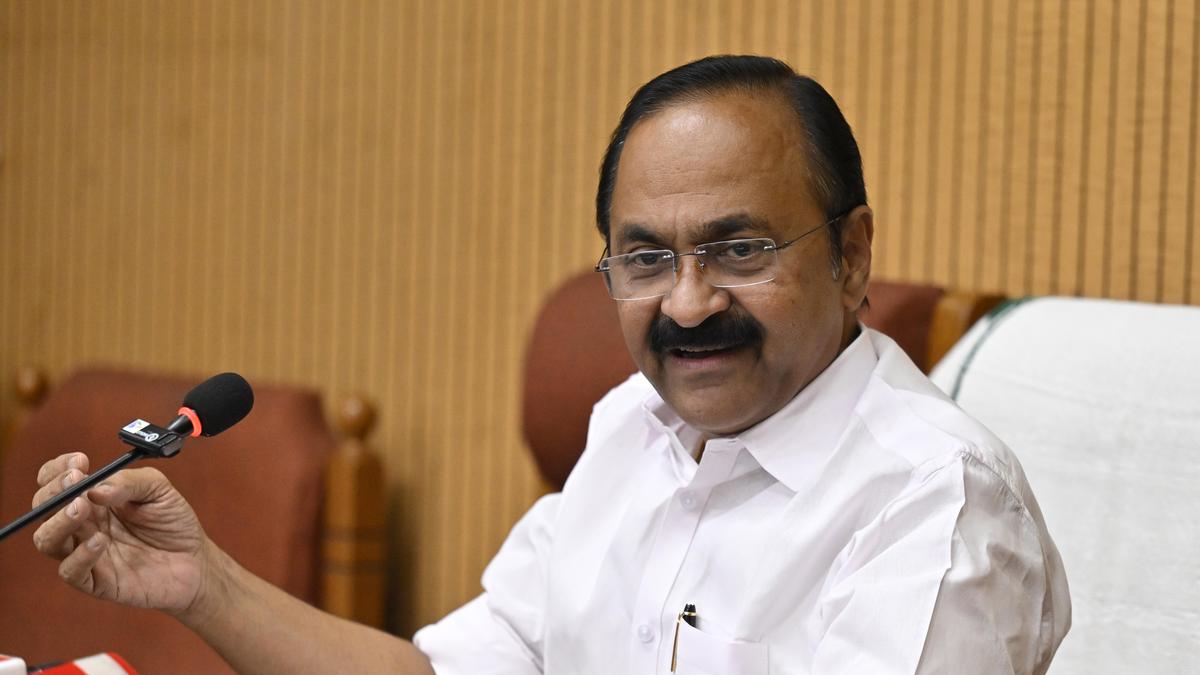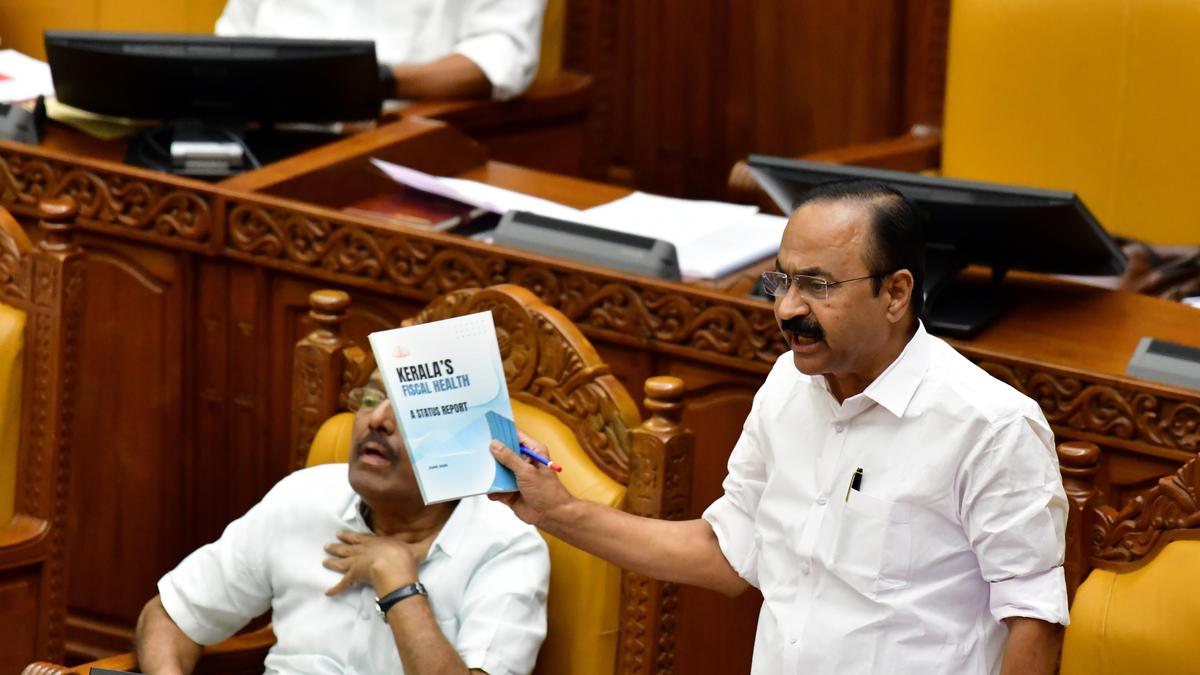
Kerala Chief Minister V.D. Satheesan presenting the White Paper on State's finances in the Assembly on June 4, 2026.
| Photo Credit: Special Arrangement
The White Paper on Kerala’s fiscal health laid in State Assembly on Thursday (June 4, 2026) urges Kerala to start serious discussions with the Union government, observing that Centre-State fiscal relations have deteriorated sharply.The document noted that Kerala today operates in a less flexible fiscal space with the discontinuation of the Goods and Services Tax (GST) compensation, the limits placed on borrowings and the elimination of revenue deficit (RD) grants under the 16th Finance Commission regime.“There seems to be no regular conversation between the Centre and the States. This is an area in which the State must work with other States in a similar position and take the initiative to start serious discussions with the Centre,” the document, drafted by a three-member panel headed by former Union Cabinet Secretary K.M. Chandrasekhar, said.The White Paper reiterates the concern that although Kerala’s share from the divisible tax pool has risen from 1.92% under the 15th Finance Commission to 2.38% under the 16th, this “nominal increase” of 0.457% does not really translate into net gain for the State. This is due to the cessation of the post-devolution RD grants, sector-specific grants, and State-specific grants that Kerala used to receive under the 15th Commission. Over the five-year period of the 15th Commission, Kerala had received ₹37,814 crore as RD grants and ₹2,412 crore under State and sector-specific grants. These heads have been removed for the 16th Finance Commission’s 2026-31 period.‘Fiscal complacency’“The (16th) Commission’s stated rationale for discontinuing RD grants is that they foster fiscal complacency in recipient States. The countervailing consideration, not addressed in the report, is that abrupt discontinuation places the immediate adjustment burden on recipient States, including States whose post-devolution revenue deficits reflect structural revenue constraints rather than discretionary fiscal indiscipline,” the White Paper noted.The White Paper also expresses concernover the difficulties faced by the State in accessing Centrally-sponsored schemes, the reliance of the Union government on cesses and surcharges, which need not be shared with the States, in contributing to curtailing the fiscal space of the States. Published - June 05, 2026 05:22 pm IST