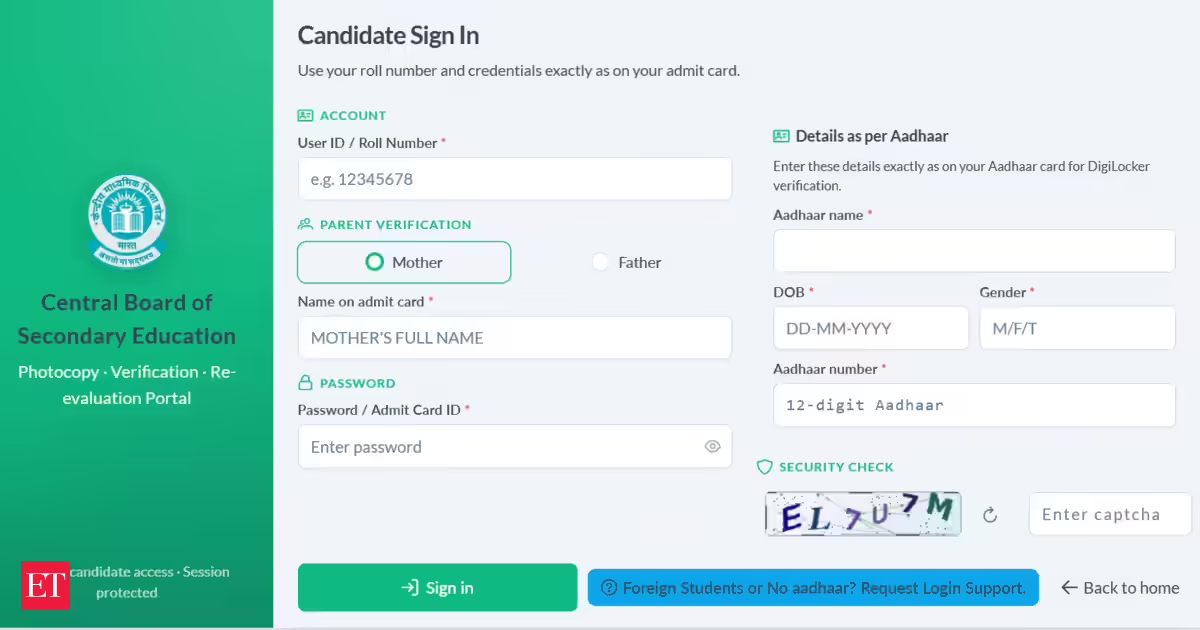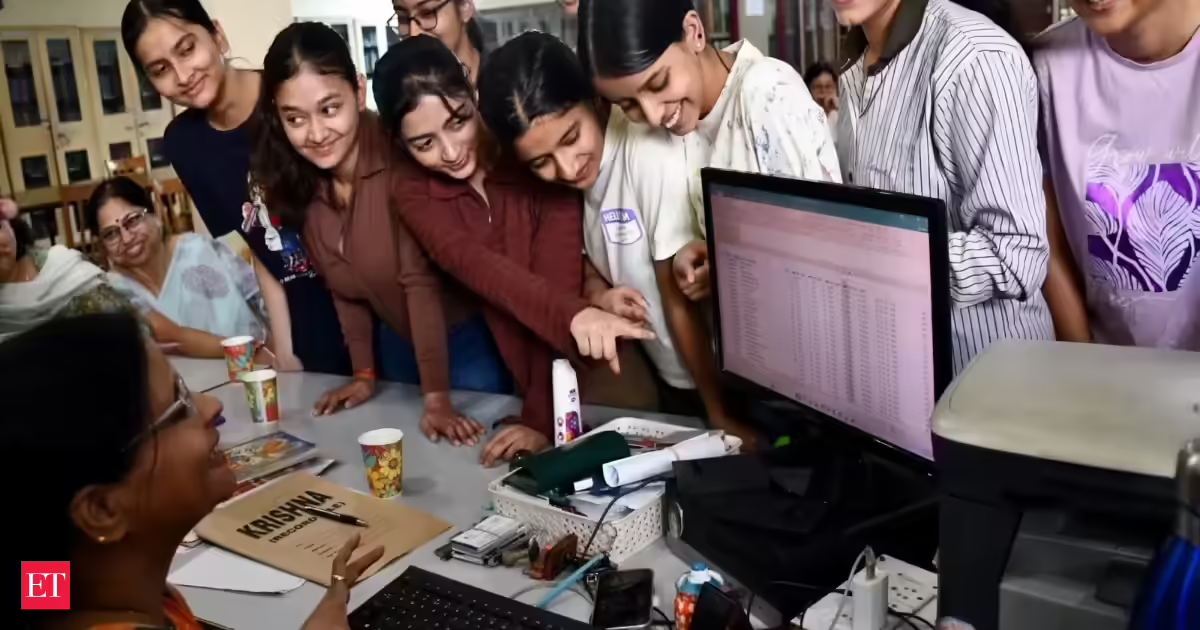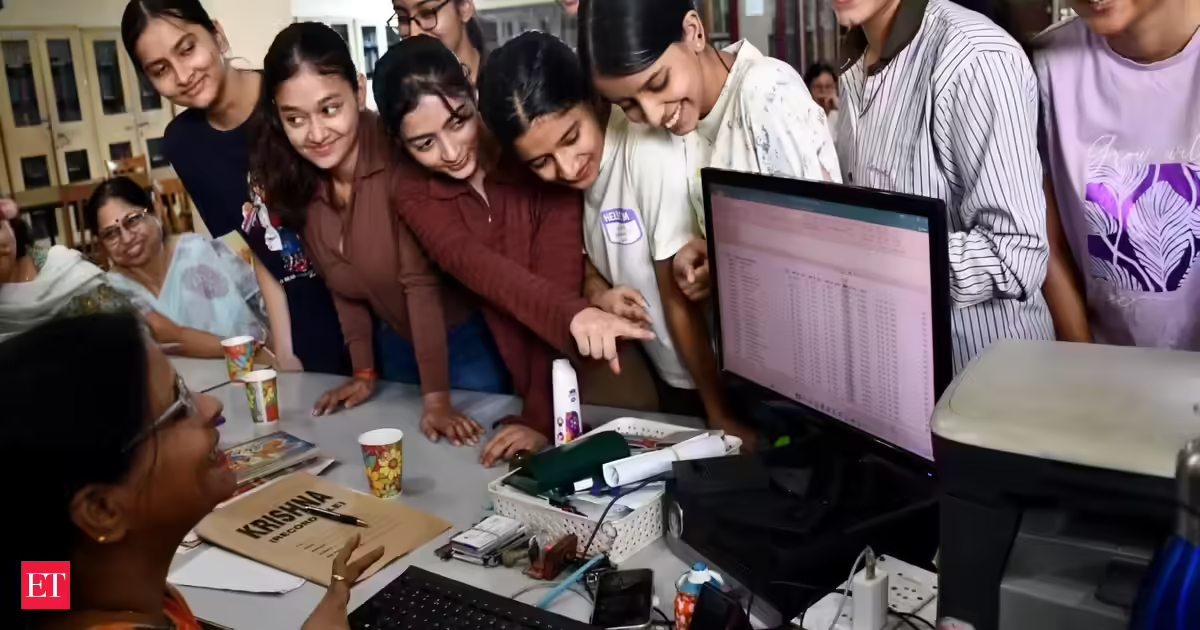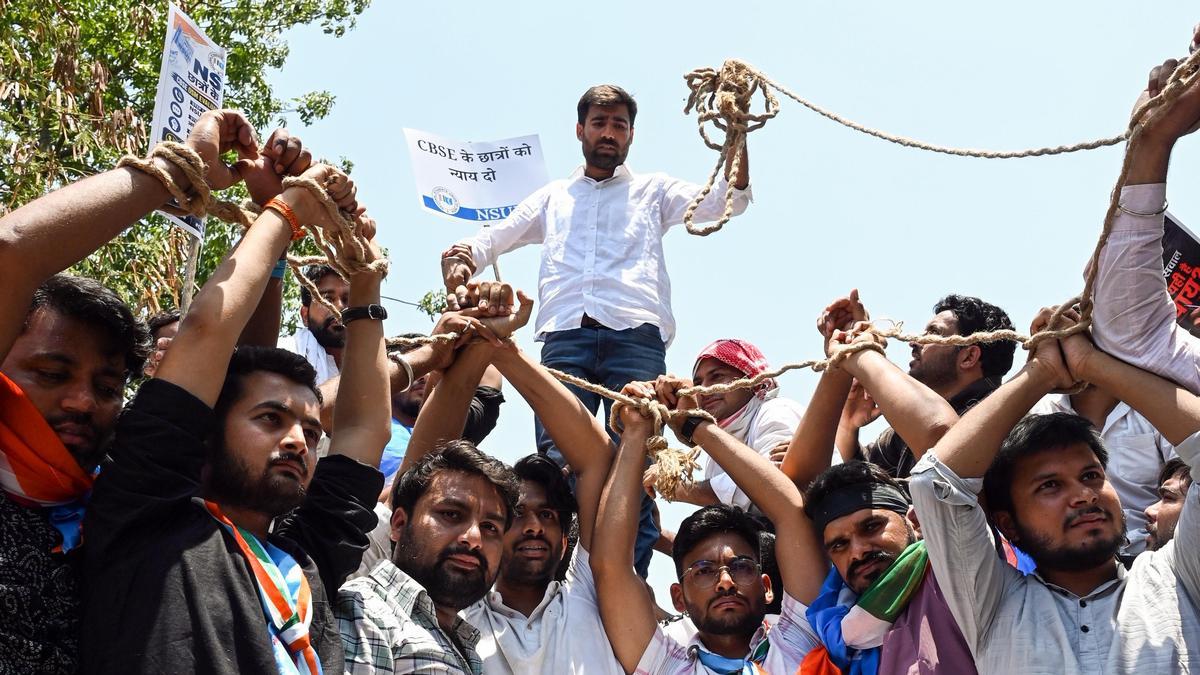
The Central Board of Secondary Education (CBSE) declared the Class XII examination results on May 13, 2026. Three weeks later, students continued to face difficulties in accessing answer scripts and pursuing verification and re-evaluation amid recurring portal disruptions. Although CBSE reopened its On-Screen Marking (OSM) portal on June 2, enabling fee-based access, verification, and re-evaluation, the issues remained unresolved at the time of writing this article, even as the review process was scheduled to conclude by June 6.(Sign up for THEdge, The Hindu’s weekly education newsletter.)Reportedly, around four lakh applications were received seeking access to nearly 11 lakh digitised answer scripts, of which about nine lakhs had been issued by May 29. Subsequently, despite the reopening of the verification and re-evaluation facility, CBSE reported receiving only about 56,000 applications by the evening of June 3. Given that the examination involved nearly 17 lakh students and about 98 lakh answer scripts, these figures appear disproportionately low, raising questions about whether procedural barriers, portal limitations, and timelines have restricted access to the review process for a large section of students.The issue extends beyond recurring portal disruptions. Once answer scripts had been digitised, access and verification could have been enabled through simpler, secure, and more direct communication mechanisms, reducing dependence on portals, payment gateways, applications, and compressed timelines. Instead, the OSM rollout evolved into a multi-stage, fee-based process in which access, verification, and re-evaluation became sequential hurdles. The central question, therefore, is whether a transparency-first approach based on proactive disclosure of digitised answer scripts could have avoided much of the uncertainty, congestion, and controversy surrounding the OSM rollout.Learning from the evolution of MCQ-based digital evaluationThe above question becomes particularly relevant in the context of the transparency framework that has evolved with MCQ-based examinations over the past decade. OSM itself was conceived as an extension of these digital-evaluation principles.In MCQ-based admission and recruitment examinations, candidates are routinely provided copies of their OMR sheets, provisional answer keys are published, objections are invited, and final answer keys are released before results are declared. Candidates can independently estimate their scores and verify the correctness of the evaluation process by comparing their self-assessed scores with the official results. As a result, the scope for ambiguity is minimal, and the need for re-evaluation is largely eliminated.The MCQ-based digital evaluation framework did not emerge automatically. It was pioneered and advocated by the author of this article in the early 2010s and subsequently evolved into a widely accepted model for transparency and accountability in public examinations. Today, it is followed by major examination bodies, including the IITs, CBSE, NTA, and, more recently, UPSC in the Civil Services (Preliminary) Examination. Importantly, access to records, correction of answer-key errors, and candidate verification are provided proactively and transparently. While institutions such as the IITs and UPSC have largely adopted this approach without applications or fees, some examination bodies continue to rely on fee-based objection mechanisms. The broader lesson remains unchanged: transparency is most effective when it is proactive, universal, and free from procedural barriers.Descriptive examinations are undoubtedly more complex than MCQ-based tests because evaluation involves judgment, interpretation, methodology, and step-wise marking. However, greater subjectivity strengthens, rather than weakens, the case for transparency. Students should have access to their scripts and an opportunity to review their evaluated answer scripts, understand how marks were awarded, and identify potential anomalies before being asked to seek verification or re-evaluation. The fundamental principle remains the same: transparency should precede dispute resolution. Access to evaluated records should be proactive and, by default, not contingent upon applications, fees, and procedural hurdles.The success of the MCQ-based framework rests on a simple principle: candidates are first given access to the records on which their results are based and, only if necessary, challenge the outcome thereafter. The current OSM process appears to reverse this sequence by making access, verification, and review dependent on applications, fees, and procedural hurdles. It is this departure from a proven transparency model that lies at the heart of the present controversy.The flawed OSM processInstead of making transparency automatic, the OSM process evolved into a multi-stage, fee-based workflow. Students must first obtain access to their digitised answer scripts, then verify their completeness and authenticity, and only thereafter seek re-evaluation.Reportedly, out of nearly 98 lakh answer scripts generated in the Class XII examination, about 11 lakh scripts were sought through four lakh applications, of which around nine lakh had been issued by May 29. This suggests that a large proportion of answer scripts remained beyond student scrutiny.The process also places on students the responsibility of identifying missing pages, omitted supplementary sheets, unreadable scans, indexing errors, and other deficiencies arising from digitization and document management. At the same time, students are expected to make review decisions within a narrow time window, even when the completeness or accuracy of the records may remain in doubt.The result is a process in which students must navigate applications, fees, and procedural hurdles to identify and correct problems they did not create. A transparency-driven system would have reversed this sequence: first disclose the answer scripts, then verify their integrity, and finally review only those cases where genuine discrepancies are identified.Why should students pay for others’ mistakes?Beyond questions of process design lies a more fundamental issue of fairness. The principle of accountability suggests that the responsibility for identifying and correcting administrative, digitisation, or evaluation deficiencies should rest primarily with the institution conducting the examination. Transparency and verification are not special services to be purchased; they are essential safeguards in an evaluation system. The central question, therefore, is whether students should bear the cost of correcting systemic deficiencies or whether access to records and verification should be available as a matter of right.The controversy deepens when students are repeatedly asked to pay through systems that many find difficult to access. If procedural and technical barriers prevent participation, responsibility cannot fairly be shifted to students. Ensuring access should be the institution’s obligation, not the student’s burden.The way forwardThe lesson from the OSM controversy is straightforward: transparency should be proactive, universal, and free from procedural barriers. The objective should be to ensure that all 1.7 million students have access to their evaluated records, not merely those able to navigate portals, applications, payment gateways, and deadlines.A simple framework based on proactive disclosure of digitised answer scripts through secure, widely used communication channels, such as WhatsApp messaging linked to registered mobile numbers, followed by verification of script integrity and targeted review of genuine discrepancies, could still restore confidence and resolve much of the current controversy. The real test before CBSE is not digitisation, but its commitment to transparency, fairness, and student-centric governance.(Rajeev Kumar is a former Computer Science Professor at IIT Kharagpur, IIT Kanpur, BITS Pilani, and JNU, and a former scientist at DRDO and DST.)
How Proactive, Fee-n-Portal Free Disclosure of Answer Scripts Can Still Prevent the CBSE OSM Crisis?
Students shouldn't bear the financial burden of verifying CBSE's errors in answer script evaluations amidst ongoing transparency issues.
1,123 words~5 min read