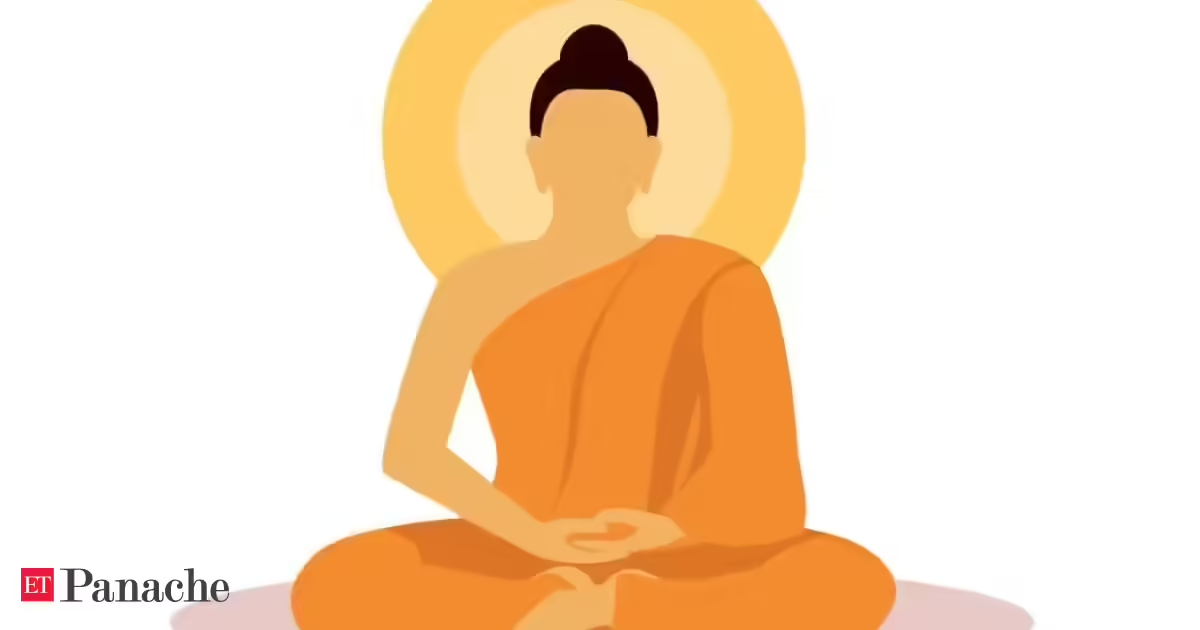
For many people, peace feels like something that will arrive once life becomes perfect. A better job, fewer worries, more money, or the resolution of a lingering problem often seem like the missing pieces. But Buddhist teacher Ajahn Chah offered a very different perspective. According to him, peace does not come from gaining more. It comes from letting go. His simple yet powerful words continue to resonate decades later because they address a struggle nearly everyone faces: the difficulty of releasing attachment, expectations, and control.Buddhist wisdom of the year Ajahn Chah once said, “If you let go a little, you will have a little peace. If you let go a lot, you will have a lot of peace. If you let go completely, you will have complete peace.”Meaning of the quote At first glance, the quote appears straightforward. However, its message touches the core of Buddhist philosophy. The teaching suggests that much of human suffering comes from attachment. People hold tightly to outcomes, possessions, relationships, opinions, status, and even past experiences. The stronger the attachment, the greater the disappointment when life does not unfold as expected. By saying that peace grows in proportion to what we let go of, Ajahn Chah was not encouraging people to stop caring about life. Rather, he was pointing to the freedom that comes from accepting uncertainty and releasing the need to control everything.Relevance of quote in modern life The quote remains highly relevant in modern life. Many people find themselves trapped by endless comparison, workplace pressure, financial anxieties, or the constant need for validation. Often, stress is not created solely by circumstances but by the expectations attached to them. Letting go of the belief that everything must happen according to a specific plan can reduce a significant amount of emotional burden. For example, someone may hold onto resentment after a disagreement, replaying the event for months. Another person may remain attached to a career path that no longer brings happiness simply because it matches an old definition of success. In both cases, the attachment becomes heavier than the situation itself. Ajahn Chah's teaching encourages stepping back and asking whether holding on is truly serving one's well-being. Who was Ajahn Chah? Ajahn Chah was born in a village in Ubon Province in northeastern Thailand. At the age of nine, he moved to a local monastery and was ordained as a novice monk. When he turned twenty, he received higher ordination and studied Buddhist teachings, discipline, and scriptures. Later, he adopted the life of a wandering ascetic monk, travelling through forests, caves, and cremation grounds in search of deeper understanding. During this period, he spent time with the respected meditation master Ajahn Mun, an experience that greatly influenced his spiritual journey. In 1954, Ajahn Chah settled in a forest near his birthplace. The area was considered wild and isolated, known for cobras, tigers, and local ghost stories. Over time, more monks, nuns, and lay followers gathered to learn from him. This eventually became Wat Pah Pong, one of Thailand's most influential forest monasteries. Today, Ajahn Chah's teachings continue to inspire practitioners worldwide, with hundreds of branch monasteries across Thailand and the West carrying forward his emphasis on mindfulness, simplicity, and inner freedom. His message about letting go remains one of the clearest reminders that peace is often found not in what we gain, but in what we are willing to release.
Buddhist wisdom of the day: ‘If you let go a little, you will have a little peace. If you let go a lot, you will have a lot of peace. If you let go completely, you will have complete peace', a lesson on detachment and inner peace
Buddhist teacher Ajahn Chah taught that peace is found in letting go. His wisdom highlights that suffering stems from attachment to outcomes and possessions. Modern life often adds stress through expectations and comparisons. Releasing the need for control brings significant emotional relief. Ajahn Chah's teachings continue to inspire worldwide, emphasizing mindfulness and inner freedom.
565 words~3 min read