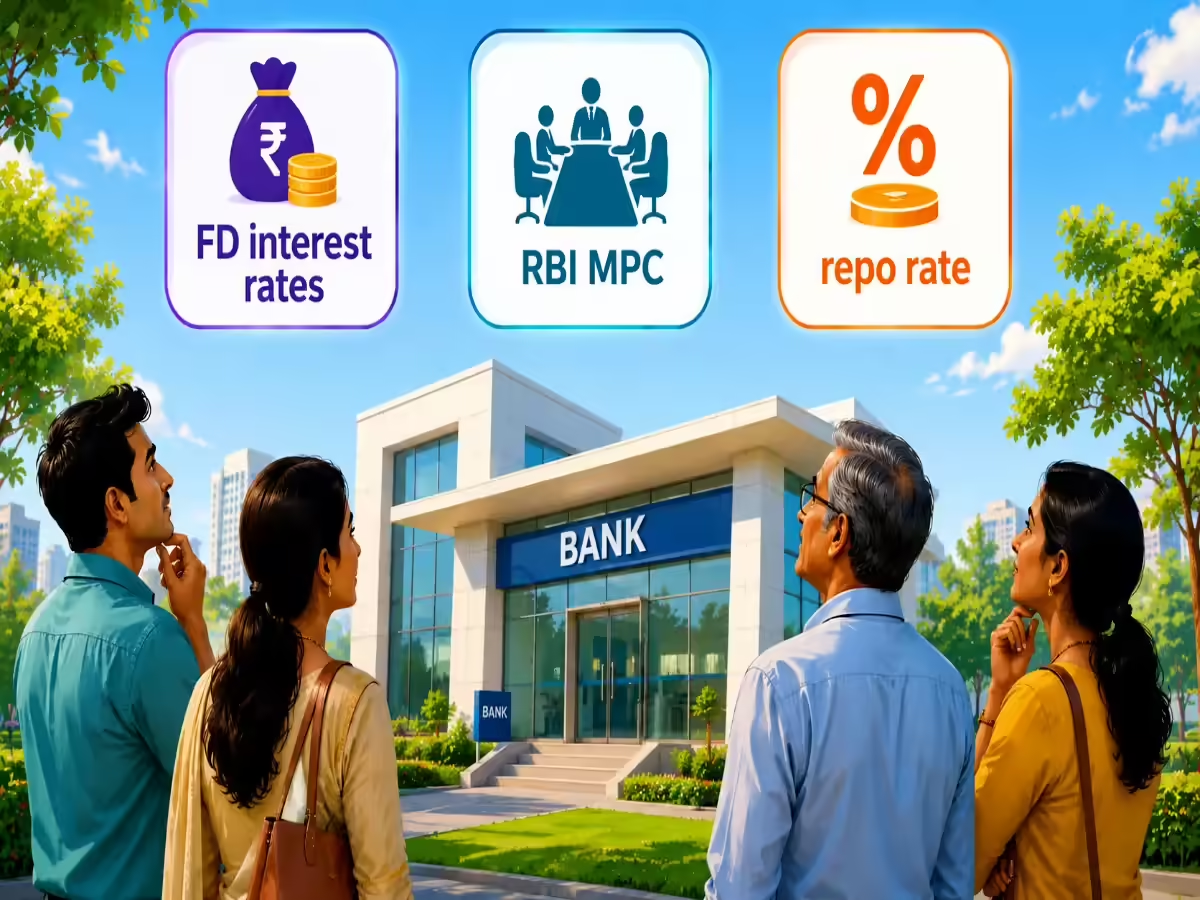
The RBI in its MPC held today kept the repo rate unchanged at 5.25% for the third consecutive time with the last change coming in December 2025. FD investors have been struggling with low interest rates and were eagerly looking forward to rate hike so that they can get better returns on their investment. Their hope was based on rising inflation which is one of the primary factors on the basis of which RBI takes a call on repo rate changes. This pause in repo rate by RBI may have prevented immediate rise in FD rates however the possibility of rate hike in coming MPCs cannot be ruled out. Beside repo rate there are many other factors at play such as deposit-credit ratio, 10-year G Sec yield and attractive interest rates of small savings schemes that also influence banks' decision on increasing FD rates. In the current perspective, many of these indicators are suggesting that banks may increase FD rates in the upcoming months, providing relief to a lot of investors looking for respite after a low FD rate cycle triggered by 125 bps repo rate cut in the year 2025. Let’s discuss factors that may make banks to increase FD rate. Repo rate- Brief history Date Repo rate (%) Change (%) 07-Feb-25 6.25% -0.25% 09-Apr-25 6.00% -0.25% 06-Jun-25 5.50% -0.50% 06-Aug-25 5.50% 0.00% 05-Dec-25 5.25% 0.25% 06-Feb-26 5.25% 0.00% 08-Apr-26 5.25% 0.00% Rising inflation Fuel, gas, household and other item prices rose in India in the wake of the Iran-Israel conflict. The recent US’ attacks on Iran and Israel’s attack on Lebanon aggravated the crisis further, stocking fresh fears on rising fuel prices. Even though the US House of Representative has voted to halt the Iran war, and Israel’s negotiations with Lebanon for a ceasefire are going on. Repercussions of these conflicts are being felt in the form of rising inflation across the world, including India. From October 2025’s low of 0.25%, inflation in India rose to 3.48% in April 2026. The data for May is yet to come but experts expect a higher rate. When inflation rises, the RBI reacts by increasing the repo rate. It provides banks a cushion to increase FD rates, which can’t be ruled out in the near future. Top 5 FD rates from PSU banks Bank Highest FD Rate (%) Tenure Punjab & Sind Bank 6.75% 666 days Bank of India 6.70% 3 years Bank of Maharashtra 6.65% 400 days Central Bank of India 6.65% 333 days Union Bank of India 6.65% 555 days Source: PaisabazaarTop 5 FD rates from private sector banks Bank Highest FD Rate (%) Tenure DCB Bank 7.50% 24 months to less than 25 months; 34 months to less than 35 months; 60 months to 61 months CSB Bank 7.35% 18 months SBM Bank India 7.30% Above 18 months to less than 2 years 3 days Bandhan Bank 7.25% 2 years to less than 5 years City Union Bank 7.25% 555 days Source: PaisabazaarTop 5 FD rates from small finance banks Bank Highest FD Rate (%) Tenure Suryoday Small Finance Bank 8.10% 30 months Utkarsh Small Finance Bank 8.10% 666 days Shivalik Small Finance Bank 7.80% 21 months 1 day to 22 months Jana Small Finance Bank 7.77% Less than 3 years to 5 years ESAF Small Finance Bank 7.75% 2 years to less than 3 years Source: PaisabazaarDeposit-credit ratio indicates banks are under pressure to garner depositsAdhil Shetty, CEO, Bankbazaar.com, says banks operate on a simple principle of balancing incoming deposits against outgoing loans and other obligations. “If credit demand is strong but deposits are scarce, as we've seen through early 2025, banks raise FD rates to attract savers. Conversely, if loans are weak and deposits pile up, they cut rates.” Shetty further says banks also monitor credit-to-deposit ratios closely. “A high ratio signals deposit scarcity and justifies rate hikes. Additionally, when banks struggle to borrow from each other, signalling system-wide cash shortage, they raise FD rates to attract deposits.”If banks have robust lending and falling short of deposits they are likely to increase interest rates on FDs to attract more depositors.CD ratio of Indian banks climbed to a very high level of 82 percent on December 15, 2025, and indicates that banks have very good demand for loans in comparison to deposits they have garnered. Therefore, banks are continuously looking for resource mobilisation to support the growth of their loans. Raising interest rate is one of the primary tools which they can utilise to mobile more deposits. 10-year G Sec yield is not coming down Banks try to keep FD interest rates higher than government securities to attract investors. Since the 10-year G-Sec yield is considered as an important benchmark for many interest rates in the country, looking at its rise in the last few months gives the impression that banks may also increase their fixed deposit rates in the future. The 10-year G-Sec is continuously hovering around 7%. On June 5, 2026, the yield stood at 6.961%. Elevated level of G-Sec yield suggests that market is expecting a higher rate on deposits.Small savings schemes have been offering attractive rates Bank FDs also face stiff competition from small savings schemes which have also been offering attractive rates. Since a large number of people invest in small savings scheme, the government has avoided decreasing small savings scheme interest rates since December 2024. If small savings schemes keep offering higher rates, banks can’t keep FD interest rates low for a long time. Small savings scheme interest rates Scheme Interest Rate (%) Tenure / Maturity Senior Citizen Savings Scheme (SCSS) 8.2 5 years Sukanya Samriddhi Account (SSA) 8.2 21 years (maximum) National Savings Certificate (NSC) 7.7 5 years Kisan Vikas Patra (KVP) 7.5 115 months Monthly Income Scheme (MIS) 7.4 5 years Post Office Time Deposit (5-year) 7.5 5 years Public Provident Fund (PPF) 7.1 15 years Source: Post office website What should an investor do if banks increase FD rates? Shetty says if rates rise, investors with unlocked capital should lock in returns promptly, especially at longer tenors like five years, where the rate differential is widest. Vijay Kuppa, CEO of InCred Money, says conservative investors to lock in FDs and stagger maturities. Kuppa’s advice for moderate investors is to allocate more to fixed income. Aggressive investors can rebalance portfolios while maintaining long-term equity exposure, suggests Kuppa.
RBI MPC 2026: Will FD interest rates increase as RBI holds repo rate? - The Economic Times
Despite the RBI keeping the repo rate unchanged, several factors suggest banks may increase fixed deposit rates soon. Rising inflation, a high deposit-credit ratio, and attractive small savings schemes are pushing banks to offer better returns to attract investors after a period of low FD rates.
1,058 words~5 min read