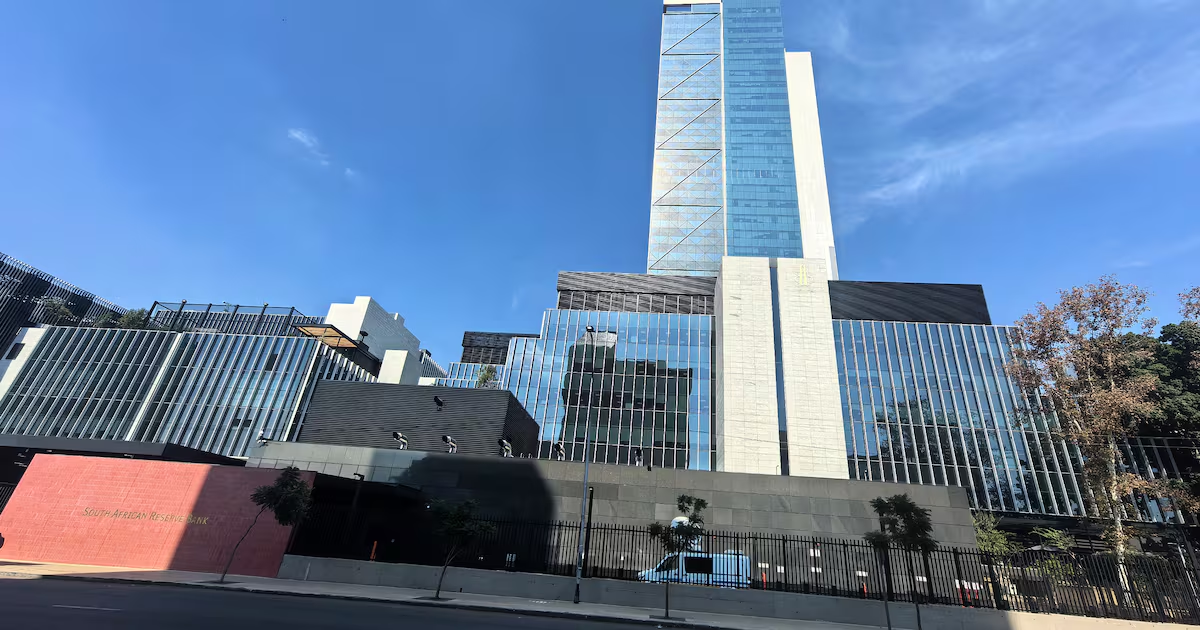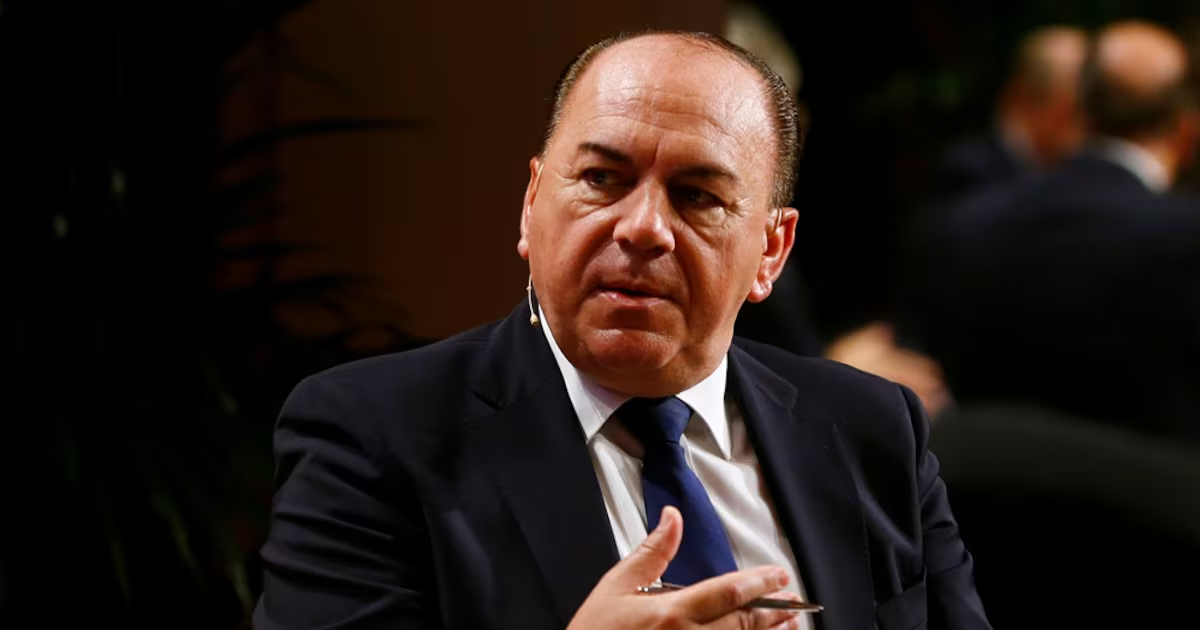
The world’s multilateral institutions must urgently improve co-ordination to respond to rising protectionism and geopolitical volatility, which are creating inflationary pressures and headwinds to growth.This is according to Prof Axel A Weber, president of the Centre for Financial Studies at Goethe University Frankfurt and former president of the Deutsche Bundesbank, who delivered the inaugural Tito Mboweni Memorial Lecture in Cape Town on Thursday.With the support of the Mboweni family, the lecture was launched by the South African Reserve Bank (SARB).Mboweni, a seasoned politician whose career highlights include being democratic South Africa’s first labour minister, the first black SARB governor and championing Operation Vulindlela as finance minister, died in 2024. Weber said a report he co-authored for the G7 economies warns that the global economy is once again threatened by deep structural imbalances, excessive current account surpluses and deficits, weak investments, industrial overcapacity, high debt levels and declining international solidarity.“We argue in our report that imbalances fuel trade tensions, that financial instability helps to push protectionist pressures, and that geopolitical fragmentation is a threat that is real for the global economy.” The lecture comes while the US has been at the centre of two of the sharpest global inflationary pressures, not least of which is its ongoing war with Iran and a raft of unilateral tariffs imposed on economies worldwide, including strategic geopolitical allies and trade partners. Weber said that he, as an economist, authored the report that advocated co-ordinated multilateral responses rather than unilateral trade wars or economic coercion. “Our recommendations include stronger international policy co-ordination, increased domestic demand in surplus countries, fiscal consolidation in deficit countries, renewed productivity investments, strengthened IMF surveillance and reforms of global governance when it comes to trade.”Weber said that during his time as governor of the SARB, Mboweni repeatedly warned against fiscal laxity, inflationary pressures and the dangers of excessive external vulnerability. “He understood that emerging economies are often the first casualties when global liquidity tightens and when geopolitical tensions disrupt and trade and capital flows get intermediated and disrupted.We argue in our report that imbalances fuel trade tensions, that financial instability helps to push protectionist pressures, and that geopolitical fragmentation is a threat that is real for the global economy.— Prof Axel A Weber“These themes strongly resonate with me, and you will find that they are also strongly embedded in a recent report of the G7 economies, a group of four economists, as a memo on global imbalances submitted to the French presidency for the meeting that will happen later this year in Libya.”He said the US is a huge exporter of digital and financial services and a recipient of global capital flows, but that it is critical to understand the dynamics that, overall, the balance of payments will always be balanced. “It’s the disequilibria in parts of that balance of payment that cause the problem. And in my view, these might not be the underlying complete source of global imbalances. “These sectoral imbalances are much harder to correct and will take much longer. So we should start now, given that we’re heading in the wrong direction and we’re picking up speed in that.”Weber said that Mboweni understood earlier than many that South African economic destiny could never be separated from the health of the global economy and that he consistently argued that macroeconomic stability, institutional credibility and international co-operation were indispensable for sustainable development.
For the love of Tito: Economist urges multilateral unity against growth rut
Tito Mboweni's legacy of global engagement remains relevant, says Germany’s Axel Weber
562 words~3 min read