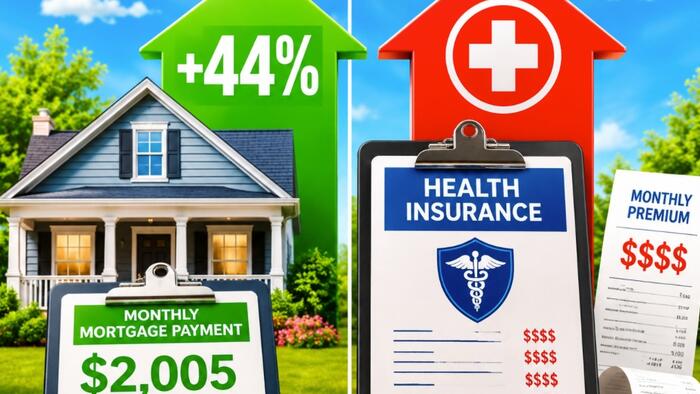
Mortgage Rates 2026: For millions of Americans, the dream of homeownership has become more expensive than ever. The average mortgage payment has now crossed a milestone that would have seemed unthinkable just a few years ago. According to Realtor.com research, the average mortgage payment reached $2,005 during the third quarter of 2025, marking the first time it has surpassed the $2,000 level. That figure is 44% higher than it was only four years earlier.The surge reflects two powerful forces reshaping the housing market. Home prices have continued climbing across much of the United States, while mortgage rates remain stubbornly elevated. Even after multiple Federal Reserve rate cuts in 2024 and 2025, the average 30-year mortgage rate stood at 6.48% in early June 2026. For many buyers, that combination has created a financial squeeze that affects affordability, savings, and long-term wealth building.Why is the average mortgage payment rising despite Federal Reserve rate cuts?Many homebuyers assume mortgage rates move directly with Federal Reserve decisions. In reality, mortgage rates follow a different path. The Fed controls short-term borrowing costs, but mortgage rates are largely determined by financial markets and investor expectations.When investors buy mortgage-backed securities, they are making long-term bets on inflation, economic growth, and government borrowing. If investors believe inflation could remain elevated, they demand higher returns. Those higher returns eventually translate into higher mortgage rates for consumers.Government borrowing also plays an important role. Rising federal deficits require the Treasury to issue more bonds. As bond supply increases, investors often seek higher yields. Mortgage rates typically move alongside yields on the 10-year Treasury note, which explains why mortgage costs can remain elevated even when the Fed lowers rates.The result is clear in today’s housing market. Mortgage rates remain near multi-year highs, pushing the average mortgage payment higher and limiting affordability for many families.What is the average mortgage payment in 2026 and what does it mean for buyers?The latest available data shows the average mortgage payment reached $2,005 per month. That number represents more than a statistical milestone. It reflects a fundamental shift in housing affordability across America.For many households, housing costs now consume a larger share of monthly income. A mortgage payment that exceeds $2,000 can significantly reduce flexibility for saving, investing, or handling unexpected expenses. First-time buyers often feel the greatest pressure because they face both higher home prices and elevated borrowing costs.Yet historical perspective matters. During much of the 1990s and early 2000s, mortgage rates commonly ranged between 6% and 8%. The ultra-low mortgage rates below 3% seen during 2020 and 2021 were extraordinary exceptions rather than the norm.This distinction is important. Many consumers continue comparing today’s market with pandemic-era conditions. However, the current environment may represent a return to more historically typical mortgage pricing rather than an abnormal spike.How can improving your credit score lower your mortgage payment?One of the most effective ways to lower your mortgage payment begins long before applying for a loan. Your credit score directly influences the mortgage rate lenders offer.Recent Experian data shows borrowers with credit scores above 780 receive significantly lower average mortgage rates than borrowers with scores around 620. Even a modest reduction in your interest rate can produce substantial savings over time.A lower mortgage rate reduces monthly payments immediately. Over a 30-year loan, the difference can amount to tens of thousands of dollars in interest savings. That is why financial experts often recommend improving credit scores six months to a year before seeking mortgage approval.Simple actions can help. Paying bills on time, reducing credit card balances, avoiding new debt, and monitoring credit reports regularly can gradually strengthen your credit profile. These habits may seem small individually, but together they can dramatically reduce the long-term cost of homeownership.As investor Warren Buffett famously observed, “Risk comes from not knowing what you're doing.” In the mortgage market, knowledge and preparation remain powerful financial tools.What are the best ways to lower your mortgage payment in today’s housing market?Beyond credit improvement, several strategies can help reduce the average mortgage payment burden. One of the most effective is increasing your down payment. A larger upfront contribution reduces the loan amount, resulting in lower monthly payments and potentially better loan terms.Shopping carefully among lenders can also create meaningful savings. Different lenders evaluate risk differently, which means mortgage rates and fees often vary. Comparing multiple offers remains one of the simplest ways to reduce borrowing costs.For eligible military families and veterans, specialized loan programs may provide access to competitive rates and favorable terms. Digital-first lenders can also offer lower operational costs that sometimes translate into better pricing for borrowers.Perhaps the most important lesson is patience. Mortgage rates are influenced by forces far beyond any individual’s control. Inflation expectations, Treasury yields, government borrowing, and investor sentiment all shape the market. While borrowers cannot change those factors, they can strengthen their financial position.The average mortgage payment may have reached a record high, but informed borrowers still have opportunities to reduce costs. In a market defined by uncertainty, preparation often becomes the most valuable advantage. Understanding how mortgage rates work is no longer just financial knowledge. For many Americans, it has become an essential life skill.
Why has the average mortgage payment crossed $2,000, and how can you lower yours as mortgage rates remain stubbornly high in 2026?
The average mortgage payment has surged past $2,000 for the first time, reaching $2,005 as high mortgage rates, rising home prices, and persistent inflation reshape the U.S. housing market. Many buyers expected Federal Reserve rate cuts to bring relief. Instead, the average 30-year mortgage rate remains near 6.5%. The real story runs deeper. Treasury yields, investor caution, and growing federal debt continue driving borrowing costs higher. Yet smart moves matter. A stronger credit score, larger down payment, and lower-rate lender can significantly reduce your mortgage payment and long-term homeownership costs.
854 words~4 min read