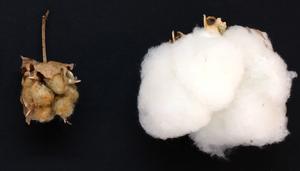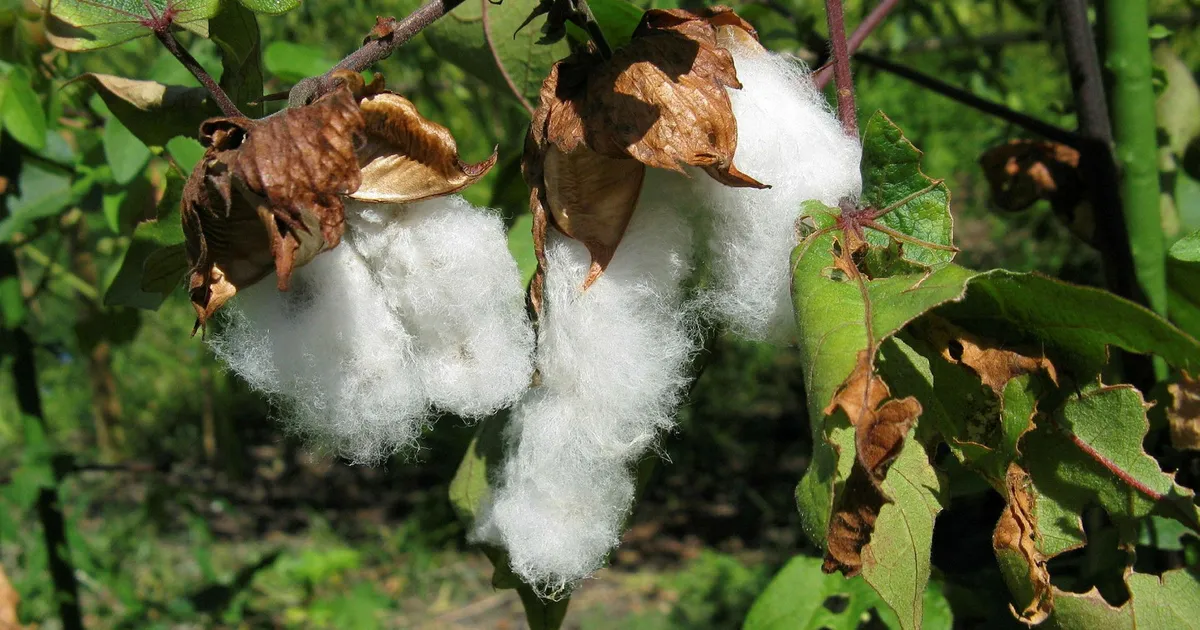
Current sectionArchaeologyThe Upland species was thought to have come from Peru. It didn't; and'Egyptian' cotton comes from EcuadorShare to FacebookShare to XArticle printing is available to subscribers onlyPrint in a simple, ad-free formatSubscribeComments: Zen reading is available to subscribers onlyAd-free and in a comfortable reading formatSubscribeTree cotton, Goissypium arboreum - it's a real thing Credit: KENPEITree cotton, Goissypium arboreum - it's a real thing Credit: KENPEI04:02 PM • June 04 2026 IDTThe origin of fashion has always been a mystery. In our deep past, clothing was made of animal pelts, we assume. The earliest example of prehistoric sewing is only 12,400 years old, by paleo-Americans in Oregon but there is indirect evidence such as ancient needles that much earlier prehistoric Europeans were garbed. In addition, both humans (and Neanderthals!) knew how to make cord from plants such as flax tens of thousands of years ago, with the earliest examples of actual textiles found in caves in Georgia from over 34,000 years ago. So we suspect early modern human Europeans and possibly the Neanderthals could weave textile.Today however cloth is the rage rather than animal skins, for a host of reasons, including humanitarian. We couldn't raise enough animals to clothe billions of people anyway. It is true that today, the majority of clothing, over 60 percent, is synthetic. But the second most common material today is cotton, specifically the Upland variant of cotton.The burning question of the day is where Upland cotton was domesticated. One snag in elucidating its story is that different peoples apparently domesticated different cotton species on different continents at different times; and the different cotton variants intermixed. It's al;l been very messy.From the mess, one variant called Upland Cotton rose to supremacy and become the most profitable non-food crop in the world. It is grown everywhere, but its origins were unclear; and it is a good thing to know where crops we count on originated. For instance, we might want to find the wild ancestral plants, in order to extract original features that vanished in the domesticate.A bud of cotton in Taiwan Credit: Ping an ChangA bud of cotton in Taiwan Credit: Ping an ChangThe earliest fabrics made of cotton were found in Neolithic Peru, from about 8,000 years ago, and it was therefore widely assumed that this is where Upland Cotton (Gossypium hirsutum) was first domesticated. But that isn't so, according to a new genetics-driven study published in the Proceedings of the National Academy of Sciences on the domestication of cotton by Weixuan Ning, evolutionary biologist Jonathan Wendel at Iowa State University, Corrinne Grover and colleagues.Upland cotton was domesticated between 7,000 and 4,000 years ago in the Yucatan peninsula. Subsequently, early domestic Upland spread through Central America, then into the Caribbean and northern South America, the team reports. As it spread, new variants emerged. The Mexican domesticate was introduced to Europe by Spanish conquistadores in the 16th century.A variant cotton known as Gossypium darwinii, Cristobal Island Credit: Benjamint444A variant cotton known as Gossypium darwinii, Cristobal Island Credit: Benjamint444Why is Upland so common now? It is relatively amiable to the farmer, conveniently in relatively diverse range of soils. It is relatively productive, though Egyptian cotton (Gossypium barbadense) is considered to be softer and to have longer fiber. But shorter fibers can produce thicker yarns, conferring greater absorbency.Today Upland is grown on every continent that can and cares to. Pest control is key. It's called upland because it was historically grown on the slopes while other cotton types do better in lower-lying wetlands. That is its origin story. Egyptian cotton is also grown all over the place.Out of AfricaWait, how many species of cotton are there? The last common ancestor of all cotton emerged in Africa about 10 to 5 million years ago, separate work suggests. Over the eons, its seeds spread worldwide, by land and sea; and over the eons, different cotton species emerged in the Americas, Eurasia and Africa.Gossypium barbadense (Sea island cotton, creole cotton, pulupulu haole)
Where was cotton domesticated? Messy genetics dishes up surprising answer
The Upland Species Was Thought to Have Come From Peru. It Didn't; and'Egyptian' Cotton Comes From Ecuador
1,484 words~7 min read