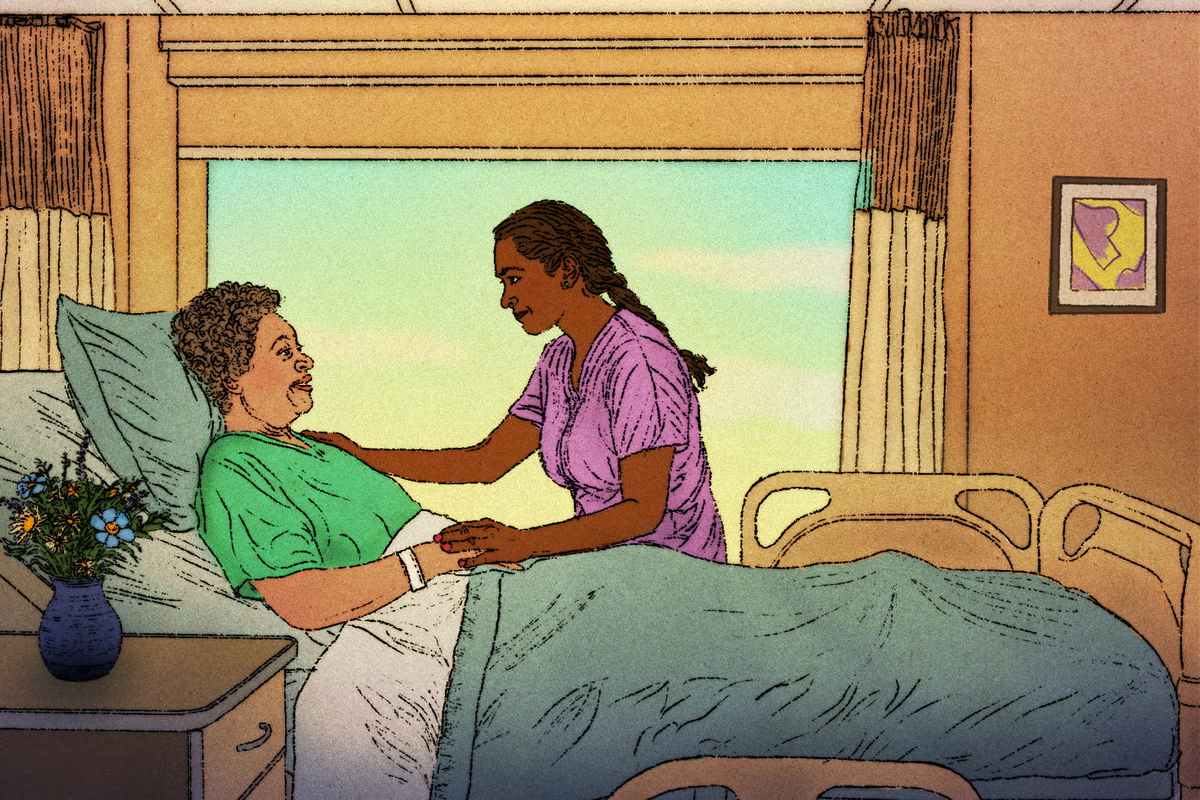
A new study on workforce automation identifies 10 human skills—and the jobs that rely on them most—that are least likely to be replaced by AI.gettyAs artificial intelligence continues to reshape the labor market, many workers are asking a troubling question: Will my job survive the next wave of automation? For millions of Americans, the concern is no longer theoretical. Job searches are stretching into months or even years, entry-level opportunities are disappearing and employers increasingly expect workers to arrive with skills they once provided through training programs.New research suggests that while AI may replace certain tasks, it remains far less capable of replicating distinctly human skills involving judgment, empathy, relationship-building and decision-making under pressure.The anxiety is understandable. According to new data from Unily, more than 37% of job seekers worry they won’t get hired despite doing everything right, while 31% say AI and automation make it harder to stand out. Adding insult to injury, the 20-minute breaking point—the moment when applicant enthusiasm begins to collapse under the weight of cumbersome application systems—causes candidates to give up.The Unily report shows more than a third of younger respondents report feeling uncomfortable using AI, and more than one in four say they would leave a new job within a year if expectations aren't met. Concerns about burnout and workplace culture are also weighing heavily on workers.The findings align with Monster’s recent Job Search Strain Report, which found that one in four job seekers has been searching for work for more than a year, 39% feel more desperate to get hired than in previous searches and nearly one-third would accept a pay cut simply to secure employment.MORE FOR YOU10 Human Skills That Protect Your Job From AIAgainst this backdrop, a May 2026 report from ClickFinder offers an encouraging message: certain skills remain remarkably resistant to automation. The study analyzed O*NET data across 84 occupations and identified the skills most strongly associated with jobs carrying the lowest automation risk. Rather than focusing on specific occupations, researchers examined which capabilities consistently appeared across multiple low-risk roles. The results reveal a common theme: the safest skills are those that require human judgment, emotional intelligence, adaptability and real-world interaction.1. Crisis Intervention And Emergency Decision-MakingTopping the list is crisis intervention and emergency decision-making. The skill appears in 22 of the 84 occupations studied, including emergency medical technicians, paramedics, firefighters, healthcare social workers and police officers. These jobs carry an average automation risk of just 9.8%.Why is it so difficult to automate? Emergencies are unpredictable. They unfold in rapidly changing environments filled with uncertainty, incomplete information and life-or-death consequences. While AI can assist with information processing, it cannot safely replicate the split-second judgment required when conditions change by the minute.2. Complex Case Diagnosis And Differential ReasoningThe second-ranked skill appears in 24 occupations and is especially common among dentists, physicians, nurses and nurse anesthetists. These jobs face an average automation risk of only 16.6%.Diagnostic reasoning requires more than pattern recognition. Healthcare professionals frequently evaluate conflicting symptoms, ambiguous evidence and patient histories that don't fit neatly into predefined categories. Human expertise remains essential when information is incomplete or contradictory.3. Patient Physical AssessmentPatient physical assessment ranks third, appearing in 18 occupations including paramedics, physical therapists and registered nurses. These roles also carry an automation risk of roughly 17%.The skill involves far more than collecting measurements. Experienced clinicians synthesize visual observations, tactile information, sounds and subtle cues that may never be captured by sensors or diagnostic software. Human presence remains a critical component of effective assessment.4. Client And Patient Relationship CultivationOne of the strongest findings in the study is the importance of relationships. Client and patient relationship cultivation appears in 41 of the 84 occupations examined—nearly half the sample—and is associated with an average automation risk of just 18%.Whether it's a physical therapist helping a patient recover, a social worker supporting a family in crisis or a hairstylist building loyalty over years, trust remains a uniquely human asset. AI can provide information, but genuine relationships require empathy, credibility and emotional connection.5. Crisis De-Escalation And Conflict ResolutionAppearing in 32 occupations, crisis de-escalation and conflict resolution ranks fifth. The skill is common among EMTs, social workers, police officers and human resources professionals and carries an average automation risk of 18.8%.Managing conflict requires interpreting emotions, reading subtle social cues and adapting responses in real time. Human behavior is notoriously unpredictable, making conflict resolution one of the most difficult skills for machines to replicate.6. Emergency And Business Continuity LeadershipThe ability to guide organizations through disruption ranks sixth. Found in occupations such as firefighters, chief executives, operations managers and information systems managers, this skill carries an average automation risk of 21.2%.Leadership during uncertainty requires balancing competing priorities, making judgment calls with limited information and coordinating people under pressure—areas where human decision-making still holds a significant advantage.7. Public Speaking And Executive PresentationPublic speaking and executive presentation skills rank seventh, appearing in occupations ranging from chief executives and lawyers to educators and political scientists. The average automation risk for these roles is 22.2%.While AI can generate speeches, effective communication requires audience awareness, persuasion, authenticity and the ability to adjust messaging based on live feedback. Those are inherently human strengths.8. Safety Compliance And Code InterpretationThe eighth-ranked skill combines technical knowledge with contextual judgment. It appears in occupations such as electricians, HVAC technicians, plumbers and industrial engineers and carries an average automation risk of 22.8%.Rules and regulations may be documented, but applying them correctly often depends on circumstances that vary from one environment to another.9. Risk Assessment And Safety Judgment On-SiteAppearing in 26 occupations, risk assessment and safety judgment requires evaluating dynamic environments and identifying hazards before they become problems. Jobs associated with this skill include paramedics, firefighters, electricians and construction workers. Average automation risk is 23.6%.Real-world settings are messy and unpredictable, making on-site judgment difficult to automate.The Common ThreadRebecca Hubbard, Technical Director at ClickFinder, says the findings challenge conventional assumptions about automation."The skills that protect healthcare jobs from automation are not the ones you might expect. Complex diagnosis ranks highly, but it is not the top skill. Crisis intervention is. That means a paramedic making split-second decisions on a roadside is safer from automation than a physician diagnosing a rare disease from an office. The reason is not about intelligence. It is about environment. The emergency scene is chaotic, unpredictable and full of incomplete information. AI can handle controlled environments much sooner than it can handle chaos."Perhaps the study’s most important takeaway is that interpersonal skills consistently outrank purely technical abilities. Relationship-building, empathy, communication and adaptive judgment appear across far more occupations than specialized technical expertise. As AI becomes increasingly capable of handling routine tasks, the qualities that make us distinctly human may become our greatest competitive advantage.
10 Human Skills Likely To Protect Your Job From AI, Per ClickFinder
A new workforce automation study highlights 10 uniquely human skills and the careers most likely to remain resilient in the age of AI.
1,116 words~5 min read