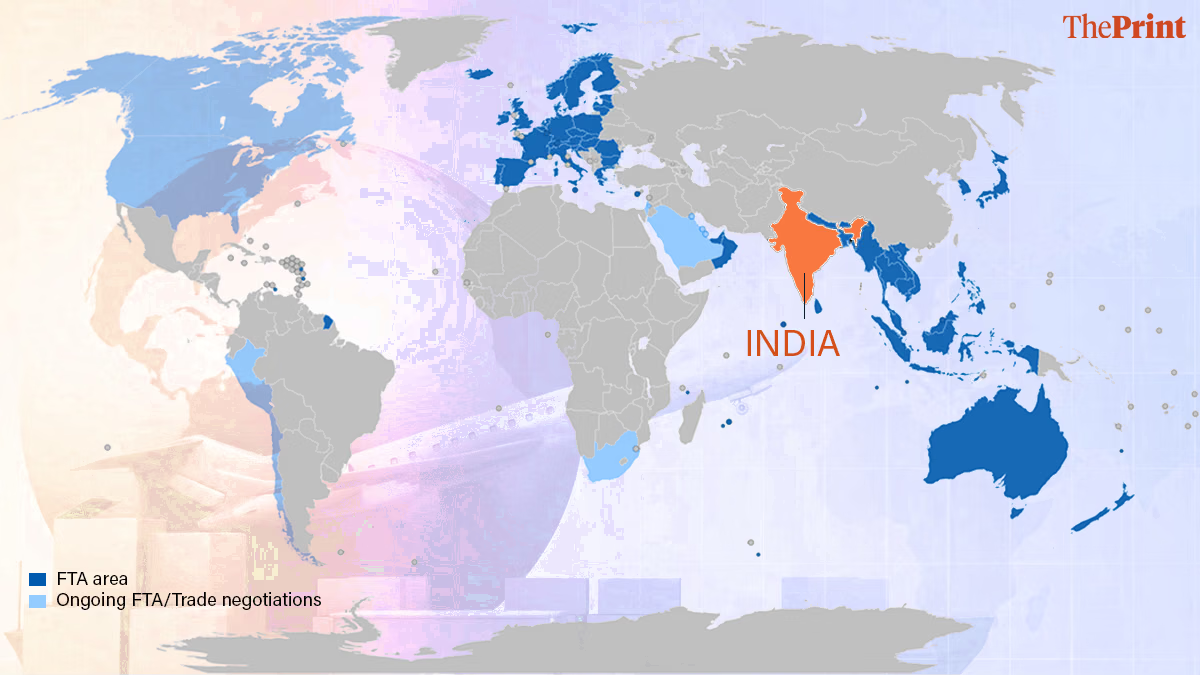
India may be on the verge of an export-led growth cycle similar to what China experienced after it entered the World Trade Organization (WTO), Saurabh Mukherjea, Founder of Marcellus Investment Managers, said at the ET Alpha Wealth Summit on Thursday.He believes a combination of free trade agreements (FTAs), a weakening rupee, and shifting global supply chains could create a massive opportunity for Indian exporters over the coming decade.Also Read | ET Alpha Wealth Summit: Future alpha may emerge from neglected markets and asset classes, says Kalpen Parekh Speaking at the event, Mukherjea outlined three themes that he finds particularly attractive: export-oriented Indian companies, small and mid-cap (SMID) companies in developed markets, and high-quality Indian financial services firms.Mukherjea drew parallels between India's current position and China's strategy in the 1990s. Before entering the WTO, China sharply devalued its currency, improved export competitiveness, and went on to deliver decades of export-led growth.While India is pursuing bilateral trade agreements rather than WTO-led integration, Mukherjea believes some of the conditions for a manufacturing and export boom are beginning to emerge.According to him, India can no longer rely solely on IT services to generate foreign exchange. As global technology spending patterns evolve and competition intensifies, manufacturing exports may need to play a much larger role in financing the country's import requirements.He expects the rupee to continue depreciating over the long term, improving India's competitiveness relative to export-driven economies such as Vietnam and Bangladesh. "The future around manufacturing exports looks good," Mukherjea said, pointing to the combination of FTAs and currency movements as potential tailwinds for exporters.Mukherjea believes the proposed India-European Union free trade agreement could become a significant catalyst for several export-oriented industries. He highlighted sectors such as textiles, where India could gain a meaningful tariff advantage over China once the agreement becomes operational.According to Marcellus' analysis, sectors where India could enjoy a competitive advantage over China represent a combined export opportunity of nearly $5 trillion. Current exports from these sectors are estimated at around $50 billion, suggesting substantial room for growth if India can capture even a fraction of the potential market. Textiles, in particular, could be among the key beneficiaries.Mukherjea noted that despite being a large economy, India has fallen behind countries such as Vietnam and Bangladesh in several export categories. He expects the next few years to provide an opportunity for Indian manufacturers to regain market share.Also Read | MF Tracker: Can ICICI Prudential Multicap Fund sustain its strong track record in a volatile market? However, he stressed that investors should focus on quality businesses with clean balance sheets, strong return on capital, prudent working capital management, and high promoter ownership rather than chasing speculative names.Mukherjea also made a case for looking beyond India and diversifying into developed-market small and mid-cap companies.According to him, many investors mistakenly equate US investing with large technology companies. While firms such as Nvidia and Microsoft dominate headlines, a significant portion of long-term wealth creation in developed markets has come from non-technology businesses.He pointed out that European and American markets offer access to hundreds of companies that have compounded earnings at attractive rates for years while trading at reasonable valuations. In particular, he finds US SMID caps appealing because earnings growth remains strong while valuations are closer to historical averages.He highlighted that US small-cap stocks are currently trading at one of their largest discounts to large-cap stocks in decades, creating what he described as a compelling opportunity for long-term investors.Mukherjea also believes that global themes such as artificial intelligence, data centres, power infrastructure, defence spending, and industrial capex will continue to support earnings growth for many developed-market companies.Back home, Mukherjea believes Indian financial services companies are entering a favourable phase after years of investor preference for public sector banks and lower-quality lenders.He argued that the "junk rally" seen in parts of the financial sector is fading, while high-quality lenders, insurers, asset managers, and financial intermediaries are becoming increasingly attractive. What excites him most is the valuation gap.According to Mukherjea, several leading financial institutions are trading at price-to-earnings multiples broadly in line with their earnings growth rates — a valuation setup often referred to as "one PEG" in investment circles.He sees this as an attractive entry point, especially if India enters a rising interest-rate environment where stronger franchises are likely to consolidate market share.Across all three themes, Mukherjea's message remains consistent: focus on high-quality businesses rather than chasing momentum.Whether it is exporters benefiting from FTAs, developed-market SMID caps riding global investment cycles, or leading Indian financial institutions, he believes investors should prioritise companies with proven management teams, strong capital allocation, clean governance standards, and sustainable earnings growth.For Mukherjea, the opportunity set today lies not in speculative bets but in quality businesses positioned to benefit from structural trends unfolding both in India and globally(Disclaimer: Recommendations, suggestions, views and opinions given by the experts are their own. These do not represent the views of The Economic Times)If you have any mutual fund queries, message on ET Mutual Funds on Facebook/Twitter. We will get it answered by our panel of experts. Do share your questions on ETMFqueries@timesinternet.in alongwith your age, risk profile, and Twitter handle.
ET Alpha Wealth Summit: India could unlock a $5 trillion export opportunity through FTAs, says Saurabh Mukherjea
He believes a combination of free trade agreements (FTAs), a weakening rupee, and shifting global supply chains could create a massive opportunity for Indian exporters over the coming decade.
854 words~4 min read