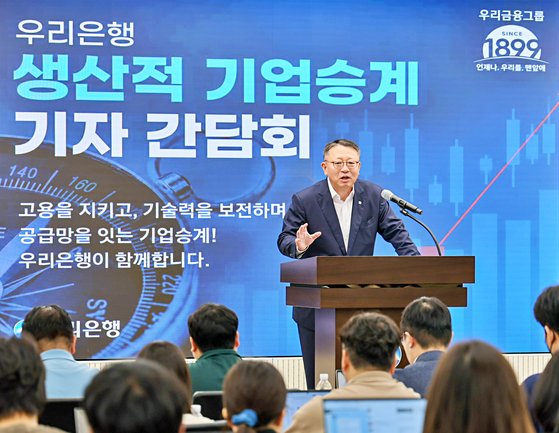
Woori Bank warns aging founders need years of planning, as more SMEs struggle to find successors Yoon Seong-hoo, general manager at Woori Bank's Corporate Succession Center (Woori Bank) As more aging founders of small and midsized companies in South Korea struggle to find heirs willing to take over, business succession is moving beyond inheritance tax planning into a broader challenge of building the financing, valuation and governance structures needed to keep viable firms alive, said Yoon Seong-hoo, general manager at Woori Bank's Corporate Succession Support Center."Family succession remains the first choice for most business owners," Yoon said in a recent interview with The Korea Herald. "But when we go deeper in conversation with owners, more are telling us their children do not want to take over, and that they may have to sell if a good offer comes along, or shut down otherwise."Yoon previously led Woori Bank's SME consulting team and served in strategy planning at Woori Financial Group, before taking up the senior manager position at the newly launched center.The succession challenge is becoming more urgent as Korea's founder-led SMEs age. Ministry of SMEs and Startups data show that, as of end-2025, business owners aged 60 or older accounted for about one-third of SMEs, while 28.6 percent of them were estimated to have no successor. More than 56,000 manufacturing SMEs are estimated to face an uncertain future because they lack heirs, most of them outside Seoul.Yoon said many of the companies Woori Bank meets are unlisted, unaudited smaller firms with annual sales below 50 billion won ($32.7 million) and fewer than 50 employees."In such companies, the owner is often the CEO, CTO and CFO at the same time," he said. "These are companies where the chief executive and the company are almost the same thing."That makes succession harder, as founders are often reluctant to disclose sensitive information such as retirement plans, sale intentions or key client relationships to outside advisers, leaving many smaller firms underserved by the legal, accounting and M&A advisory market.The government is also moving to build a market framework, with the SMEs Ministry pushing a special law to promote M&A-based succession, a dedicated platform and support for consulting, valuation and due diligence costs.Yoon said such deals cannot be treated like ordinary mergers and acquisitions, where price and financial synergy often dominate. In succession deals, the bigger question is whether jobs, technology, customer relationships and company culture can continue."In succession M&A, continuity is the most important factor," he said. That means continuity of employment, technology and transactions, but at the core, it also means preserving the company's philosophy, values and culture, he added.The process is especially delicate for smaller firms. "Once the fact that a company is considering an M&A is exposed, it can immediately create instability in business operations," Yoon said, adding that such information could affect employees, clients and the broader supply chain.With that concern, Woori began preparing a dedicated succession business in October 2025 and launched the center in February. On Monday, the bank held a press conference on the center's launch with partners including Kim & Chang and Samil PwC, where it said it is reviewing 3 trillion won in financial support over the next five years, with an initial goal of providing succession consulting to 2,500 firms.Yoon said local banks need to expand their role beyond loans by turning succession from a one-off tax or sale decision into a longer financial process, helping capital move through each stage from preparation to post-transfer management.For that to happen, Korea needs more than policy support, he said. The market remains in its early stages, and recent government and legislative efforts are meaningful because they seek to "level a tilted playing field" shaped by information gaps between buyers and sellers, he stressed.Yoon pointed to Japan, where policy support, regional lenders and intermediaries have helped turn successor shortages into a business succession market. Korea, he said, should also approach business succession not only as a matter of ownership transfer, but as a regional economic issue tied to local employment and industrial continuity."This is an area that ordinary valuation methods cannot capture," Yoon said. "Regional business owners should not think succession is still far away but should recognize it as a task that requires 10 years of preparation and management."
No heirs, no buyers: Korea's SME succession dilemma
As more aging founders of small and midsized companies in South Korea struggle to find heirs willing to take over, business succession is moving beyond inherita
713 words~3 min read