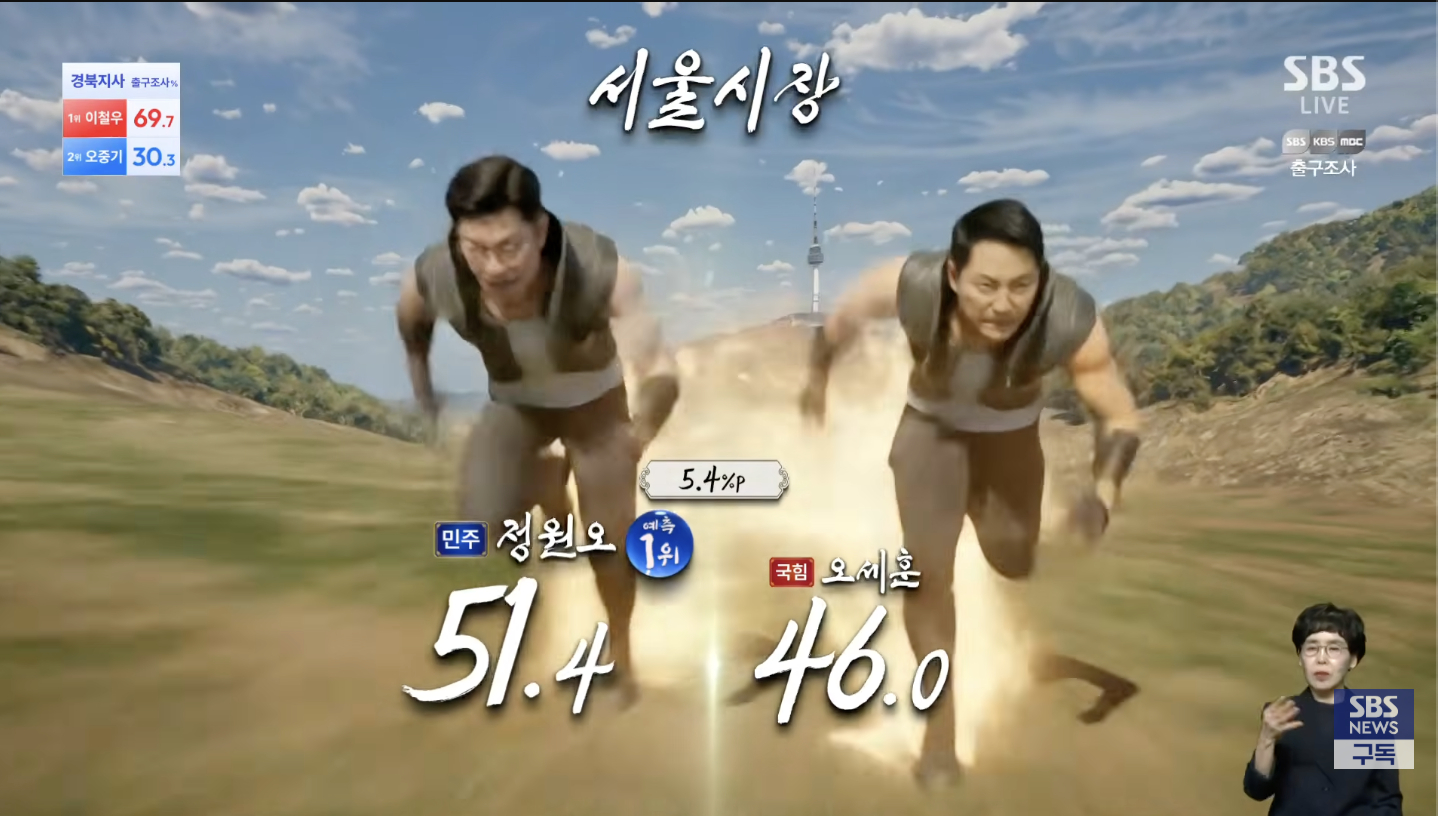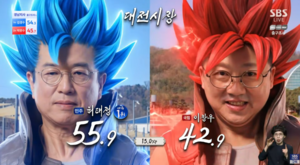
How the country's broadcasters turned ballot-counting into prime-time spectacle for Wednesday's local elections A screenshot from local broadcaster SBS's coverage of South Korea's local elections on Wednesday (SBS) South Korea's major television networks once again set out to package Wednesday's local elections as prime-time entertainment, layering CGI animation, pop-culture parody and, for the first time on a large scale, generative AI over their live vote counts.In the election for mayors and provincial governors, along with hundreds of lower offices, President Lee Jae Myung's governing Democratic Party won most of the major races, while the conservative People Power Party held Seoul and its traditional southeastern strongholds. But the results were only half the show; the rest was the spectacle built around them.In one recurring sequence, candidates from the major races appeared on screen with their faces grafted onto CGI bodies, soaring across the frame like superheroes, squaring off with superpowers and then breaking into K-pop dance routines as vote tallies ticked upward in a running scoreboard.Candidates were also rendered as the spiky-haired warriors of the anime "Dragon Ball" and as Marvel superheroes, set to tracks ranging from Seventeen's "Super" to Shinee's "Ring Ding Dong." A screenshot from SBS's coverage of South Korea's local elections on Wednesday (SBS) Such gimmicks have been a fixture of the country's election night coverage for some time. For over a decade, major Korean television networks have treated the vote count as a genre of its own, running playful graphics and celebrity guest appearances alongside the real-time tallying. The format has drawn attention abroad, with some Japanese networks adopting elements of it in February's general election.Styles varied from one broadcaster to the next. Public broadcaster KBS opted for the most conventional presentation, staging its coverage from the National Museum of Korea in central Seoul. Flag-shaped graphics hovered over the museum's reflecting pool to indicate which way races were leaning, as the network used images of artifacts excavated in each region to mark the outcomes. A screenshot from KBS's coverage of South Korea's local elections on Wednesday. (KBS) MBC built its set around a large LED wall and a rotating cube-shaped screen, which it said was a first for an election broadcast, to display turnout and projected winners. It also featured a lineup of popular YouTubers and television personalities to lighten the mood between results. A screenshot from MBC's coverage of South Korea's local elections on Wednesday (MBC) SBS, which pioneered the format, leaned hardest into game-show energy. Its animation-laden real-time graphics, a long-running signature, kept the tone light through the night even as the numbers turned serious. At one point, the network built a segment around its hit drama "Taxi Driver," turning candidates into the show's cab-driving avengers.New this year was the prominent use of generative AI in production. SBS partnered with OpenAI to run an "AI Situation Room" that analyzed election data to flag close races and project when winners would be called.MBC applied the technology to the countdown video that traditionally precedes the release of exit polls, replacing the usual historical montage with an AI-generated short film following a girl through major moments in modern Korean history.According to Nielsen Korea, MBC's election broadcast recorded the highest average viewership rating at 5.3 percent, followed by KBS at 2.7 percent and SBS at 2.2 percent.
In Korea, election night coverage becomes a visual feast again
South Korea's major television networks once again set out to package Wednesday's local elections as prime-time entertainment, layering CGI animation, pop-cultu
549 words~2 min read