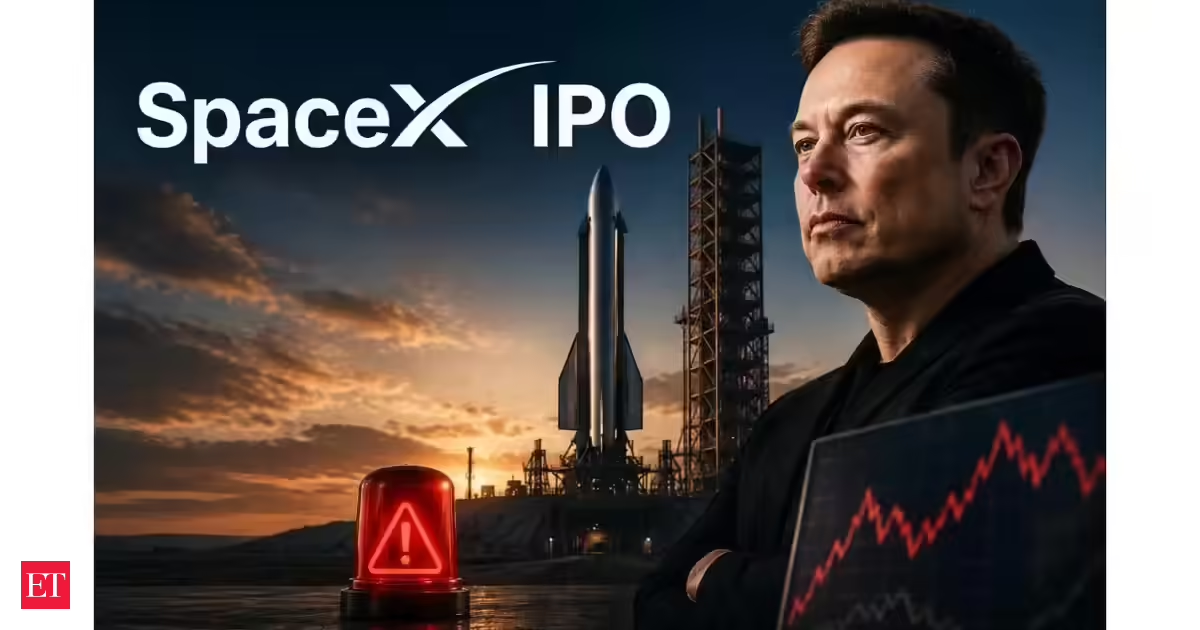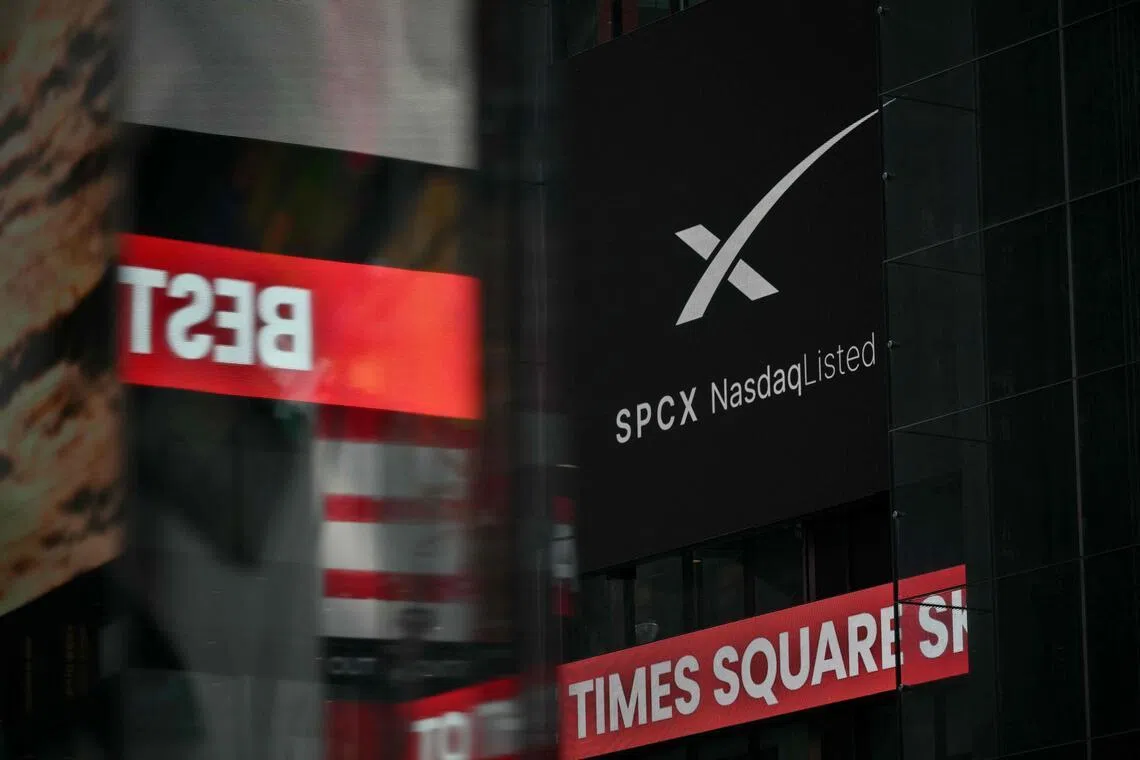
Elon Musk’s SpaceX is poised to have the largest stock-market debut in history when it goes public later in June. SpaceX is aiming to raise US$75 billion (S$96.23 billion) in the initial public offering, more than twice the previous record holder. The IPO is expected to be a market spectacle as investors get a chance to buy into Musk’s vision to create a combined space and AI powerhouse. His long list of growth plans – including putting data centres in space – are hugely ambitious but also come with high costs, significant risks and could take many years to come to fruition.Here’s what to know about the planned SpaceX IPO.The company plans to market about 555.6 million shares at US$135 apiece, according to a filing with the US Securities and Exchange Commission. At that price, SpaceX would have a market value of almost US$1.77 trillion.SpaceX’s goal of raising US$75 billion in the IPO would shatter the previous record set by Saudi Aramco’s US$29.4 billion in 2019.The big question is whether such a large valuation can be sustained in public markets.Analysts value companies based on their future earnings and growth, as well as industry competition and profit margins. But valuation is not a pure science. Especially in bullish market conditions, investors are sometimes prepared to pay up for a company’s shares based on something other than fundamentals.Some might see the seemingly vast potential of the company’s space businesses as justifying a higher price than the current financials would ordinarily support. But the challenges surrounding SpaceX’s xAI business could dampen the appeal. Even though SpaceX generates significant cash flow, largely from Starlink, its satellite-based internet broadband service, the company requires a lot more money to fund its biggest ambitions.SpaceX has indicated that IPO proceeds will be used, among other things, to expand the company’s AI computing infrastructure, enhance its space infrastructure and rockets and boost its satellite constellations.SpaceX could have opted to continue raising capital in private markets rather than going public. But the company’s funding needs appear to have risen substantially with the acquisition in February of xAI, which is burning through around US$1 billion of cash per month to cover the cost of computing infrastructure including training its AI models, according to people briefed on the company’s financials. IPO paperwork shows that SpaceX’s AI segment, which includes xAI, had an operating loss of US$6.4 billion in 2025 and nearly US$2.5 billion in the first three months of 2026. That said, SpaceX just entered into a deal in which Anthropic PBC will pay it US$1.25 billion per month through May 2029 for AI computing capacity.In addition, being a public company with the ability to tap the broader market for funds could help SpaceX’s AI business raise money faster than rivals OpenAI and Anthropic before they go public themselves, as they all spend hundreds of billions of dollars on their AI dreams. The company has morphed from a relative underdog in the space industry to an aerospace behemoth that receives billions of dollars in government contracts and serves as a backbone for the US space programme. In addition to its rocket launch business and Starlink, SpaceX now owns xAI, developer of the Grok chatbot. X, the microblogging site previously known as Twitter, rounds out its portfolio of businesses.As a result of the xAI deal, the company has increasingly become a bet on AI. In fact, SpaceX said that AI represents US$26.5 trillion of the company’s quantifiable total addressable market, or maximum revenue, of US$28.5 trillion, by far the largest in history, according to the filing.The sheer size of the offering, unprecedented for Wall Street, has bankers lining up to help SpaceX go public. The company has said that 23 banks are working on the IPO, led by Goldman Sachs Group, Morgan Stanley, Bank of America, Citigroup and JPMorgan Chase & Co.Banks involved in the offering will take orders for shares from institutional investors. At the same time, ordinary investors will be able to put in orders via brokers. Some of the millions of these everyday investors who use popular trading platforms such as Robinhood Markets, SoFi Technologies and Morgan Stanley’s E*Trade unit will be able to place orders directly through their platforms.The day before the shares begin to trade, SpaceX and the banks will agree on the final share price that initial investors will pay and the number of shares to be sold. In deciding the price, SpaceX and the banks will have to balance what is best for existing shareholders, who want to limit reducing their stakes from the issuance of too many shares, and new investors who want access to shares and are hoping for some early gains to justify their investment.For SpaceX, the downside of having an IPO is that the company will have to publicly report its financials every quarter and answer to Wall Street analysts and public investors. Its plans also could be disrupted if its stock price is volatile or falls sharply in reaction to bad news. Not everyone is pleased that SpaceX has opted to buy xAI ahead of the IPO. That is because xAI is burning a lot of cash, potentially diluting the appeal of SpaceX’s other businesses, especially Starlink.Investors who thought they owned a space company now have a big exposure to AI, and for those with a bearish take on the sector, they would suddenly be shouldering another potential loser from the high-stakes race to dominate that business. If SpaceX is viewed as an unwieldy conglomerate, it might translate into a lower market value than the company is hoping for.SpaceX also faces intense competition in AI. OpenAI is planning to go public later in 2026, and Anthropic might be close behind. The private valuations of both companies already have soared into the hundreds of billions of dollars and look poised to top US$1 trillion as public companies.Musk tightly controls SpaceX, mainly because he owns most of the company’s super-voting Class B shares. Documents filed ahead of the IPO revealed that Musk, the Tesla co-founder and world’s richest person, will have roughly 82 per cent of the voting power after the listing.Investors enthralled by SpaceX’s potential and Musk’s track record likely are not bothered by this, but it could present problems if something went wrong and investors wanted a change at the helm.SpaceX has said it intends to reserve as much as 5 per cent of shares in the IPO for certain employees and friends and family of its executive officers. Central to the pitch is that SpaceX will be a top player in AI if it is able to use data centres in space to enormously scale up its computing capacity. That could be a tough sell to investors as Musk rebuilds the company’s AI business from the ground up. Still, it already dominates the commercial space industry, and has seemingly vast growth potential and links to industries such as defence and telecommunications. SpaceX also has a potential cash cow in Starlink, with its global high-speed internet service, and a competitive advantage in the rocket launch business that it plans to grow with its massive Starship rocket.To get investors to buy into SpaceX’s huge valuation, Musk will also look to tap into his cult status and track record with the many investors who profited from owning Tesla shares, which have surged around 3,000 per cent in the past decade.For the IPO, that might be the best advertisement of all. BLOOMBERG
What to know about the SpaceX IPO
The IPO is poised to be the largest stock-market debut in history. Read more at straitstimes.com. Read more at straitstimes.com.
1,238 words~6 min read