For three decades Indian banks have provisioned on an incurred-loss basis
| Photo Credit:
sakhorn38
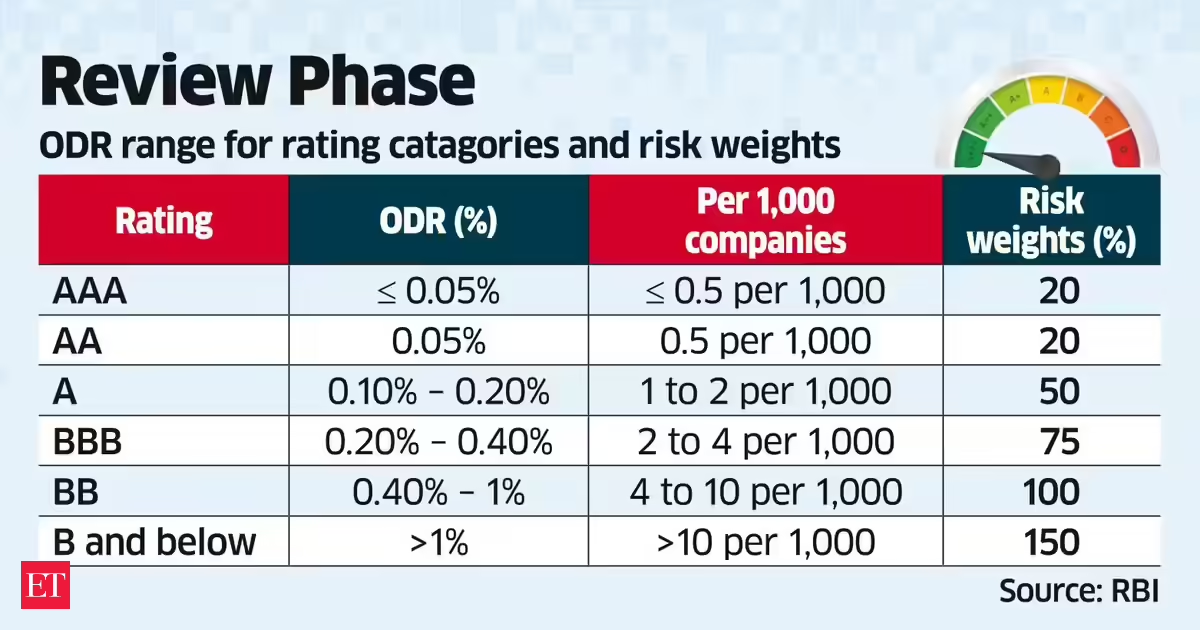
The former Chair of the Federal Reserve, Ben Bernanke once said: “The central bank needs to be able to make policy without short-term political concerns”. To a large extent, the Reserve Bank of India has been making such policies — with one such move being making banks embrace Indian Accounting Standards (Ind AS). In April 2026, it mandated banks to follow the Expected Credit Loss (ECL) model from April 1, 2027. For three decades Indian banks have provisioned on an incurred-loss basis — money was set aside only once an account had actually slipped. Banks will now have to provide for losses they expect.Three stagesAt the heart of ECL is a three-stage classification that tracks credit risk from the day a loan is made. A standard exposure that has not deteriorated sits in Stage 1, where the bank carries a provision equal to 12 months of expected loss. The moment there’s a ‘significant increase in credit risk’ (SICR) since origination, the exposure migrates to Stage 2 and the provision jumps to cover the loss expected over the remaining life of the loan. Once the asset is credit-impaired, it falls into Stage 3, again carrying a lifetime provision. The directions force a bank to recognise stress well before an account turns non-performing, capturing borrower problems while there is time to price and manage it.For most instruments the loss is built from three estimates — the probability of default (PD), the loss given default (or loss in the event of default) or LGD and the total exposure at default (EAD) — multiplied together and discounted to present value. Stage 1 uses a 12-month PD; Stages 2 and 3 use a lifetime PD that must genuinely reflect higher lifetime risk rather than be mechanically scaled from the 12-month figure.The RBI has set a PD floor of 0.03 per cent, and where a bank cannot reliably model recovery, it has set regulatory backstop LGDs of at least 65 per cent on secured and 70 per cent on unsecured exposures, easing to 30 per cent for the safest collateral such as cash, gold and government paper. Crucially, the estimate must be forward-looking and probability-weighted across multiple macroeconomic scenarios. A loss is recognised even where the bank expects to be repaid in full, but if repayment will arrive later than contractually due. This is because ECL reflects the timing of money, not only its eventual receipt.The norms do not leave provisioning entirely to internal models. Recognising that models can be optimistic, the RBI overlays prudential floors as a regulatory minimum: the final threshold is the higher of the modelled ECL and the prescribed floor. NPA recognition must be system driven and borrower-level — if one facility defaults, every exposure to that borrower is tagged. Banks must adopt effective interest rate method for amortised cost, and on April 1, 2027, the transition date, route the difference through retained earnings rather than P&L account.The capital impact of moving from the old regime to ECL may be phased into Common Equity Tier 1 over four years on a declining 80-to-20 per cent basis. Overseeing this is a governance architecture: board-level accountability, a committee chaired with the CFO and CRO, and a risk management framework requiring independent validation before any model goes live.Disclosure obligations are correspondingly granular — credit quality by stage, reconciliations of the loss allowance, the SICR methodology and the macroeconomic assumptions all enter the notes to accounts, with further detail filed privately with the RBI. The framework brings Indian banks materially closer to Ind AS 109 and in doing so it changes what a provisioning number means. A provision will no longer be a backward glance at accounts already gone bad; it will be a forward statement about the portfolio’s health. Going forward, like the IRDAI, the RBI should mandate banks to transition completely to Ind AS including fair valuing treasury portfolio.The writer is a chartered accountantPublished on June 4, 2026