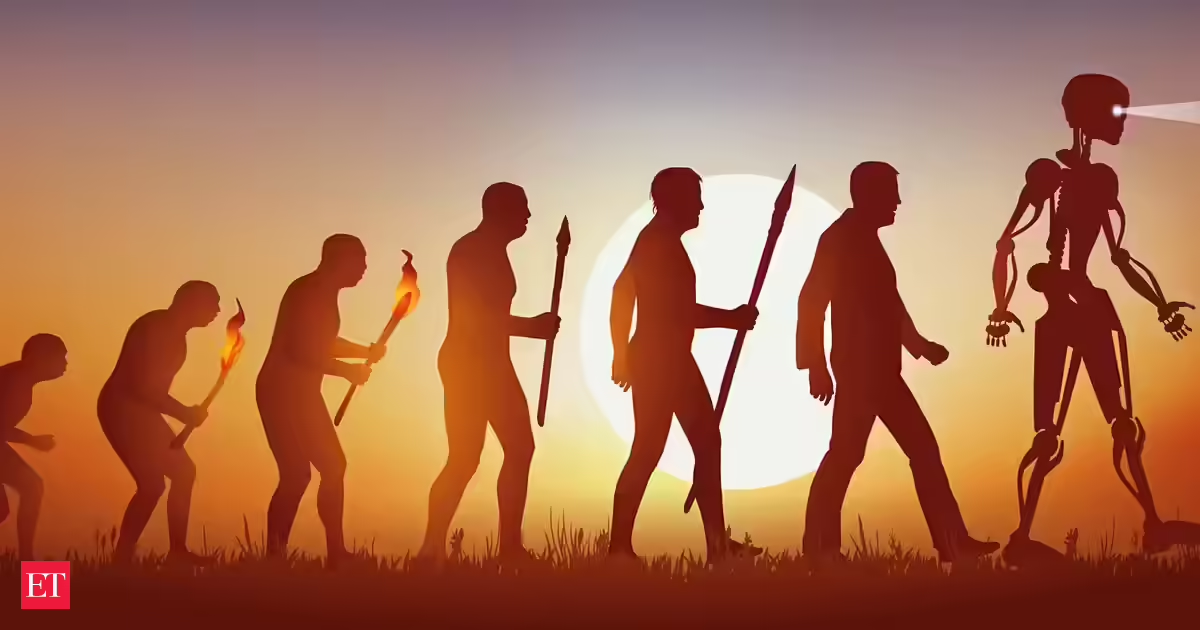
Human identity remains one of the most debated questions in philosophy, psychology, sociology, and history. What defines the human being? Is it intelligence, creativity, work, play, spirituality, or the search for meaning? From ancient philosophers to modern thinkers, countless theories have attempted to explain the essence of humanity. Some view people as rational beings capable of wisdom and progress.Others argue that unconscious desires, conflict, economic interests, and existential struggles reveal a more complex reality. As technology, artificial intelligence, and social change continue transforming society, the question of what defines the human remains as relevant today as it was thousands of years ago. Understanding these philosophical perspectives helps explain human nature, behavior, and the forces that shape civilization.Is Homo Sapiens really the best definition of human nature?The most widely accepted definition of humanity is Homo sapiens, the scientific name for modern humans. The term originates from Latin and translates as “wise human” or “knowing human.” This definition highlights intelligence, self-awareness, reasoning ability, language, and advanced problem-solving skills. Human civilization, scientific discoveries, medical breakthroughs, and technological innovation all appear to support this view.From agriculture and writing to space exploration and artificial intelligence, humans have repeatedly demonstrated remarkable intellectual capacity. Yet history also reveals repeated failures of wisdom. Global conflicts, environmental destruction, inequality, and violence challenge the assumption that intelligence always guides human behavior. Many philosophers therefore argue that while humans possess extraordinary cognitive abilities, wisdom alone may not fully explain human identity. The debate over whether humanity deserves the title Homo sapiens remains central to discussions about human nature and civilization.Are humans driven more by instinct than wisdom?The idea of Homo insapiens emerged as a direct challenge to the belief that humans are fundamentally wise creatures. Influential thinkers such as Sigmund Freud and Karl Marx argued that hidden forces often shape human decisions more than rational thought. Freud’s theory of the unconscious suggested that repressed desires, instincts, fears, and impulses influence behavior beneath conscious awareness. According to his analysis, many human actions originate from psychological forces people barely understand.Marx offered a different perspective by focusing on social and economic structures. He argued that individuals frequently operate under false consciousness, believing they act freely while being influenced by economic interests and class systems. The devastation of major wars reinforced these criticisms of human rationality. British author H.G. Wells even used the term Homo insapiens to describe humanity’s tendency toward destructive and irrational behavior. This perspective suggests that human beings are often governed by emotions, instincts, and hidden motivations rather than wisdom alone.Does human history prove we are naturally conflict-oriented?Another influential definition is Homo belligerans, meaning “the human who wages war.” Historian Arnold J. Toynbee introduced this concept while studying patterns of conflict throughout history. Human civilization has witnessed thousands of wars involving territory, religion, ethnicity, ideology, and political power. Ancient empires, world wars, civil conflicts, and modern geopolitical struggles demonstrate humanity’s repeated tendency toward organized violence.Supporters of this perspective argue that competition and aggression have played major roles in shaping societies and political systems. Yet conflict tells only part of the story. Human history also includes cooperation, diplomacy, charity, cultural exchange, and collective problem-solving. While warfare has undeniably influenced civilization, reducing humanity entirely to conflict ignores the equally powerful forces of creativity, empathy, and collaboration. The concept nevertheless raises important questions about whether aggression is an unavoidable aspect of human nature.Why do some philosophers believe humans are defined by play?The theory of Homo ludens presents a far more optimistic understanding of humanity. Popularized by Dutch historian Johan Huizinga, this concept describes humans as fundamentally playful beings. According to this perspective, play is not simply entertainment but a core element of culture and identity. Sports, games, storytelling, music, theater, and artistic expression all emerge from humanity’s capacity for play.Unlike activities driven purely by survival, play often exists for its own sake. Through playful interaction, humans develop social bonds, creativity, imagination, and innovation. Childhood learning frequently occurs through games, while adults continue seeking meaning through recreational and cultural activities. Supporters argue that play shapes education, politics, religion, and even law. The idea of Homo ludens suggests that joy, imagination, and creativity may reveal as much about human nature as reason or productivity.FAQs:Q1. What is the most accepted definition of human nature? The most widely accepted definition of human nature is Homo sapiens, meaning “wise human.” This concept highlights intelligence, self-awareness, language, creativity, and problem-solving abilities. However, modern philosophy and psychology suggest that human behavior is also influenced by emotions, instincts, culture, and unconscious motivations, making human identity far more complex than intelligence alone.Q2. Why do philosophers disagree on what defines humanity? Philosophers disagree because human beings display many different traits throughout life, including reason, conflict, spirituality, creativity, economic behavior, and the search for meaning. Thinkers such as Aristotle, Sigmund Freud, Karl Marx, and Gabriel Marcel each focused on different aspects of human experience, leading to multiple philosophical perspectives on what truly defines humanity and human existence.
Could these 8 philosophical perspectives completely change the way we understand human nature and what it means to be human?
More than 8 major philosophical perspectives, from Homo sapiens to Homo viator, have attempted to explain human nature, human identity, and human existence. These theories reveal that people are driven not only by intelligence but also by emotions, culture, creativity, conflict, and the search for meaning. As technology reshapes modern life, understanding what makes humans truly human offers deeper insight into society, behavior, and our evolving future.
821 words~4 min read