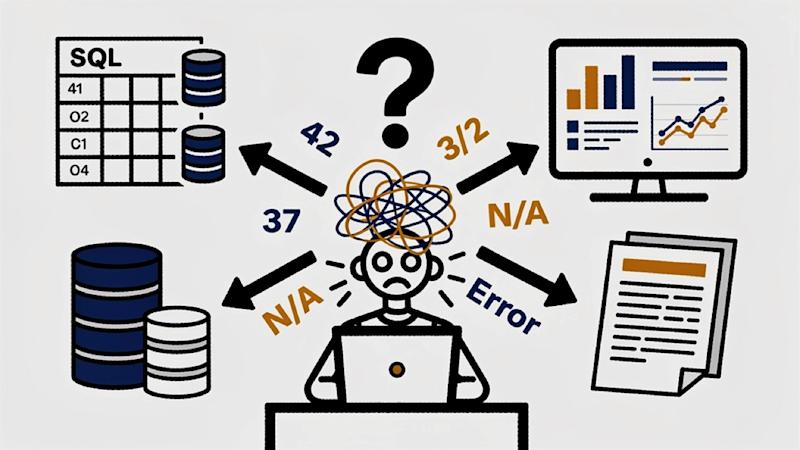
Your AI can summarize documents and answer questions about almost anything on the internet. But ask it about your business, and things fall apart. It pulls stale pricing, ignores internal policies, or hallucinates details that sound plausible but don't match reality.The instinct is to blame the model: swap in a bigger model or tune it with proprietary data and new prompts. But the weak point is usually what you're feeding it. The context layer your app reasons over, not the model itself, is where most production AI failures actually start.This article breaks down the most common ways business context breaks in production, why a bigger model won't fix it, and what teams do at the infrastructure layer to keep context fresh, relevant, and usable.Why enterprise AI needs current business contextEnterprise AI has to be exactly right. A business runs on specifics: this customer's contract, today's inventory, the policy that changed last week, the price that's valid until Friday. When an AI system reasons over anything less precise than that, the output stops being useful, even when it's technically well-formed.Most enterprise AI failures trace back to a context gap: the system can access the data, but not the context that tells it what the data means right now. It retrieves a revenue figure without knowing it's provisional, not finalized. It recommends an action without the context that a policy changed last week and now rules it out. It quotes a price that expired overnight. The model reasons correctly over what it's given; it's the missing context that turns technically correct output into something a business can't act on.This is also why so many AI projects clear the demo bar and then stall in production. A demo runs on a curated slice of data that doesn't move. Production runs on the live state of the business, which changes constantly. When the context the model reasons over doesn't reflect that current state, trust erodes fast and the system gets quietly shelved.Where business context matters most in AI appsThe clearest way to see why context matters is to look at where AI apps run into the real edges of a business.Customer support copilots. An agent answering a refund question needs this customer's plan, this order's status, and the return policy for this region today, not last quarter's. Feed it the wrong policy and it won't flag any doubt. It states the outdated rule as fact and builds the whole reply around it. One wrong fact in, a fluent wrong answer out, one customer who believes it.Sales and revenue assistants. A rep asking "what should I send this account?" needs current pricing, active discounts, recent support tickets, and the last conversation the account had with anyone on the team. When the index holds current pricing alongside last quarter's launch deck and an archived discount sheet, the rep gets a confident answer built from the wrong mix and quotes a number the deal desk won't honor.Internal knowledge copilots. Human resources (HR), legal, IT, and finance copilots are only as good as the policies they retrieve. Pull the right clause alongside outdated discussion threads and the model blends them, so an employee acts on guidance that hasn't been valid for months. The copilot isn't wrong because the model failed; it's wrong because the system handed it the wrong document.Operations and supply chain agents. Inventory, capacity, and service-level agreement (SLA) decisions move hour to hour. When two versions of the same SLA or routing rule live in different repositories, one workflow path sees the update and another sees the archive, so the same question gets two answers depending on which source was hit first. An agent recommending a reroute, a reorder, or an escalation has to reason over the state of the business right now, not a snapshot from the last batch sync.Agentic workflows that chain steps together. Once one agent's output becomes another agent's input, every bit of stale or missing context compounds. As the agent chains steps, the window fills with tool outputs, intermediate notes, and prior turns, key business facts get buried, and the final action reflects what was loudest in the context rather than what was true. The further down the chain, the more expensive the wrong answer gets.The common thread: in every one of these, the model isn't the bottleneck. The bottleneck is whether the system around it can put the right business state in front of the model at the moment it's reasoning.Redis Iris serves agent context in millisecondsRedis Iris connects memory, live data, and retrieval in one place.Why a bigger model won't fix bad contextEven when the data exists somewhere in the stack, context tends to break in a few predictable ways before it ever reaches the model: stale or compromised information that gets treated as ground truth, noise that drowns out the actual signal, contradictory sources that leave the app with no reliable way to know which version reflects the business right now, and the gradual quality decay that sets in as context windows grow longer. Each of these failure modes has a different root cause and a different fix, but they share the same outcome: the model produces something the business can't act on.None of these are model problems, which is why the usual fix misfires. The common mislabel is to call them model quality issues and go shopping for a bigger LLM, but a better model just phrases the wrong answer more fluently. The work that actually moves the needle sits in the system around the model: retrieval, freshness, conflict handling, and noise control. Teams underinvest in that layer and then pay for it in production. The surrounding system has to fix the inputs before the model ever responds.What a context layer doesA context layer is the part of the stack that takes the live state of the business and turns it into something an AI app can reason over at inference time. In practice, that means doing three things well.Keep systems of record separate from the layer the app actually queries. Operational databases, customer relationship management (CRM) systems, and document stores still hold the source data, but an AI app can't afford to hit them directly for every step of every interaction. It needs a layer built for fast retrieval and serving, with the latest state continuously streamed in so the app isn't reasoning over yesterday's snapshot.Retrieve the right material, not just more of it. A bigger context window doesn't help if the app pulls in the wrong chunks. Business context isn't one shape. Some questions depend on semantic similarity over text, others on full-text relevance for exact terms and product codes, others on structured filters like tags, numeric ranges, and metadata. A context layer has to handle all three and rank the results well enough that the model isn't drowning in near-misses.Build agents that remember, not agents that guessRedis Iris gives every agent fresh context and long-term memory.Serve it fast enough to be useful. Context only matters if the app can fetch and assemble it inside the window of a live user interaction or an agent step. Slow retrieval doesn't just hurt UX; it changes what the app can attempt at all. The faster the layer, the more steps an agent can chain before latency compounds into something users won't tolerate.How Redis powers the AI context layerRedis is built for fast access to changing data, which is what makes it a natural fit for the context layer in AI workloads. The app orchestrates the workflow; Redis stores, indexes, and serves the context that workflow depends on, with low-latency reads against state that's continuously kept current.For teams that want this as a packaged layer, Redis Iris is a real-time context engine that sits between an agent and the data it needs to act. It brings together Redis Context Retriever (to make external data sources navigable by agents), Redis Agent Memory (for short- and long-term memory across sessions), Redis Data Integration (real-time change data capture from systems like Postgres, MongoDB, and Oracle into Redis), Redis LangCache (semantic caching to cut latency and token cost on repeated intents), and Redis Search (hybrid retrieval that combines vector, full-text, and structured field matching in a single query). Together, those pieces make "current, relevant, fast" a layer you call rather than a stack you wire up yourself.Building AI on a real-time context layerWhat separates a good model from a useful system is rarely better prompts. It's giving the model the right business state at the moment it's reasoning: current, relevant, and fast enough to use. That's an infrastructure problem, not a prompting one.Redis fits that layer directly: fast retrieval against changing data, hybrid search that combines vector and full-text matching with structured filters, and semantic caching for the repeated intents that show up in every production app. Redis Iris brings those capabilities together behind a single layer your agents can call.Fresh context, every callRedis Iris keeps agent data current so answers stay accurate.If you're running into any of the failure patterns above, the next step is to see how Redis handles them against your own workload. Try Redis free, or talk to our team about what your context layer should look like.
Why AI Misses Business Context & How Teams Fix It
AI fails in production when business context is stale, noisy, or conflicting. Learn how teams fix context gaps with fast retrieval and real-time data.
1,530 words~7 min read