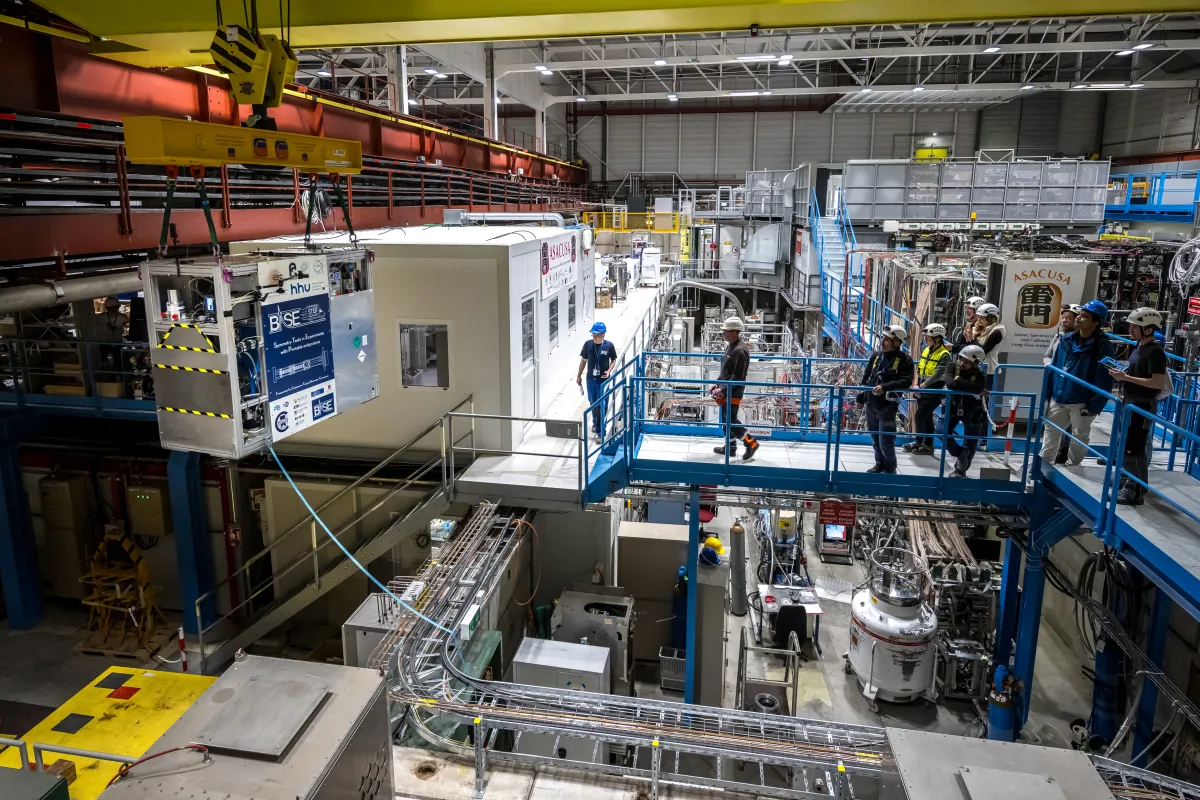
When Mark Thomson was 13, he read a book about the European Organization for Nuclear Research, better known as CERN, a particle physics lab whose remit was to interrogate the fabric of reality. The book left him both fascinated by how the universe worked and frustrated by its lack of detail. More than 40 years later, Thomson is CERN’s director general, taking charge just as it shuts down the Large Hadron Collider (LHC) for upgrades and decides where to place its next multibillion-pound bet.
The goal of this gamble is to answer big, lingering questions we still have. In a sense, particle physics hasn’t changed since Thomson was a boy: it is dazzling in its outline, but maddening in the details it cannot yet supply. The field’s crown jewel, the standard model, describes the particles and forces that make up the visible universe with extraordinary precision. And in 2012, the discovery of the Higgs boson seemed to be the masterstroke that completed its picture of reality. But for all its success, the standard model says nothing about dark matter, an invisible substance thought to make up most of the cosmos, and it offers no deeper explanation for the masses of the particles it catalogues. It also cannot account for why the universe contains matter at all after the big bang.